Future-Mapping
GUEST POST from Chateau G Pato
I. Introduction: The Death of the Five-Year Plan
The Volatility Trap
Traditional, linear strategic planning is dying. In an era defined by exponential technological growth, unpredictable climate shifts, and hyper-connected global markets, the rigid five-year plan has become a liability. Organizations that tether themselves to fixed long-term predictions often find themselves blindsided by market disruptions, trapped in rigid structures unable to pivot when the ground shifts beneath them.
From Planning to Foresight
To survive and thrive in exponentially volatile markets, leaders must shift their organizational mindset from predicting a single corporate future to preparing for multiple, fluid realities. Strategic foresight is not about gazing into a crystal ball; it is about building the organizational muscle to anticipate waves of change, interpret weak signals, and map out dynamic pathways that maintain strategic agility.
The Human Element
At its core, future-mapping is not merely an exercise in data aggregation or trend analysis. The most profound disruptions are deeply human. True foresight requires a human-centered approach — marrying futurology with experience design and deep empathy. We must understand how the psychological needs, anxieties, and behaviors of both our workforce and our customers will evolve, ensuring that as we design the future of business, we keep humanity at the center of the experience.
II. The Foundations of Future-Mapping
Defining Future-Mapping
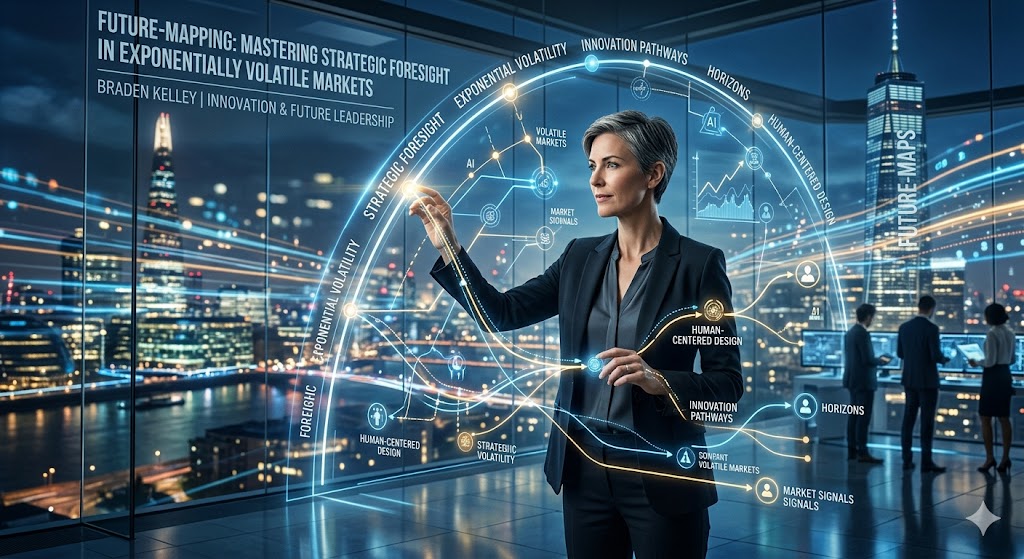
Future-mapping bridges the gap between abstract futurology and actionable, human-centered innovation. While traditional forecasting looks at a narrow data set to predict a single outcome, future-mapping visualizes the marketplace as a complex ecosystem of shifting human behaviors, technological waves, and economic realities. It is a visual, collaborative methodology designed to transform ambiguous macro-trends into concrete innovation strategies.
The Horizon Framework
To navigate exponential change without losing sight of daily survival, organizations must distribute their focus across three distinct horizons simultaneously:
- Horizon 1: Optimizing the Present. Protecting, defending, and improving the core business model to maximize current efficiency and profitability.
- Horizon 2: Nurturing Emerging Opportunities. Extending current capabilities into new, fast-growing markets or scaling adjacent business ideas.
- Horizon 3: Designing for Visionary Futures. Developing genuinely disruptive innovations, business models, and capabilities tailored for unchartered territories five to ten years out.
Signal vs. Noise
The future rarely arrives without warning; it leaves clues. Success in volatile markets requires robust organizational sensing mechanisms to distinguish between temporary “noise” (passing fads) and true “weak signals” (early, localized indicators of structural change). By systematically scanning the fringes of technology, society, and culture, leaders can spot inflection points and catch the wave of disruption before it becomes an industry mainstream reality.
III. The Strategic Foresight Toolkit
Dynamic Scenario Planning
Static forecasting assumes the future is a straight line, but exponential volatility demands a matrix. Dynamic scenario planning moves beyond simple “best-case/worst-case” projections to construct multiple, vivid, and plausible alternate world narratives. By immersing leadership teams in these diverse realities, organizations can stress-test their current strategies, expose hidden vulnerabilities, and identify blind spots before they manifest in the real market.
Cross-Impact Analysis
Disruption rarely happens in a vacuum; it occurs at the intersection of converging forces. Cross-impact analysis evaluates how distinct macro-trends — such as the democratization of artificial intelligence, shifting generational values, and changing labor dynamics — interact with and accelerate one another. Understanding how these compounding variables collide allows organizations to anticipate secondary and tertiary market behaviors that competitors will miss.
The Backcasting Methodology
While forecasting looks forward from today to guess tomorrow, backcasting flips the timeline. It begins by designing a visionary, human-centered future state ten years down the road. From that North Star, we work backward to the present day, isolating the exact capabilities, technology investments, partnership models, and strategic pivots required along the journey. This ensures that today’s innovation portfolio is explicitly engineered to build tomorrow’s required reality.
IV. Human-Centered Experience Design for Tomorrow
The Future Customer Persona
Demographic data alone is no longer enough to understand tomorrow’s buyer. In a volatile landscape, we must map the evolving psychology of the future customer. This means anticipating how their trust metrics, digital friction points, and deep emotional needs will shift as technology integrates further into daily life. Designing tomorrow’s experiences requires building empathy today for the unique anxieties and aspirations of the next-generation consumer.
Designing for the “Next Economy”
The days of simple, isolated transactional business models are fading fast. True experience design requires transitioning from selling standalone products to orchestrating deeply integrated, adaptive ecosystem experiences. Value will increasingly be co-created at the intersection of physical spaces, fluid digital layers, and human communities, requiring organizations to design holistic journeys that adapt to changing customer contexts in real time.
The Ethics of Co-Creation
As experiences become highly personalized and driven by predictive data, the line between helpful anticipation and digital intrusion blurs. Foresight-driven innovation must be anchored by a robust ethical framework. Experience designers must actively protect human agency, inclusivity, and digital equity, ensuring that tomorrow’s platforms and ecosystems are built transparently and designed to lift people up rather than exploit them.
V. Operationalizing Innovation Under Uncertainty
Fostering Corporate Agility
The greatest threat to an organization during market upheaval is not a lack of vision, but the heavy anchor of systemic corporate inertia. Moving from insight to execution requires dismantling bureaucratic silos and creating flexible, cross-functional teams capable of rapid pivoting. Leadership must intentionally foster a culture that views change as a continuous opportunity rather than an occasional disruption, realigning internal incentives to celebrate calculated risk-taking and rapid, iterative learning.
The Resilient Portfolio
Managing innovation under exponential volatility requires a balanced investment strategy. Leaders must split resource allocation effectively, ensuring they maintain the structural integrity to defend the current bottom line while simultaneously funding high-risk, high-reward future bets. A resilient portfolio treats innovation investments like options, allowing the organization to place small, experimental bets across multiple scenario paths and dynamically scale funding as certain futures become clearer.
Continuous Iteration Loops
Strategic foresight can no longer be relegated to a static, annual executive retreat or a beautiful slide deck that sits on a shelf. Future-mapping must be embedded into the organization as an ongoing, living capability. By establishing continuous feedback loops that feed real-time market data and changing human behaviors back into the strategic matrix, the business can constantly refine its trajectory, ensuring that long-term vision and daily execution remain locked in lockstep.
VI. Conclusion: Leading Through the Fog
The New Leadership Imperative
In a world of exponential volatility, true thought leadership is no longer about having all the answers — it is about asking the right questions and possessing the institutional courage to navigate uncertainty. The most dangerous trap a successful organization can fall into is complacency. Survival in the next economy requires leaders to willingly challenge their own assumptions and actively design the mechanisms to dismantle their own legacy business models before a competitor or a shifting market force does it for them.
A Call to Action
The future is not a destination we blindly arrive at; it is a landscape we actively construct. Organizations cannot afford to sit on the sidelines, waiting for clarity that will never come, or merely reacting to disruptions after they hit. By embedding human-centered future-mapping into the core DNA of your strategy, your teams can step out of a defensive posture. Start scanning the fringes for weak signals, embrace dynamic scenario planning, and begin intentionally shaping the customer and employee experiences of tomorrow, today.
Frequently Asked Questions
What is Future-Mapping and how does it differ from traditional strategic planning?
Traditional strategic planning relies on linear forecasting to predict a single corporate future, which often fails in volatile markets. Future-Mapping is a human-centered, visual methodology that maps out multiple fluid realities based on macro-trends and weak signals, allowing organizations to remain agile and proactive.
Why is experience design critical to strategic foresight?
Technology and market changes don’t happen in a vacuum — they fundamentally alter human behavior. By integrating experience design into foresight, organizations can build deep empathy for the future customer and employee, ensuring tomorrow’s business models solve real psychological needs and friction points.
How do organizations operationalize future-mapping without disrupting current operations?
By utilizing frameworks like the Three Horizons, organizations can optimize their present core business (Horizon 1) while simultaneously nurturing emerging opportunities (Horizon 2) and designing visionary futures (Horizon 3). This creates a resilient portfolio where innovation is treated as a continuous, living capability.
Image credit: Gemini
 Sign up here to get Human-Centered Change & Innovation Weekly delivered to your inbox every week.