Removing Roadblocks for Internal Startups
LAST UPDATED: February 2, 2026 at 12:54PM
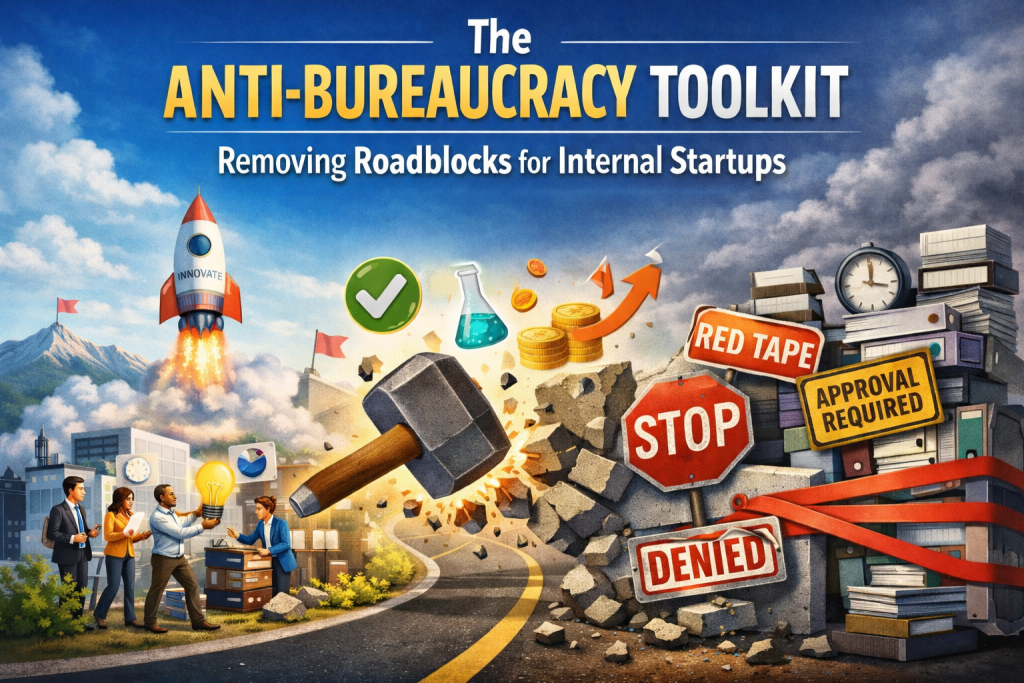
GUEST POST from Chateau G Pato
To innovate at the speed of the market, we must move beyond the “Innovation Theater” of colorful sticky notes and beanbag chairs. We need to dismantle the invisible fences of bureaucracy. This toolkit is about creating a “Green Lane” for innovation—a set of protocols that allow internal ventures to bypass the friction of the legacy machine without breaking the company.
The Core Components of the Toolkit
1. The “Metabolic Rate” Alignment
Bureaucracy thrives on annual budget cycles and quarterly reviews. Internal startups, however, operate on a weekly or even daily metabolic rate. Removing roadblocks starts with shifting from “Annual Budgeting” to “Metered Funding.” Instead of a massive upfront investment, provide small tranches of capital tied to the validation of specific hypotheses.
2. The Legal and Procurement “Sandbox”
Nothing kills a pilot faster than a 60-page Master Service Agreement (MSA) for a $5,000 experiment. The Anti-Bureaucracy Toolkit requires a pre-negotiated “Lite” contract framework. This allows internal teams to engage with external startups or vendors in days rather than months.
3. Governance as a Service (GaaS)
Instead of the innovation team seeking permission from HR, IT, and Finance, these departments should provide dedicated liaisons whose job is to say “How can we make this happen?” rather than “Here is why you can’t.”
Case Studies in Bureaucracy Busting
Case Study A: The Global Financial Services Pivot
A major European bank struggled to launch a mobile-first micro-investment app because the internal IT compliance checklist involved over 200 security gates designed for core banking systems. The innovation lead implemented a “Risk-Tiering” model. Since the app didn’t touch the core ledger in its Alpha phase, they bypassed 80% of the gates. Result: The app launched in 4 months instead of the projected 18, capturing a demographic the bank had previously ignored.
Case Study B: Manufacturing Giant’s Procurement Hack
A Fortune 500 manufacturer found that its internal startups were failing because they couldn’t buy specialized components from non-approved vendors. The solution was the creation of a “Strategic Experimentation Fund” with its own corporate credit card and a modified compliance charter. This empowered teams to source materials instantly, reducing prototype iteration time by 65%.
“Innovation is not a department; it is the byproduct of an ecosystem that values velocity over validation and curiosity over compliance. If your processes are designed to prevent failure, they are simultaneously designed to prevent growth.”
— Braden Kelley
The Real Cost of Bureaucracy
Bureaucracy is often invisible to those who benefit from it. For internal startups, it shows up as endless approvals, premature financial scrutiny, and rigid processes that assume certainty where none exists.
Every extra form, meeting, or gate sends a signal: avoid risk, avoid attention, avoid change. Over time, innovation teams stop behaving like startups and start behaving like survivors.
The cost is not just speed. It is lost insight, missed markets, and talent that learns to stop trying.
Designing Governance for Exploration
The goal of anti-bureaucracy is not chaos. It is alignment. Exploration requires different constraints than execution. Leaders must intentionally design operating models that reflect this reality.
The Anti-Bureaucracy Toolkit focuses on enabling movement while maintaining trust:
- Exploration charters that define boundaries instead of permissions
- Incremental funding tied to evidence, not forecasts
- Pre-approved tools and vendors for rapid experimentation
- Executive sponsors who remove friction in real time
- Metrics that reward learning velocity
The Leadership Imperative
Anti-bureaucracy is a leadership behavior, not a process initiative. Leaders must actively protect internal startups from being measured by the wrong standards at the wrong time.
This means rewarding teams for evidence over polish, curiosity over certainty, and progress over perfection.
If bureaucracy is left unchallenged, it will always win. If it is redesigned with intent, innovation has a fighting chance.
Frequently Asked Questions
What is the biggest roadblock for internal startups?
The primary roadblock is often “organizational friction”—legacy processes in procurement, legal, and IT that are designed for risk mitigation in the core business rather than the speed and agility required for new ventures.
How can an innovation speaker help change this culture?
An innovation speaker like Braden Kelley provides the external perspective and framework necessary to align leadership, helping them see that bureaucracy is a choice and providing the tools to dismantle it.
What is metered funding?
Metered funding is an investment approach where capital is released in small increments based on the startup hitting specific learning milestones, rather than providing a large lump sum upfront.
Image credits: ChatGPT
 Sign up here to get Human-Centered Change & Innovation Weekly delivered to your inbox every week.