Exclusive Interview with Mark C. Winters
Visionaries are often celebrated for their ideas, their intensity, and their ability to see what others can’t. But what’s far less understood — and far more consequential — is how Visionaries actually win over time. Not just by dreaming bigger futures, but by building the clarity, structure, and self-awareness required to make those futures real without burning themselves or their organizations to the ground.
In this wide-ranging interview, we explore what it truly means to be a Visionary inside a growing organization. From the essential partnership between Visionary and Integrator, to the hidden blind spots that slow progress, to the role of health, self-knowledge, and what “winning” really looks like, this conversation goes well beyond mythology. It offers a grounded, experience-tested look at how Visionaries can amplify their impact, reduce chaos, and create the kind of freedom they were chasing in the first place.
Today we dive deep into the characteristics and interactions of the Visionary with our special guest.
From Vision to Reality: What It Really Takes to Lead What’s Next
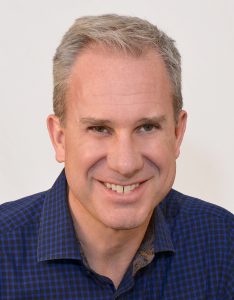 Mark C. Winters is an entrepreneurial leader with 30-plus years building and advising companies, from startups sketched on a napkin to global enterprises like Proctor & Gamble and BP.
This range of experience helps him spot patterns fast and apply what works to almost any business scenario. Author of Visionary, co-author of Rocket Fuel, founder of Rocket Fuel University, and host of the Rocket Fuel podcast, Mark helps visionary entrepreneurs get unstuck and expand their unique freedom — exponentially.
He’s delivered 1,000+ full-day EOS® workshops with clients from around the world.
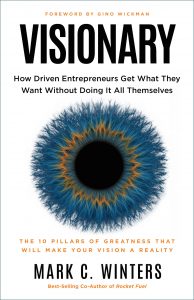
Below is the text of my interview with Mark and a preview of the kinds of insights you’ll find in Visionary: How Driven Entrepreneurs Get What They Want Without Doing It All Themselves presented in a Q&A format:
1. What is a Visionary and why does every successful organization have one?
A Visionary is the person who sees the future before it arrives. Endless ideas to help us get there. Big external relationships.
They live in the world of possibility. They connect dots others don’t yet see. They define where the organization is going and why that matters.
Every ambitious organization has one, whether they acknowledge it or not. Progress doesn’t come from squeezing more out of what we have… It comes from seeing a future that doesn’t yet exist. Absent a Visionary, organizations tend to stay pretty much where they are. Maybe they do more of the same. Or maybe they do the same stuff a little better. But they’re unlikely to actually change the game.
That said, here are two important notes:
- Every organization doesn’t require the same amount of Visionary. There’s actually a range that we call the “visionary spectrum.” It needs to be a match.
- Visionaries don’t win by themselves. Vision alone, without execution, is merely hallucination. And that’s quite often the biggest challenge.
2. How does the Visionary differ from the Integrator and why do you need both?
The Visionary sees the future. They “make it up.”
The Integrator “makes it real.”
Visionaries think in leaps. Integrators think in projects, processes, and systems. Visionaries are energized by what could be. Integrators are energized by what must get done.
You need both because they solve different problems. Visionaries break through ceilings. Integrators remove friction and create traction. When they’re aligned, you get clarity, momentum, and leverage. When they’re not, you get chaos, burnout, and frustration.
This is an intentional pairing of two very different capability sets. When surrounded by the right structure (which we call the 5 Rules), the friction of these polar differences gets blended into a powerful positive force. Thus the name of our first book, ROCKET FUEL (with Gino Wickman).
3. What are the key elements of the Entrepreneurial Operating System (EOS) that make it so powerful?
EOS works because it does three things exceptionally well:
- It creates clarity and focus: vision, priorities, roles, and expectations are no longer fuzzy.
- It instills discipline: weekly pulses, data, and accountability replace good intentions.
- It strengthens the leadership team. They get healthy. Important issues get surfaced and solved – instead of avoided.
For Visionaries, a “business operating system” such as EOS is powerful because it aligns the energy of all the people in the organization. It’s very powerful when all those arrows are pointed in the same direction.
4. Why is it so important for a Visionary to understand themselves — and what are they trying to understand?
Because “Knowing Thyself” is the big multiplier.
It all starts with figuring out who you are now, and where you want to go.
From there, you must understand how this business is going to help you make that happen.
And then become aware of how your behavior is either helping or hurting that process.
Visionaries don’t need to become different people. They need to become clearer versions of who they already are.
They’re trying to understand:
- What truly energizes them
- What drains them
- Where they create the most value
- Where they unintentionally cause damage
Without that clarity, Visionaries tend to overstep, under-delegate, or send mixed signals. With it, they make better decisions, build better teams, and experience more freedom.
5. Why is the crashing together of the wellness and biohacking trends so important for entrepreneurs?
Because Visionaries are high-output humans running long races. This demands that you maintain “Warrior Shape.”
You can’t separate performance from health anymore. Energy, focus, emotional regulation, and recovery all directly impact leadership effectiveness.
The danger is chasing hacks instead of fundamentals. Biohacking without the proper foundation can become another form of self-sabotage.
Elite performance starts with basics: sleep/recovery, fitness/movement, nutrition, and boundaries. Get those right first. Then optimize from there.
6. What are some of the most common blind spots for visionaries?
 A few show up again and again:
- Thinking out loud without context
- Changing direction too quickly (or too often)
- Holding onto too much for too long (becoming the bottleneck)
- Confusing passion with priority
- Underestimating the impact of their words
These blind spots don’t come from ego or bad intent. They come from the very natural instincts and habits of people who are wired as Visionaries. However, left unchecked, they slow everything down. In turn, slowing the Visionary themselves from getting what they want.
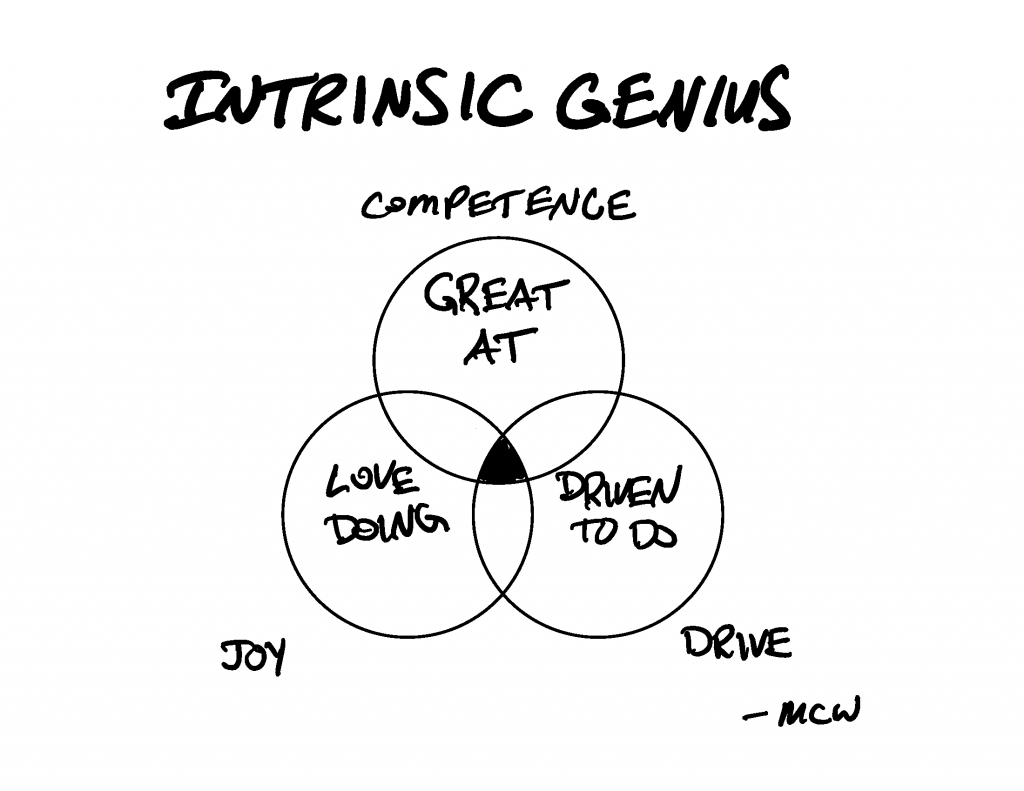
7. Tell us more about Intrinsic Genius and why it matters.
Intrinsic Genius lives at the intersection of three things:
- Competence – what you’re naturally good at
- Joy – what energizes you most
- Drive – the purpose and cause that propel you forward
When Visionaries operate inside that zone, their impact compounds. When they drift outside it, everything feels heavier than it should.
Understanding Intrinsic Genius isn’t about self-indulgence. It’s about tapping fully into the unique contribution you were built to make. And your maximum impact.
8. Are all Visionaries the same?
Not even close.
I talked earlier about the Visionary Spectrum. And that’s one way to think about it – as a defined function of the business that requires a certain set of capabilities.
While the Visionary patterns are similar, they certainly show up in different ways. Some are bold and extroverted. Others are quiet and introverted. Some thrive on disruption. Others on pulling things together. What they share isn’t style, it’s their orientation toward the possible future.
9. Besides partnering with an Integrator, what other roles should surround a Visionary?
Visionaries need what I call a “shield wall” to surround them. Protecting them from dangerous external threats, and preparing them to engage the world from their most powerful base.
A great shield wall is made up of 7 unique “posts” that support the Visionary by providing 7 special “forces.”
That includes:
- Truth-tellers who challenge their thinking
- Operators who translate ideas into action
- Coaches who help them see patterns
- Peers who can relate to the journey
Isolation is a common feeling for a Visionary. Having the right people around them can stabilize and amplify their signal.
10. People lionize Visionaries like Steve Jobs. How do Visionaries go off-track?
Usually in three ways:
- They start believing their own mythology
- They confuse intensity with effectiveness
- They stop listening
Visionaries go off-track when their strengths run unchecked. Greatness isn’t about being right more often. (In fact, intellectual humility is a healthy attribute.) Instead, it’s about building structure that creates clarity, alignment, and focus in everyone else, while you pursue what’s possible.
11. What is Visionary Chaos and how is it avoided?
Visionary chaos is what happens when ideas outpace clarity, alignment, and execution. They flood the system. They tamper.
It shows up as initiative overload, organizational whiplash, confused priorities, exhausted teams, uncertainty, and slow execution.
It’s avoided through structure, cadence, and restraint. Not by silencing the Visionary, but by sequencing their best ideas. Go slow to go fast.
12. Why is it dangerous for leaders to think out loud?
Because Visionaries don’t always realize how loud their voice is to the people around them .
What feels like a passing thought to a Visionary often feels like a directive to those who hear it. Thinking out loud creates false urgency, unnecessary work, and more whiplash.
This can be avoided by creating safe places to think out loud – where everyone present knows that’s what’s happening… and label the brainstorming. “No Action Needed.”
13. Is there a question you wish I had asked?
Yes.
How does a Visionary know if they’re actually winning?
In my experience, this question is not just about financial numbers, but about your Unique Freedom. Your definition of that is different than mine, is different than theirs, and is different than every other Visionary’s. It’s truly unique to you. So you must first solve for that. This is why I created the Exponential Freedom Model, and the 9 Domains of Freedom.
Clarify the future you want. Draw a line back to the present. Then focus on the near-term activities (and habits) that will increase the probability of making that future real.
“Clarity. Focus. Freedom.”
It’s that simple – just not easy.
To experience more of the Unique Freedom you seek, without being trapped by the business you built. That’s the real promise of becoming a great Visionary.
Conclusion
Thank you for the great conversation Mark!
I hope everyone has enjoyed this peek into the mind of the man behind the insightful new title Visionary: How Driven Entrepreneurs Get What They Want Without Doing It All Themselves!
Image credits: Mark C. Winters, ChatGPT
 Sign up here to join 17,000+ leaders getting Human-Centered Change & Innovation Weekly delivered to their inbox every week.