Tag Archives: Trump

How to Navigate the Future Without Getting Lost

How to Navigate the Future Without Getting Lost

GUEST POST from Robert B. Tucker

When the Trump administration abruptly withdrew from the World Health Organization in January, the Gates Foundation was thrown into turmoil. Years of investment in global health infrastructure — vaccines and medicines developed in Gates-funded labs—were suddenly jeopardized.

“We tried to anticipate what the new government might bring,” Gates Foundation director Mark Suzman told The New York Times. “But we did not foresee the scale of the change.”

They’re not alone. From boardrooms to bedrooms, individuals and institutions alike are struggling to stay upright in what can only be described as a sea of unrelenting change.

As a futurist, I observe that we are living through a rare historical inflection point. The old order is dissolving. New rules are being written. Established ways of operating — many of them holdovers from the Industrial and Information Ages — are quickly becoming obsolete. AI and automation are reshaping work. Climate disruptions are transforming industries and business models, such as insurance, upside down. Institutions are groaning under the stress of unrelenting pressure to adapt. Welcome to the Age of Acceleration.

To survive — and yes, to thrive in — the emerging future, we must develop new mindsets. We need new tools for navigating what I call the ‘MegaForces of Change’. These are not fads or short-term trends. They are seismic, global-scale shifts that have the potential to reshape our lives, careers, and communities – and indeed, the planet itself.

Just consider what we’re likely to witness over the next decade:

  • The merging of humans and machines, with AI and neuro-technology blurring the boundaries of consciousness and agency.
  • A 40 percent surge in climate-related disasters — wildfires, floods, droughts, and hurricanes — driven by a planet under duress.
  • Geopolitical unrest, economic volatility, and the possible unraveling of democratic norms.
  • Entire industries vanishing while others spring up overnight, powered by breakthroughs in quantum computing, bioengineering, and synthetic media.
  • Radical transformation in how we live, work, learn, and govern ourselves—at speeds and scales never before seen in human history.

The coming decade will confront us with unprecedented challenges—and open the door to equally unprecedented opportunities. We’ll face existential threats to our health, security, and planetary future. And yet, at the same time, we will unlock scientific, technological, and social breakthroughs with the potential to solve our most urgent problems.

But we won’t get there by clinging to yesterday’s mindsets.

To flourish in this new landscape, we must develop future preparedness—the capacity to see change coming, make sense of it, and act before we’re forced to. This isn’t just about forecasting. It’s about cultivating what I call an Anticipatory Mindset: the ability to scan the horizon, decode signals amidst the noise, and prepare for what’s next while others are still reacting to what just happened.

It’s time to embrace the mindsets that will allow us to navigate the turbulence but also ride the waves, and not be capsized by them. The future isn’t something that happens to us. It’s something we help create.

This article originally appeared in Forbes

Image credit: Pixabay

Subscribe to Human-Centered Change & Innovation WeeklySign up here to get Human-Centered Change & Innovation Weekly delivered to your inbox every week.
China Plans to Trump Innovation from Outer Space

China Plans to Trump Innovation from Outer Space

First, let me say that this is not a political article, but instead an article about a potential innovation crisis looming just over the horizon thanks to brinkmanship between China and the United States.

Second, let me say this article is not about killer satellites being launched into orbit by the Trump administration or the People’s Republic of China.

Instead this article is about the psychology of a country being backed into a corner, the measures China is likely to take to fight back when they can’t match the United States dollar for dollar in a tariff fight, the current state of the rare earth metals market and its impact on the future of innovation.

Now, some of you might be asking yourself – What the heck are rare earth metals?

Well, as the name might suggest they are metals that are not often found in dense quantities on earth. Some hypothesize that some of the best rare earth metal finds have an extraterrestrial origin. So, some might say that rare earth metals are literally alien, brought to our planet not by little green men (and women) but by blazing hot meteors smashing into the earth. Rare earth metals are so valuable to collectors and to high tech manufacturers that there are groups of modern day Indiana Jones clones out there racing around the world to be the first to claim the next meteor strike before someone else does (see article) and the Chinese government made a conscious choice to invest in trying to corner the market.

Why?

Because rare earth metals are CRUCIAL to all of the technology that empowers the innovation economy.

There was a 60 Minutes segment from three years ago that CBS recently refreshed and re-aired now that it is again timely given the United States vs. China trade war but they have since moved it to Paramount+. It provides a great introduction to rare earth metals and the role they play in the innovation economy, but this Financial Times video does a good job as well:

(updated 60 minutes video available has been moved to Paramount+)

About the only substantial change in the video is that China’s dominance has dropped from 90% of global production to 80% of global production.

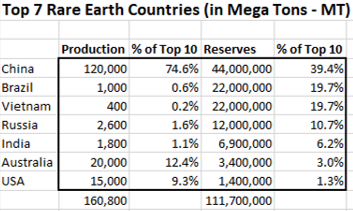
Here is a chart showing the production of rare earths in 2018 in the world (data source):

Rare Earth Data

As the chart shows, China has about 40% of the world’s rare earth metals, but is responsible for 75% of the world’s production of rare earth metals. The military machine of the United States relies on rare earth metals to operate, along with green energy, high technology, electric cars, you name it – nearly every innovation direction we’re trying to go in – relies on rare earth metals.

China has cut off countries from rare earth metals before, most notably Japan, and now they are threatening to do it again to the United States (one article highlighting the threat not just to the United States, but to Europe as well). China is also threatening to begin blacklisting individual technology companies not sympathetic to its cause in the battle of egos and stare down between these two economic superpowers. You have to imagine this would include being cut off from rare earth metals.

So, is the innovation train, this pace of unrelenting technological advance and change, about to come a grinding halt?

I guess we’re all about to find out…


Accelerate your change and transformation success

Subscribe to Human-Centered Change & Innovation WeeklySign up here to get Human-Centered Change & Innovation Weekly delivered to your inbox every week.