Democratizing Strategy
GUEST POST from Chateau G Pato
I. Introduction: The Strategy Execution Paradox
For decades, traditional strategic planning has suffered from a persistent and costly flaw: it fails not at the point of vision, but at the point of execution. Study after study reveals that up to 90% of well-crafted corporate strategies fail to achieve their intended outcomes. This is the Strategy Execution Paradox. Organizations invest millions of dollars and countless executive hours shaping brilliant long-term blueprints, only to watch them stall, fracture, or wither away once handed off to the teams responsible for making them a reality.
The Ivory Tower Trap
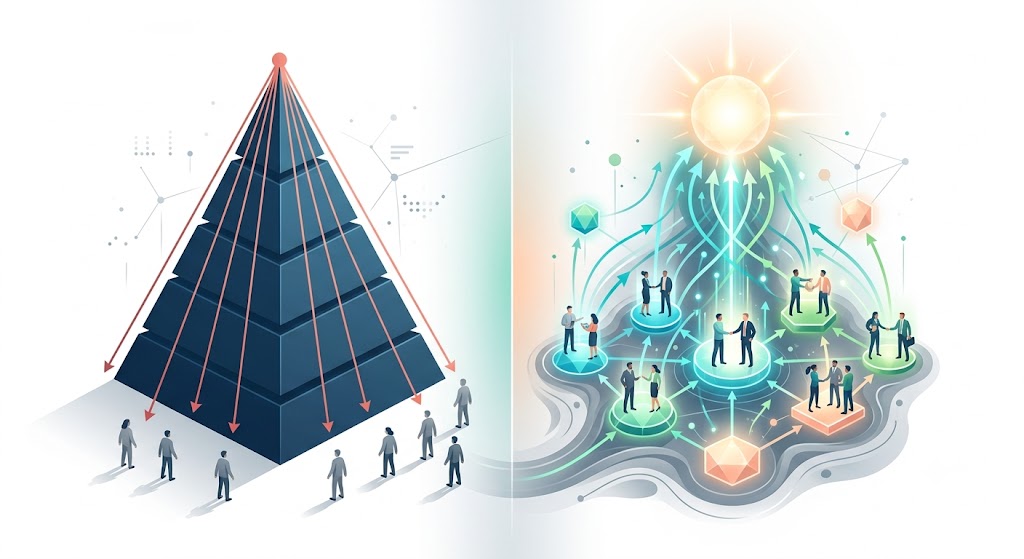
The root cause of this failure lies in how strategy is traditionally conceived and communicated. Far too often, strategic design occurs within an executive vacuum — an ivory tower disconnected from the day-to-day operational realities, customer interactions, and frontline friction points of the business. When leadership crafts strategy in isolation, the resulting plan inevitably contains unexamined assumptions. When dropped onto the organization as a finished product, employees receive it with skepticism rather than enthusiasm. It becomes an exercise in top-down imposition rather than shared enterprise.
The Illusion of Control
Conventional leadership models mistake commanding direction for creating commitment. Leaders operate under the illusion that because a directive was issued from the top, alignment and momentum will naturally follow. In practice, top-down mandates produce passive compliance at best and quiet resistance at worst. People rarely support that which they had no part in creating. When strategy feels like something being done to employees rather than with them, psychological ownership vanishes, taking initiative and innovation along with it.
The Core Thesis
Strategy shouldn’t be a secret document handed down from on high; it must be an ongoing, collaborative dialogue that empowers every level of the organization to co-create and own the vision. Democratizing strategy flips the traditional paradigm on its head. By moving from rigid top-down directives to human-centered, bottom-up alignment, organizations unleash frontline intelligence, foster genuine enterprise-wide ownership, and build the adaptive capacity needed to thrive in an unpredictable world.
II. The Failure Modes of Top-Down Mandates
When strategic planning operates purely as a top-down mandate, it introduces structural vulnerabilities into the organization. Mandates rely on an outdated command-and-control paradigm that assumes executive leadership possesses complete clarity on market dynamics, customer behavior, and operational capabilities. In reality, this approach creates friction points that systematically undermine execution before work even begins.
The Engagement and Insight Gap
The further leadership sits from the front lines, the greater the risk of strategic detachment. Frontline employees — customer service representatives, product engineers, field sales personnel, and operations managers — interact directly with customer pain points and process inefficiencies every day. When strategy is dictated from the executive suite, this rich source of real-time market intelligence is entirely bypassed.
Ignoring frontline insights leads to a double loss: the strategy itself is built on incomplete data, and the employees possessing critical context feel undervalued. For deeper context on how organizational disconnects derail execution, explore our analysis on bridging the execution gap through human-centered change design.
Passive Resistance and the Compliance Trap
Top-down mandates inherently demand compliance rather than fostering commitment. While compliance can secure basic task completion, it completely fails to inspire discretionary effort, creative problem-solving, or emotional investment. When directives feel imposed rather than co-created, organizational culture shifts toward self-preservation and minimal acceptable performance.
This dynamic routinely produces two destructive behaviors:
- Malicious Compliance: Teams follow instructions to the letter even when they know the plan is flawed, allowing initiatives to fail to prove leadership wrong.
- Passive Friction: Middle managers nod along in executive meetings while quietly delaying, deprioritizing, or diluting implementation within their business units.
Fragility in the Face of Rapid Market Shifts
Traditional top-down strategies are inherently rigid, typically anchored to annual budget cycles and static multi-year plans. When market disruptions occur — whether driven by technological breakthroughs, economic shifts, or emerging competitor moves — centralized decision-making becomes a bottleneck.
In a command-and-control setup, frontline teams lack the agency or authority to adjust tactics without seeking multi-layered approvals. By the time information travels up through management chains, gets debated at the executive level, and descends back down as a revised mandate, the window of opportunity has closed. Top-down mandates create organizational fragility precisely when speed, adaptability, and local responsiveness are required most.
III. The Four Pillars of Democratized Strategy
Democratizing strategy does not mean abandoning leadership or replacing clear direction with consensus-driven chaos. Instead, it transforms strategic planning from an exclusive, periodic event into an open, continuous operating system. To successfully shift from top-down directives to bottom-up alignment, organizations must establish four foundational pillars that bridge the gap between executive vision and enterprise-wide ownership.
1. Human-Centered Strategy Design
Human-Centered Strategy Design applies the principles of experience design directly to organizational strategy. Rather than viewing employees merely as resources responsible for executing a plan, this pillar treats them as the primary users and co-designers of the strategy itself. By deeply understanding employee workflows, operational friction, and customer insights, leaders can craft strategies that align naturally with human behavior, driving intrinsic motivation rather than relying on forced compliance.
2. Context Over Control
Command-and-control leadership attempts to manage outcomes by prescribing granular tasks. Democratized strategy replaces detailed mandates with high-level clarity and operational autonomy. Leaders define the overarching vision, strategic intent, and non-negotiable guardrails, then give frontline teams the authority to determine how best to achieve those goals within their domain. When teams understand the “why,” they are empowered to innovate the “how” without waiting for top-down permission.
3. Transparent Co-Creation
Strategy cannot be co-created in the dark. Transparent co-creation relies on accessible, visual frameworks that demystify strategic thinking and invite participation across every tier of the organization. Utilizing visual tools — such as visual project charters, change canvases, and open strategy workshops — enables cross-functional teams to map dependencies, identify risks, and contribute ideas in real time. Learn more about implementing collaborative strategy frameworks in our guide to visual strategy and human-centered change toolkits.
4. Continuous Feedback Loops
In a rapidly shifting business environment, strategy cannot remain a static document locked into annual review cycles. Democratized strategy functions as a dynamic series of hypotheses and real-time experiments. By embedding continuous feedback loops into daily operations, frontline observations and customer responses immediately inform strategic adjustments, transforming strategy into an agile, evolving dialogue.
IV. Operationalizing Bottom-Up Alignment: From Concept to Practice
Moving from the philosophy of democratized strategy to everyday organizational practice requires tangible mechanisms, shared tools, and structured habits. Bottom-up alignment does not happen by accident — it is cultivated through intentional processes that invite participation, simplify strategic communication, and connect daily operational work directly to long-term enterprise goals.
Visual Strategic Tools & Frameworks
Complex, fifty-page strategy documents isolate employees and obscure intent. To truly democratize strategic thinking, organizations must democratize the language and tools of strategy. Shared visual frameworks — such as visual project charters, innovation canvases, and human-centered change toolkits — translate abstract goals into accessible, collaborative spaces.
When cross-functional teams sit down around a single visual canvas to map out strategic intent, dependencies, and operational friction, strategy ceases to be an executive secret. It becomes a shared mental model that anyone in the organization can understand, critique, and contribute to. Discover how visual frameworks accelerate enterprise execution by exploring our insights on visual collaboration tools and the future of work.
Crowdsourcing Insight and Frontline Innovation
Operationalizing bottom-up alignment requires active channels for sourcing intelligence directly from the organizational periphery. Rather than waiting for annual planning cycles, progressive organizations create structured opportunities for continuous input:
- Open Strategy Hackathons: Dedicated time blocks where cross-functional teams tackle specific strategic challenges and pitch solutions directly to executive sponsors.
- Frontline Innovation Challenges: Targeted calls for ideas that focus employee creativity on solving urgent customer pain points or removing operational bottlenecks.
- Distributed Signal Scanning: Empowering employees across all tiers to report emerging market shifts, technology trends, and customer behavioral changes into a centralized organizational foresight network.
Cascading Alignment, Not Commands
Traditional cascading passes down prescribed projects from executives to vice presidents, directors, managers, and individual contributors. Democratized cascading flips this flow by cascading context and objectives downward, while encouraging teams to translate those objectives upward through locally defined solutions.
In this model, leadership establishes enterprise-level strategic horizons and non-negotiable boundaries. Local teams then define their own tactical commitments aligned with those horizons. This approach creates high alignment while preserving high autonomy—ensuring every employee sees a direct line of sight between their daily contributions and the company’s ultimate destination.
V. Overcoming Leadership Friction & Navigating the Transition
Transitioning from a traditional command-and-control hierarchy to a democratized strategic model represents a profound cultural and operational shift. It requires reimagining power dynamics, establishing clear boundaries, and cultivating psychological safety. While the rewards of bottom-up alignment are substantial, organizations inevitably encounter friction during the transition — particularly among leadership structures accustomed to top-down control.
Redefining the Leader’s Role: From Chief Architect to Chief Enabler
The most significant hurdle in democratizing strategy is shifting the mindset of executive leadership and middle management. In traditional organizations, leadership status is tied to having all the answers and issuing authoritative directives. Democratized strategy requires leaders to transition from acting as sole architects of vision to becoming facilitators, contextualizers, and enablers.
A leader’s primary responsibility in a democratized model is to articulate clear strategic intent, define overarching guardrails, and actively remove operational friction for their teams. Rather than managing task completion, leaders focus on fostering strategic capabilities across the workforce, asking coaching questions, and creating spaces where frontline wisdom can surface and flourish. For guidance on driving this mindset shift across your leadership team, explore our approaches to human-centered change leadership and executive alignment keynotes.
Managing Strategic Noise: Guardrails vs. Chaos
A common fear among executives is that opening strategy to broader participation will lead to consensus-driven paralysis, endless debate, or fragmented priorities. However, democratizing strategy is not about managing by committee or turning every decision into a vote; it is about expanding input while maintaining decisive action.
To prevent chaotic divergence, leaders must establish firm strategic guardrails — clearly defined boundaries regarding target markets, core capabilities, budget constraints, and risk tolerance. These guardrails provide the necessary perimeter within which decentralized innovation and bottom-up alignment can occur safely and effectively:
- Clear Decision Rights: Explicitly clarify which decisions are open for broad co-creation, which are consultative, and which remain central executive choices.
- Focus Mechanisms: Use standardized visual frameworks and evaluation criteria to filter frontline ideas, ensuring contributions directly serve strategic intent.
- Time-Bounded Co-Creation: Structure strategy input phases within defined windows to maintain momentum and prevent analysis paralysis.
Building Psychological Safety for Unvarnished Candor
Bottom-up alignment is entirely dependent on the quality and honesty of the information flowing upward. If frontline employees or middle managers fear pushback, career risk, or embarrassment for highlighting flawed assumptions in leadership’s vision, they will default to passive silence.
Creating true strategic alignment requires cultivating a culture of high psychological safety where candor is actively rewarded. Leaders must visibly celebrate team members who identify operational risks early, challenge orthodoxy with customer data, and report unvarnished market realities. When psychological safety becomes an organizational standard, strategy evolves from a fragile corporate ritual into a resilient, self-correcting engine.
VI. Conclusion: Building the Agile, Resilient Future
The traditional model of strategy execution — crafted behind closed doors by an elite few and handed down as an unyielding top-down mandate — is no longer viable in a world characterized by constant acceleration and unpredictability. When strategy relies on command-and-control mechanics, it creates organizational brittleness, alienates frontline talent, and guarantees an ever-widening execution gap.
Democratizing strategy offers a far more dynamic and sustainable path forward. By anchoring your strategic operating system in human-centered design, transparent visual collaboration, and continuous feedback loops, you transform strategy from a static, annual ritual into a living, enterprise-wide capability. You tap into the collective intelligence of those closest to your customers and operational reality, building high-trust teams that don’t just execute plans — they actively refine and adapt them.
Ultimately, a successful strategy is not defined by the elegance of its presentation deck, but by the shared commitment and clarity of the people bringing it to life. When you empower every level of your organization to see themselves as strategic co-creators, execution ceases to be an uphill struggle and becomes your greatest sustainable competitive advantage. To continue exploring visual frameworks, innovation toolkits, and strategies for leading human-centered transformation, visit BradenKelley.com.
Frequently Asked Questions
1. Does democratizing strategy mean decisions are made by consensus or vote?
No. Democratizing strategy is about expanding input and co-creation, not running the company by committee. Executive leadership still maintains authority over the overarching vision, resource allocation, and non-negotiable guardrails. However, frontline teams are given the autonomy and visual tools to inform that vision, identify operational friction, and co-design the tactical solutions required to achieve it.
2. How do you prevent bottom-up alignment from devolving into strategic chaos?
By setting clear strategic guardrails and decision rights upfront. Leaders must define the non-negotiable parameters — such as target markets, budget limits, core values, and risk thresholds — within which decentralized teams can innovate. Using standardized visual tools and time-bounded strategy sessions keeps input focused, actionable, and aligned with enterprise goals.
3. What is the biggest barrier to transitioning from top-down mandates to democratized strategy?
The primary barrier is leadership mindset and organizational culture. In traditional setups, leadership status is tied to issuing commands and having all the answers. Shifting to a democratized model requires leaders to transition into facilitators and enablers, while simultaneously building high psychological safety so frontline employees feel safe offering unvarnished, real-time market feedback.
Bottom line: Futurology is not fortune telling. Futurists use a scientific approach to create their deliverables, but a methodology and tools like those in FutureHacking™ can empower anyone to engage in futurology themselves.
Image credit: Pixabay
 Sign up here to get Human-Centered Change & Innovation Weekly delivered to your inbox every week.