(and How to Act)
LAST UPDATED: March 22, 2026 at 10:41 AM
GUEST POST from Art Inteligencia
The Myth of the Sudden Failure: Reading the Whispers Before the Roar
In the high-stakes world of human-centered innovation, there is a persistent myth that projects fail in a singular, catastrophic explosion — a “Big Bang” of incompetence or bad luck. In reality, project failure is rarely a sudden event; it is a progressive erosion. It is a series of quiet, cumulative departures from the original vision, the user’s needs, and the team’s collective psychological safety.
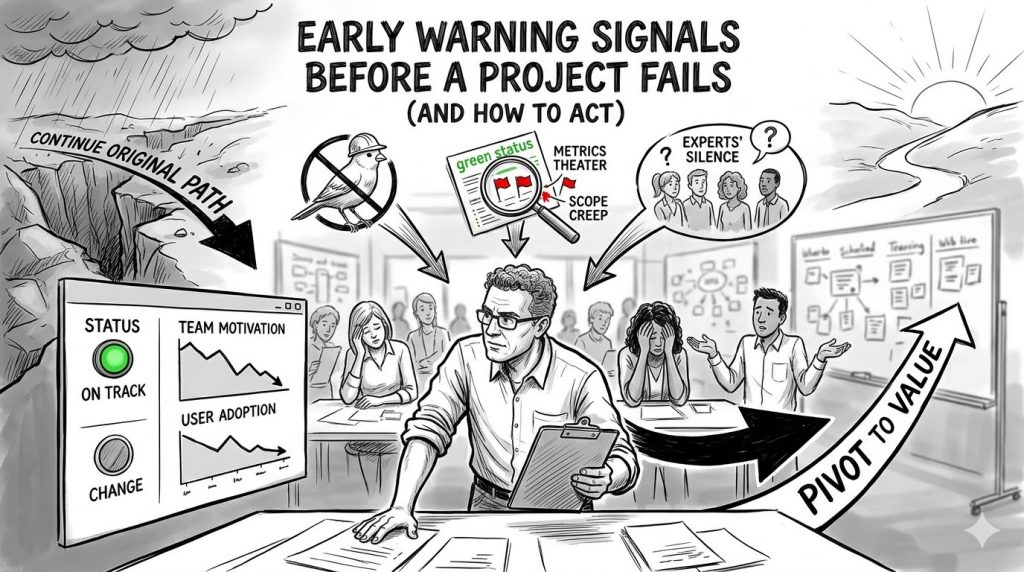
As leaders, we often fall into the trap of “Lagging Indicator Leadership.” We wait for the budget to hit the red or the milestone to be missed by a month before we sound the alarm. By then, the “human debt” — the loss of trust, energy, and creative alignment — is often too high to recover. To lead change effectively, we must shift our gaze from the spreadsheet to the “canary in the coal mine”: the behavioral and systemic shifts that precede technical failure.
Core Objectives of Early Detection
- The “Invisible” Decline: Recognizing why project leads often miss the “canary in the coal mine” until it is too late to pivot effectively.
- The Human Element: Re-framing failure not just as a missed deadline or a budget overrun, but as a fundamental breakdown in the human-centered design or change process.
- From Reactive to Proactive: Moving the organizational culture from a state of constant firefighting to one of systemic observation and strategic stewardship.
Project Incubation Bias
The decline of a project often happens in the shadows of “green” status reports. This is a phenomenon where teams hide friction in hopes that extra effort will smooth things out before the next steering committee meeting. When we ignore these subtle tremors, we aren’t being optimistic; we are being negligent. A human-centered approach requires us to acknowledge that if the people behind the project are struggling, the project itself is already failing, regardless of what the current Gantt chart says.
Reframing Failure Through a Human Lens
We must stop viewing failure as a binary outcome and start viewing it as a divergence from value. Every project is a hypothesis. When we stop testing that hypothesis against the reality of human behavior — both of our users and our internal teams — we begin to drift. Identifying early warning signals isn’t about finger-pointing; it’s about honoring the innovation process by maintaining the agility to pivot when the data and the “vibe” of the room changes.
“The goal of proactive observation is to move from reactive firefighting to systemic stewardship. We don’t just want to save the project; we want to save the innovation capacity of the people building it.”
By learning to recognize these signals early, we transform “failure” from a disaster into a strategic, well-timed pivot that preserves resources and protects the organization’s most valuable asset: its people’s passion for change.
The Five Early Warning Signals: Identifying the Silent Tremors
In the framework of organizational agility, the most dangerous risks aren’t the ones on the formal risk register — they are the behavioral shifts that signal a loss of momentum and alignment. Recognizing these “human-centered” indicators allows a leader to intervene while there is still enough social capital to course-correct.
1. The “Silence of the Experts”
Innovation thrives on constructive friction. When your most vocal subject matter experts (SMEs) suddenly stop pushing back, offering critiques, or suggesting alternatives, the project is in peril. This shift from active collaboration to passive compliance usually means the team has lost faith in the outcome or feels their input no longer influences the direction.
- The Indicator: Meetings that used to be vibrant debates become sessions of quiet nodding.
- The Risk: You are no longer building a solution; you are merely executing a checklist of flawed assumptions.
2. Metrics Theater and “Green” Reporting
When a project’s status reports are consistently “green” despite a lack of tangible user validation or functional progress, you are witnessing Metrics Theater. Teams often focus on vanity metrics — hours billed, documents completed, or meetings held — because they are easier to achieve than actual value delivery.
- The Indicator: A heavy emphasis on activity over outcomes.
- The Risk: The project appears healthy on paper until the very moment of launch, where it fails to meet market or organizational needs.
3. The Incremental Drift (Scope Erosion)
Unlike traditional “scope creep,” which is often additive, Incremental Drift is the quiet removal of the “innovation” elements of a project to meet a deadline. To stay on schedule, teams start cutting the very features or human-centered research that made the project worth doing in the first place.
- The Indicator: The “Minimum Viable Product” (MVP) starts looking like a “Minimum Viable Bureaucracy.”
- The Risk: You deliver on time, but you deliver something that provides zero competitive advantage.
4. Shadow Workarounds and “Invisible” Solutions
When the official tools, processes, or project frameworks fail the team, they don’t always complain — they bypass them. If you see team members building their own “shadow” spreadsheets, unofficial communication channels, or manual workarounds to get the job done, your project infrastructure is broken.
- The Indicator: Discovery of “unofficial” documentation or side-projects designed to fix the main project’s flaws.
- The Risk: Massive technical and process debt that will collapse once the project scales.
5. The Collapse of Psychological Safety
Innovation requires the safety to be “wrong” early and often. When a team stops sharing “half-baked” ideas or becomes hesitant to admit a mistake, the project’s learning loop has died. Fear is the ultimate killer of agility.
- The Indicator: A noticeable drop in transparency and an increase in “polished” presentations that hide experimental failures.
- The Risk: Problems remain hidden until they are too large and expensive to fix.
“The most accurate project health indicator isn’t a dashboard; it’s the level of honest, uncomfortable conversation happening in the breakroom.” — Braden Kelley
Section III. Diagnostic Tools: Validating the Signals
Once you suspect the “silent tremors” of project erosion, you must move from intuition to validation. In human-centered change, we don’t rely on traditional audits that look backward; we use diagnostic tools that assess the current state of alignment and the health of our assumptions. These tools are designed to surface the truth before the “sunk cost fallacy” makes it impossible to pivot.
1. The “Pulse Check” vs. The Formal Survey
Traditional monthly surveys are often too slow and too formal to catch rapid shifts in sentiment. Instead, we implement high-frequency, low-friction “Pulse Checks.” These are single-question interactions designed to gauge the team’s true north.
- The Diagnostic: Ask the team: “On a scale of 1-10, how confident are you that we are building the right thing for the user today?”
- The Validation: If the average drops below a 7, or if there is a high variance in scores, your alignment has fractured.
2. Assumption Mapping: Fact-Checking the Foundation
Every project is built on a set of core assumptions regarding technology, user behavior, and market timing. Project failure often occurs because an assumption made in month one is no longer valid in month six, yet the team continues to build as if it were.
- The Diagnostic: Categorize your project assumptions by Importance and Certainty.
- The Validation: Any assumption that is “High Importance” but “Low Certainty” is a potential failure point. If these haven’t been validated through experiments recently, the project is flying blind.
3. Stakeholder Empathy Maps: Re-aligning with Reality
Over time, project teams can become “insular,” solving internal technical problems rather than external user problems. We use updated Empathy Maps to see if our internal perception of the stakeholder still matches their actual lived experience.
- The Diagnostic: Re-run a rapid empathy mapping session focusing on what the stakeholder is currently Thinking, Feeling, Saying, and Doing.
- The Validation: If the “Pains” and “Gains” of the stakeholder have shifted but the project roadmap hasn’t, you have identified a divergence from value.
4. The “Pre-Mortem” Check-In
Unlike a post-mortem, which happens after the funeral, a pre-mortem asks the team to imagine it is one year from now and the project has failed spectacularly. What happened?
- The Diagnostic: A facilitated session where “prospective hindsight” is used to identify risks that people are currently too polite or too scared to mention.
- The Validation: If multiple team members identify the same “cause of death,” you have found your most critical early warning signal.
“Validation isn’t about proving yourself right; it’s about having the professional maturity to find out where you are wrong before the market does it for you.” — Braden Kelley
Section IV. The Pivot Protocol: Turning Insight into Decisive Action
Identifying an early warning signal is only half the battle; the true test of leadership is the ability to act before the “sunk cost fallacy” traps the project in a death spiral. In an agile, human-centered environment, we don’t “fix” projects through brute force — we pivot them back toward value. This requires a structured protocol to transition from a state of decline to a state of re-invention.
1. The “Courageous Pause”: Normalizing the Stop-and-Assess
The most difficult step is often the first: stopping the momentum. We must de-stigmatize the “Pause.” A pause is not an admission of failure; it is a strategic maneuver to ensure resources aren’t being poured into a leaky bucket.
- The Action: Call a “Transparency Summit” with key stakeholders. Frame the meeting not as a post-mortem, but as a “Strategic Re-alignment.”
- The Goal: To halt non-essential work while the team validates the early warning signals identified in Section III.
2. Ruthless De-scoping to “Minimum Viable Value” (MVV)
When a project is failing, it’s often because it has become too heavy. To save it, you must strip away the “nice-to-haves” and return to the core problem you were trying to solve. We shift the focus from a “Feature-Complete” mindset to a “Value-Complete” mindset.
- The Action: Perform a “Value vs. Effort” audit on the remaining backlog. Anything that doesn’t directly address the primary human-centered “Pain Point” is moved to a future phase or deleted.
- The Goal: To reduce the cognitive load on the team and shorten the path to a win.
3. The Feedback Loop Reset
If the project is drifting, it’s likely because the team has been talking to themselves more than they’ve been talking to the users. The Pivot Protocol requires an immediate injection of external reality.
- The Action: Within 48 hours of the “Pause,” get a prototype — no matter how rough — in front of three to five actual users.
- The Goal: To replace internal opinions with external evidence. This evidence provides the “political cover” needed for a major pivot.
4. Re-alignment Workshops: Re-connecting with the “Why”
Project erosion often leaves the team feeling cynical or burnt out. Acting on the signals requires re-energizing the human element. We use the “Stable Spine” concept of organizational agility — providing a clear, unchanging purpose while remaining flexible on the execution.
- The Action: Facilitate a workshop to re-draft the “Project North Star.” Ask: “If we started this project today, knowing what we know now, how would we solve this problem?”
- The Goal: To regain psychological safety and collective ownership of the new direction.
“A pivot isn’t a retreat; it’s a redirection of energy toward a target that has finally come into focus. The best leaders don’t just ‘fail fast’; they ‘learn fast’ and ‘pivot precisely’.” — Braden Kelley
By following this protocol, you transform a potential disaster into a demonstration of organizational agility. You prove that the organization is capable of self-correction—a trait far more valuable than any single successful project.
Section V. Conclusion: Cultivating a Culture of Early Detection
The ultimate goal of identifying early warning signals is not just to “save” a single project; it is to build a Resilient Organizational Culture. In high-performing innovation teams, a signal of failure isn’t a cause for punishment — it’s a data point for growth. When we shift the narrative from “Project Success” to “Systemic Agility,” we empower every team member to act as a guardian of the organization’s resources and vision.
1. Celebrating the “Early Save”
We must change what we reward. If we only celebrate the final product launch, we inadvertently encourage teams to hide problems until they are too big to ignore. A human-centered organization celebrates the lead who raises their hand and says, “We are drifting, and we need to pause.”
- The Cultural Shift: Treat a well-timed pivot with the same prestige as a successful launch.
- The Benefit: This builds Psychological Safety, ensuring that the next time a “canary in the coal mine” stops singing, someone will actually report it.
2. Building the “Stable Spine” of Agility
True organizational agility requires a “Stable Spine” — a clear, unwavering understanding of the organization’s core purpose and values — coupled with dynamic, flexible execution. When the team knows the “Why” is stable, they are much more comfortable changing the “How” when signals suggest the current path is failing.
- The Cultural Shift: Focus leadership communication on the Impact we want to create, rather than the Tasks we want to complete.
- The Benefit: It allows teams to pivot without feeling like they have “lost” their mission.
3. From “Post-Mortem” to “Continuous Learning”
Innovation is a journey of discovery, not a straight line. By embedding these diagnostic tools into the weekly rhythm of a project, failure stops being a destination and starts being a feedback loop. We move from a culture of “Blame” to a culture of “Iterative Excellence.”
“An organization’s capacity to innovate is limited only by its capacity to face the truth. Identifying a failing project early isn’t a failure of leadership; it is the highest form of leadership excellence.”
As you move forward, remember: the goal of human-centered change is to keep the people engaged and the innovation flowing. By watching for the whispers, you ensure you never have to deal with the roar of a total collapse. You protect the people, you protect the investment, and you protect the future of the organization.
Frequently Asked Questions: Navigating Project Turbulence
How do I tell the difference between a “rough patch” and a failing project?
A rough patch is typically a localized technical or resource hurdle that can be cleared with a specific fix. A failing project exhibits systemic erosion: experts stop contributing, the team avoids the “Why,” and metrics are used to hide reality rather than reveal it. If the human-centered alignment is gone, it’s not just a patch; it’s a failure in progress.
Won’t pausing a project to “pivot” just waste more time and money?
Inversely, continuing on a flawed path is the ultimate waste. The “Courageous Pause” is a risk mitigation strategy. By stopping to validate assumptions and de-scope to the Minimum Viable Value (MVV), you prevent the “Sunk Cost Fallacy” from burning through your remaining budget on a solution that the market or user no longer wants.
How can I encourage my team to report bad news early?
You must build a Stable Spine of psychological safety. This means rewarding the “Early Save” as much as the “Final Launch.” When leadership treats a pivot as a successful application of organizational agility rather than a personal failure, teams will feel safe enough to bring the “whispers” to your attention before they become a roar.
Image credit: Google Gemini
 Sign up here to get Human-Centered Change & Innovation Weekly delivered to your inbox every week.