Scenario Architecture
GUEST POST from Chateau G Pato
I. Introduction: Beyond the Illusion of the Linear Horizon
The Failure of Single-Track Planning
Traditional three- to five-year strategic plans rest on a dangerous assumption: that tomorrow will look substantially like today, only slightly faster, larger, or more digital. In an era marked by geopolitical shifts, rapid technological breakthroughs, and persistent economic volatility, linear forecasting is no longer just ineffective—it is a organizational liability. When strategy relies on a single target horizon, even minor market deviations can render long-term roadmaps obsolete overnight.
Introducing Scenario Architecture
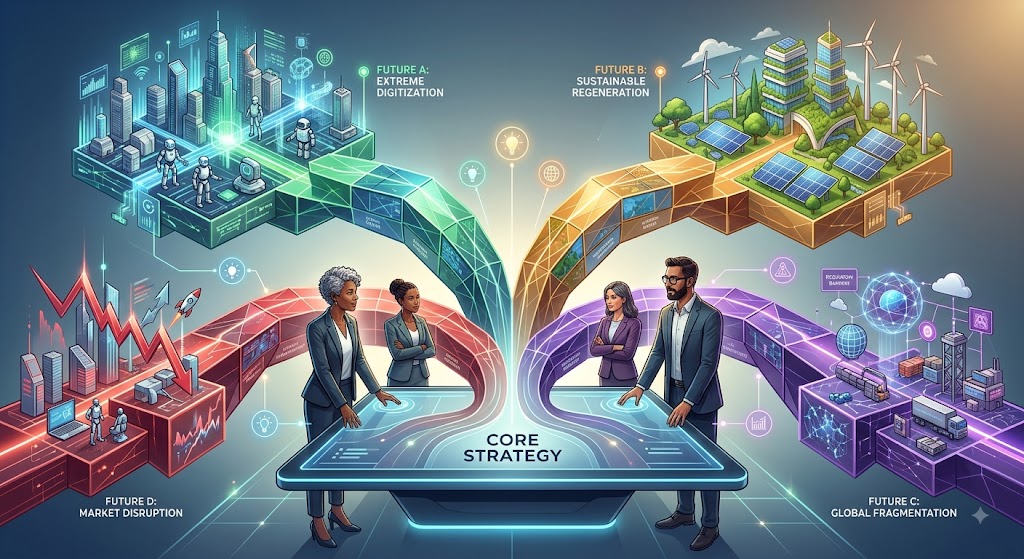
To navigate perpetual disruption, organizations must move away from static predicting and adopt Scenario Architecture. Far from an academic exercise or a passive speculative essay, Scenario Architecture is a active, human-centered framework designed to craft corporate strategy across multiple simultaneous futures. Rather than selecting one path forward, leaders build a flexible structure capable of operating, pivoting, and thriving across divergent potential realities.
The Core Principle
The goal of modern enterprise strategy isn’t to guess what comes next; it is to design the organizational agility and structural resilience needed to excel no matter which future takes shape. Scenario Architecture transforms uncertainty from a source of paralysis into a source of competitive advantage.
II. The Human Foundations of Scenario Architecture
Overcoming Strategic Myopia
Strategy fails not for lack of data, but from human constraint. Cognitive biases, status quo traps, and leadership anxiety naturally pull organizations toward comfort—leading executives to plan for the future they desire rather than the multiple futures that could emerge. Scenario Architecture directly addresses these blind spots, forcing teams to confront uncomfortable disruptions within a safe, structured strategic context.
Experience-Centric Design in Strategy
Future scenarios are abstract until grounded in human experience. By applying human-centered design principles to strategic foresight, we map how each plausible future transforms daily touchpoints for customers, employees, and broader ecosystems. This experience-centric focus ensures that strategic options aren’t just theoretically sound on a spreadsheet, but emotionally resonant and practical in execution.
Culture as the Anchor
The best scenario architecture remains purely theoretical without a culture equipped to navigate constant change. True organizational agility requires embedding a continuous innovation mindset—one where shift indicators are met with curiosity and action rather than friction and resistance. When culture acts as the anchor, teams hold their long-term vision tightly while holding their tactical pathways lightly.
III. Building the Architectural Framework
Identifying Macro-Pillars
Every robust scenario architecture begins by anchoring itself in the structural drivers re-shaping the broader ecosystem. Rather than tracking isolated trends, leaders must map macro-pillars across technological breakthroughs, social and demographic shifts, economic realignments, and environmental imperatives. Identifying these foundational forces creates the boundary conditions within which future possibilities will collide and unfold.
Designing Plausible Multi-Worlds
Strategic foresight breaks down when reduced to simplistic best-case, worst-case, or baseline modeling. True resilience requires constructing three to four distinct, highly believable future scenarios—each defined by unique combinations of macro-pillar interactions. These multi-worlds should challenge core assumptions, expose hidden vulnerabilities, and illuminate unexpected market opportunities.
Defining Core vs. Contingent Strategy
With plausible worlds established, strategy bifurcates into two distinct, deliberate posture types:
- No-Regret Moves: Foundational initiatives, capability builds, and core innovations that deliver undeniable value regardless of which future materializes.
- Option Bets: Targeted, scalable investments designed to remain lightweight until specific early-warning triggers signal that a particular scenario is gaining momentum.
IV. Operationalizing Continuous Foresight & Innovation
Early-Warning Indicator Dashboards
Scenario architecture only moves strategy from static to active when paired with continuous monitoring. Organizations must establish clear, quantitative and qualitative early-warning indicators linked directly to each plausible future. By tracking these subtle signals across market shifts, regulatory moves, and emerging customer behaviors, leaders gain the lead time required to pivot proactively rather than react defensively.
Integrating Change Management & Execution
A strategic shift is only as effective as an organization’s capacity to absorb it. Operationalizing multiple futures requires visual, collaborative change tools that break down silos and align cross-functional teams around evolving priorities. When strategy is transparent and shared, teams can rapidly realign resources, adjust operational cadences, and execute tactical pivots without organizational friction.
Prototyping Future Experiences
To de-risk option bets before full-scale deployment, leaders must apply service design and rapid prototyping methods directly to scenario demands. By creating low-fidelity prototypes of prospective customer interactions, supply chain flows, and business models, teams can stress-test strategy against specific scenario conditions—learning faster and failing cheaper in simulated futures before market forces demand it in real life.
V. Conclusion: Dynamic Leadership in an Unscripted Future
The Architectural Imperative
The traditional mandate of strategic planning—to chart a singular, predictable path—is fundamentally broken in a hyper-connected, fast-moving world. Future-proofed organizations don’t attempt to predict what comes next; they build the architectural capacity to thrive in whatever reality emerges. By framing strategy as a flexible, human-centered blueprint, leaders can transform volatility from an operational threat into a profound engine of opportunity.
Call to Action
The transition to Scenario Architecture requires an intentional shift in leadership mindset. It demands moving away from static, annual binder exercises and embracing dynamic, living strategic architecture. Leaders must begin today by challenging single-horizon assumptions, designing for parallel plausible futures, and empowering their teams with the tools, clarity, and culture needed to navigate an unscripted future with confidence.
Frequently Asked Questions
What is Scenario Architecture and how does it differ from traditional strategic planning?
Scenario Architecture is a dynamic, human-centered framework for designing strategy across multiple plausible futures simultaneously. Unlike traditional strategic planning—which relies on a single linear forecast—Scenario Architecture prepares organizations to pivot and thrive regardless of how market conditions unfold by balancing foundational “no-regret moves” with trigger-based “option bets.”
How do organizations operationalize multiple strategy scenarios without spreading resources too thin?
Organizations avoid resource dilution by categorizing strategic actions into Core vs. Contingent postures. “No-regret moves” receive immediate baseline funding because they deliver value across all potential futures, while “option bets” remain lightweight, targeted investments that are only fully activated when early-warning indicator dashboards signal that a specific future scenario is gaining momentum.
What role does human-centered design play in scenario architecture?
Human-centered design grounds abstract future scenarios into concrete human experiences. By applying service design, rapid prototyping, and experience mapping to strategic foresight, leaders can stress-test how divergent futures impact touchpoints for customers, employees, and ecosystems—ensuring strategic choices are emotionally resonant, practical, and executable.
Bottom line: Futurology is not fortune telling. Futurists use a scientific approach to create their deliverables, but a methodology and tools like those in FutureHacking™ can empower anyone to engage in futurology themselves.
Image credit: Gemini
 Sign up here to get Human-Centered Change & Innovation Weekly delivered to your inbox every week.