LAST UPDATED: April 3, 2026 at 4:20 PM
by Braden Kelley and Art Inteligencia
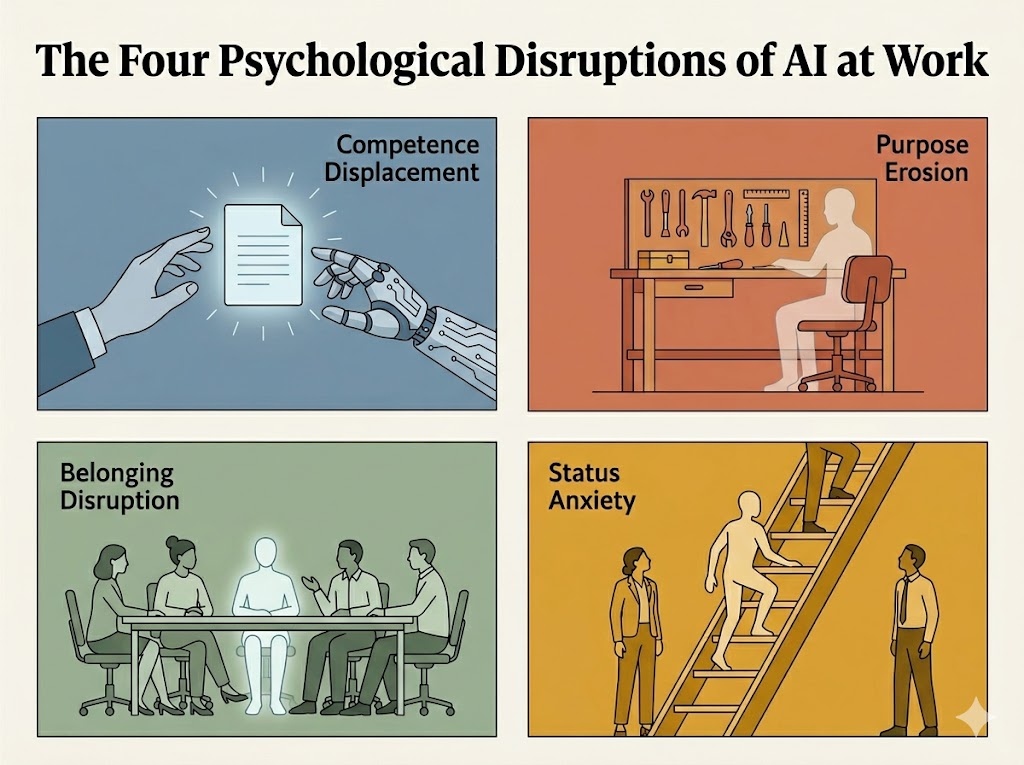
Most AI-and-work frameworks are built around economics – job categories, task automation rates, re-skilling costs. This one is built around something different: the interior experience of the person sitting at the desk. The four disruptions mapped in this infographic were identified not through labor market data, but through a human-centered lens – the same lens used in design thinking and change management to surface the needs, fears, and identity stakes that people rarely articulate out loud but always feel.
The framework draws on three converging sources: organizational psychology research on professional identity and role transition; change management practice, particularly the observed patterns of how workers respond when their expertise is devalued or displaced; and direct observation of how individuals are actually experiencing AI adoption in their workplaces right now – not in surveys, but in the unguarded conversations that happen before and after workshops, in the margins of keynotes, in the questions people ask when they think no one important is listening.
Why these four disruptions
| 1 |
Competence Displacement The skill that defined you no longer distinguishes you. Professional identity is heavily anchored in the belief that what I know how to do has value. When AI can replicate a signature competency – even imperfectly – it attacks that anchor directly. The disruption isn’t primarily about job loss. It’s about the sudden, disorienting feeling that years of deliberate practice have been, in some meaningful sense, made ordinary. This disruption appears earliest and most acutely in knowledge workers whose expertise was previously considered difficult to acquire – writers, analysts, coders, researchers, strategists. |
| 2 |
Purpose Erosion The meaning embedded in the craft begins to hollow out. Work is not only instrumental – it is ritual. The process of doing difficult things carefully, over time, is itself a source of meaning. When automation removes the friction, it can also remove the satisfaction. This is subtler than competence displacement and slower to surface, but ultimately more corrosive. People find themselves producing more output and feeling less connected to it. This disruption is particularly acute for people who chose their profession not just for income but for intrinsic love of the work – and who built their identity around that love. |
| 3 |
Belonging Disruption The social fabric of work shifts when AI enters the team. Work teams are social ecosystems built on complementary expertise, shared struggle, and mutual reliance. AI changes those dynamics in ways that are easy to overlook. When an AI tool makes one team member dramatically more productive, or when collaborative tasks are partially automated, the invisible social contracts of the team – who depends on whom, who contributes what – are quietly renegotiated. Belonging depends on feeling needed. When that changes, isolation can follow. This disruption tends to surface not as explicit conflict but as a gradual withdrawal – people collaborating less, sharing less, protecting their remaining territory. |
| 4 |
Status Anxiety The professional hierarchy is being redrawn by AI fluency. Workplace status has always been tied to expertise scarcity – the person who knew things others didn’t held power. AI is redistributing that scarcity rapidly. Early and confident AI adopters gain speed, output, and visibility. Those who resist, or who are slower to adapt, find themselves losing ground in ways that feel both unfair and disorienting. The new status question – are you someone who uses AI, or someone AI is used on? – is already being asked in organizations, even when no one says it explicitly. This disruption is uniquely uncomfortable because it combines external threat (status loss) with internal shame (the fear of being seen as behind). |
How to read the framework
These four disruptions are not sequential stages – they are simultaneous and overlapping. A single professional can be experiencing all four at once, with different intensities depending on their role, their organization, and how rapidly AI is being adopted around them. The infographic presents them as discrete panels for clarity, but the lived experience is messier and more entangled.
They are also not uniformly negative. Each disruption contains within it the seed of a corresponding renewal: competence displacement can become an invitation to lead with judgment rather than task execution; purpose erosion can prompt a deeper reckoning with what the work is ultimately for; belonging disruption can surface the human connection that was always the real foundation of team cohesion; status anxiety can motivate the kind of deliberate identity authoring that makes professionals more resilient over the long term.
The framework is designed to give leaders and individuals a common language for conversations that are currently happening in fragments — in one-to-ones, in exit interviews, in the silence after a difficult all-hands. Named things can be worked with. Unnamed things can only be endured.
This framework is a practitioner’s model, not a peer-reviewed clinical instrument. It is designed for use in workshops, coaching conversations, and organizational change programs as a starting point for honest dialogue — not as a diagnostic or classification system. It will evolve as our collective understanding of AI’s human impact deepens.
Framework developed by Braden Kelley as part of the article series Psychological Impact of AI on Work Identity · Braden Kelley · © 2026
Image credits: Gemini
Content Authenticity Statement: The topic area, key elements to focus on, etc. were decisions made by Braden Kelley, with a little help from Claude AI to clean up the article and add citations.
 Sign up here to get Human-Centered Change & Innovation Weekly delivered to your inbox every week.