Integrating Sensory Data into Global Logistics Architecture
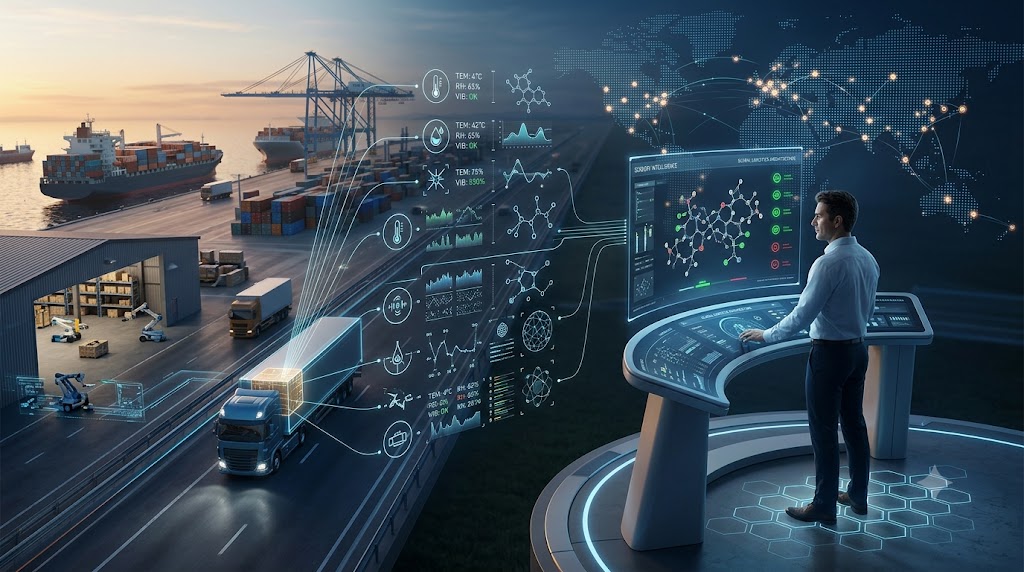
GUEST POST from Chateau G Pato
I. Introduction: Beyond Macroscopic Logistics
For decades, global logistics has operated on a macro-level paradigm. Organizations have spent billions refining their ability to track “boxes on pallets” or containers on cargo ships. While this macroscopic visibility answers the baseline question of where an asset is located in space and time, it leaves a critical operational blind spot: it tells us nothing about the dynamic condition, integrity, or environmental state of what is inside those containers until the doors are opened at the final destination.
The Molecular Supply Chain represents a fundamental paradigm shift — moving logistics from mere geographical tracking to real-time molecular perception. By embedding continuous sensory telemetry into the foundational architecture of global networks, we gain instant visibility into microscopic environmental states: localized temperature shifts, humidity spikes, vibration patterns, atmospheric pressure fluctuations, and chemical degradation markers. Supply chains cease to be passive corridors of transport; they become living, sensing nervous systems.
However, technology alone does not equal transformation. The greatest failure mode of advanced Internet of Things (IoT) and sensory implementations is treating them as purely technical upgrades while ignoring the human element. A truly resilient supply chain must be human-centered by design. Integrating granular sensory data requires restructuring how frontline operators make decisions, how cross-functional teams collaborate, and how customers experience value. Without intentional change management and intuitive experience design, hyper-sensory data creates noise rather than clarity. To lead this evolution, we must balance technological capability with human agency, turning real-time data streams into meaningful, proactive action.
II. The Core Architecture: The Four Layers of Molecular Perception
Building a molecular supply chain requires moving past fragmented IoT point solutions toward a cohesive, multi-layered architecture. To transform raw physical phenomena into strategic operational agility, the infrastructure must seamlessly connect microscopic environmental events to high-level decision-making. This architecture relies on four interconnected layers.
1. The Edge Sensing Layer
The foundation rests on hyper-localized physical perception. Moving beyond traditional GPS loggers, this layer deploys flexible printed electronics, nano-sensors, and bio-interactive indicators directly at the item or primary packaging level. These low-power devices continuously monitor ambient and internal variables — including micro-climates, chemical off-gassing, shock vectors, and structural micro-fractures—effectively giving every physical asset a digital voice.
2. The Orchestration & Analytics Engine
Sensory density generates immense volumes of unstructured stream data that can easily overwhelm legacy systems. The orchestration engine utilizes edge computing and predictive algorithms to process telemetry at the point of capture, filtering routine noise from critical signals. By applying contextual intelligence, the system translates raw physical metrics into meaningful risk indicators, predicting degradation or failure hours before physical symptoms manifest.
3. Autonomous Interventions
Perception without timely execution is wasted effort. This layer bridges insights to action through automated protocols and smart contract execution. When an environmental boundary is breached, the network triggers immediate countermeasures: automatically re-routing sensitive shipments, adjusting climate controls within smart reefer units, or initiating preemptive replacement orders to prevent downstream bottlenecking — all before human intervention is required.
4. The Human Experience (HX) Layer
Automation must support, not obscure, human oversight. The HX layer translates complex, multi-dimensional telemetry into clear, intuitive visual interfaces for logistics operators, supply chain planners, and frontline teams. By reducing cognitive load and presenting actionable recommendations rather than raw data dumps, this layer ensures human workers retain situational awareness, agency, and confidence in automated system responses.
III. Experience Design & Human-Centered Change Management
Introducing hyper-sensory data into global logistics architecture is fundamentally a human challenge, not a hardware installation. When organizations increase data density by orders of magnitude, the immediate risk is cognitive overload and operational paralysis. Transforming real-time telemetry into systemic value requires grounding the transition in human-centered design principles and deliberate change management frameworks.
Empowerment Over Automation
Technology should augment human intelligence rather than treat skilled operators as passive observers. In a high-performing molecular supply chain, automated sub-systems handle routine micro-adjustments, but human agency remains central for complex, non-standard exception handling. The goal of experience design is to elevate the role of logistics professionals from reactive troubleshooters to proactive network orchestrators, providing them with clear contextual narrative behind automated system recommendations.
Overcoming Friction & Operational Shock
Radical transparency often meets institutional resistance. Shifting from periodic milestone tracking to continuous molecular visibility exposes hidden inefficiencies across procurement, warehousing, transportation, and quality assurance. Successfully navigating this friction requires applying structured change frameworks — such as the Change Planning Toolkit™ — to align cross-functional stakeholders around shared outcomes. Leaders must actively design the transition journey, addressing cultural inertia, establishing clear data governance, and upskilling frontline teams to build psychological safety around real-time visibility.
The End-to-End Stakeholder Journey
To maximize adoption and ROI, sensory architectures must deliver tangible value across every touchpoint in the supply chain ecosystem:
- Suppliers & Manufacturers: Gain real-time feedback on packaging integrity, environmental vulnerabilities, and raw material degradation during transit.
- Logistics Operations Teams: Access unified dashboards that distill millions of telemetry points into prioritized, actionable interventions, eliminating alert fatigue.
- End-Customers & Consumers: Experience verifiable proof of product provenance, freshness, and cold-chain compliance, transforming logistics data into a pillar of brand trust.
IV. Strategic Innovation & Future-Proofing
Integrating sensory data into logistics is not merely an operational refinement; it is a catalyst for strategic innovation. When supply chains transition from periodic milestone updates to continuous, molecular-level perception, organizations unlock entirely new operating models. Sensory intelligence enables networks to shift from fragile efficiency toward adaptive resilience, positioning the enterprise to navigate systemic volatility with confidence.
From Reactive Crisis Management to Predictive Resilience
Traditional logistics architectures operate on lag indicators, responding to disruptions long after damage has occurred. Molecular sensing converts physical variables into leading indicators, enabling true predictive resilience. By analyzing continuous environmental telemetry against historical decay curves, systems can predict cargo degradation, equipment failure, or route vulnerabilities before they manifest. This foresight allows organizations to dynamically re-evaluate pricing, optimize buffer stock in real time, and reroute assets autonomously, transforming supply chains from rigid cost centers into flexible, anti-fragile networks.
Sustainability & the Circular Economy
Achieving true environmental sustainability requires granular visibility into resource consumption and waste creation. Molecular data provides an objective, immutable ledger of product lifecycle integrity. In cold chains and perishable networks, hyper-local sensing eliminates spillage and spoilage by triggering dynamic distribution — directing inventory nearing environmental thresholds to the closest market before quality degrades. Furthermore, sensory tracking validates Scope 3 emissions, verifies ethical sourcing compliance, and provides the baseline data necessary to operate circular recovery networks with complete transparency.
The Horizon: Sensing at the Frontier
As sensor technology continues its exponential miniaturization and cost reduction, the molecular supply chain will converge with emerging technological paradigms:
- Quantum Sensing: Ultra-precise quantum sensors capable of detecting gravimetric shifts, magnetic variance, and sub-ppm chemical changes across long distances.
- Autonomous & Edge-Native Fleets: Self-driving freight systems that continuously ingest cargo telemetry to adjust driving dynamics, cabin environments, and route parameters on the fly.
- Self-Healing Supply Networks: Decentralized algorithms that automatically negotiate smart contracts, initiate claims processing, and re-balance global inventory nodes without manual intervention.
V. Conclusion: Leading the Transformation
The transition to a molecular supply chain is far more than an incremental technology refresh or an IT infrastructure project. It represents a fundamental modernization of how global networks operate, perceive risk, and deliver value. Moving from coarse, macro-level location updates to granular, real-time environmental perception shifts logistics from a reactive overhead cost into a strategic engine of continuous innovation and customer value creation.
To successfully capture this opportunity, executive leadership must approach molecular logistics through a holistic lens. Technology provides the sensory neural network, but human-centered change design provides the organizational capability to act on those signals. True resilience lies at the intersection of advanced edge sensing, intelligent orchestration, and empowered human decision-makers who have the psychological safety, tools, and operational flexibility to adapt in real time.
The future belongs to organizations that build supply chains that are not merely fast or cost-efficient, but deeply intelligent, environmentally sustainable, and fundamentally human-centric. By embedding molecular perception into your logistical architecture today, you lay the groundwork for an anti-fragile enterprise capable of thriving amidst the complexity of tomorrow’s global economy.
Frequently Asked Questions
What is a molecular supply chain, and how does it differ from traditional logistics?
A molecular supply chain moves beyond traditional macro-level tracking (knowing a shipment’s location) to real-time micro-level perception. Using continuous sensory telemetry (such as localized temperature, humidity, vibration, and atmospheric pressure), it monitors the precise physical state and integrity of goods inside cargo containers, enabling proactive interventions before damage or degradation occurs.
Why is human-centered change management necessary for sensory data integration?
High-density sensory data can easily overwhelm logistics operators with noise and alert fatigue. Human-centered change management and intuitive experience design ensure that AI and IoT telemetry augment human intelligence rather than replace it — providing operators with clear context, reducing cognitive load, and empowering frontline teams to make effective, data-driven decisions.
How does molecular perception support sustainability and circular economy goals?
By monitoring cargo environmental states in real time, organizations can prevent spillage and spoilage — for instance, dynamically rerouting perishable inventory nearing quality thresholds to the nearest available market. Additionally, sensory data provides an immutable record of product lifecycle integrity, validating Scope 3 emissions and supporting transparent circular recovery networks.
Bottom line: Futurology is not fortune telling. Futurists use a scientific approach to create their deliverables, but a methodology and tools like those in FutureHacking™ can empower anyone to engage in futurology themselves.
Image credit: Gemini
 Sign up here to get Human-Centered Change & Innovation Weekly delivered to your inbox every week.