The Innovation Diagnostic
GUEST POST from Chateau G Pato
The Invisible Walls of Corporate Innovation
Organizations regularly pour millions into transformation initiatives only to hit an invisible wall. They rely on traditional innovation audits that act as lagging indicators — expensive, top-down compliance exercises that measure superficial metrics rather than cultural reality. These rigid assessments might look good in an executive summary, but they consistently fail to surface the true bottlenecks stifling growth.
The Shift to Open-Source Discovery
True transformation requires moving away from proprietary, rigid maturity models and embracing human-centered, open-source diagnostic toolkits. When the frameworks used to measure innovation are locked behind a consultant’s “black box,” the organization remains a passive participant in its own diagnosis. By decentralizing and democratizing these tools, we give frontline employees the agency to map their own operational realities.
The Thesis: Uncovering the Unvarnished Truth
To uncover deep-seated corporate blind spots, organizations must distribute the tools of discovery. Making innovation diagnostics open-source and modular democratizes the change management process, fosters cross-functional collaboration, and forces the unvarnished truth about friction points into the light. We don’t just need better answers; we need an open architecture that empowers everyone to ask the right questions.
The Anatomy of a Corporate Blind Spot
Before an organization can fix its innovation engine, it must understand exactly where and why it is losing sight of reality. Corporate blind spots aren’t accidental; they are structurally manufactured by legacy business designs.
The Structural Silo: Horizontal Friction
Functional isolation is the enemy of innovation. When departments operate as independent kingdoms, information gets trapped, and the horizontal flow of ideas grinds to a halt. Marketing doesn’t know what R&D is discovering; operations has no visibility into customer success insights. This fragmentation creates a massive blind spot where systemic vulnerabilities thrive unnoticed in the gaps between teams.
The Success Trap: The Peril of Optimization
The most dangerous blind spots often develop when business is booming. Organizations fall into the success trap, focusing all their energy on optimizing “what works today” to maximize short-term returns. In doing so, they become blind to shifting customer expectations, macro trends, and emerging disruptions. By the time the current model starts to fail, the organization has lost the muscle memory required to pivot.
The Fear Factor: The Psychological Reality
You cannot diagnose a problem that people are terrified to talk about. Psychological safety is the absolute prerequisite for any accurate corporate diagnostic. If employees believe that pointing out a flaw, a failed project, or an operational bottleneck will damage their career, your diagnostic data will be hollow and useless. Uncovering blind spots requires building a culture where truth is valued over comfort.
The Open-Source Imperative: Why Open and Adaptable Wins
Legacy change management relies heavily on external gatekeepers. High-priced consultancies enter an organization, apply a proprietary “black box” methodology, and leave behind a static report. This model is built for a static world. In a dynamic business landscape, the tools used to diagnose organizational health must be as agile as the market itself.
Breaking the Consultant Monopoly
When you rely on proprietary diagnostic frameworks, your organization remains dependent on external life support. Shifting to an open-source model means publishing, sharing, and freely modifying the diagnostic blueprints. It strips away the mystique of the “black box” and replaces it with an accessible, living toolkit that belongs to the organization, not a third-party vendor.
Co-Creation as Engagement
The traditional approach to change management treats employees as subjects to be changed rather than authors of the transformation. By open-sourcing the diagnostic toolkit, you invite the workforce to help design, tweak, and expand the tools themselves. This co-creation naturally dissolves the friction and skepticism that usually accompanies top-down mandates. When people help build the diagnostic, they are inherently invested in acting on the findings.
Flexibility Over Formality: The Modular Approach
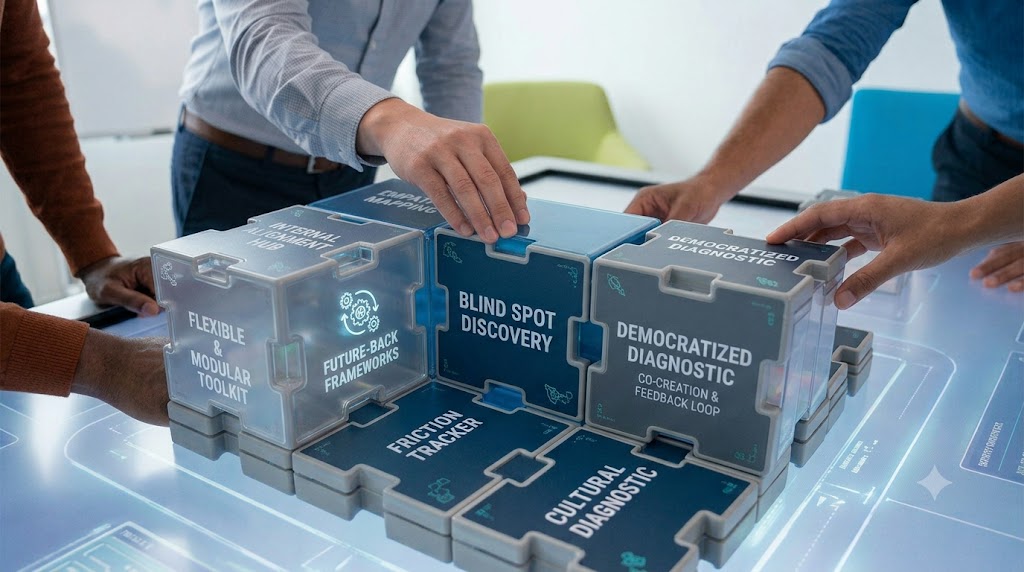
Every corporate culture and department operates under a unique set of constraints. A rigid, one-size-fits-all survey fails because it cannot account for these nuances. An open-source toolkit thrives on modularity. Teams can pick and choose the specific components they need — whether that is a customer journey mapping canvas, a friction-point tracker, or a cultural velocity index — adapting the diagnostic framework to fit their immediate operational reality.
Designing the Toolkit: Human-Centered Pillars
An open-source diagnostic toolkit is only as good as the principles guiding its design. To truly uncover operational blind spots, the tools must look past cold financial metrics and focus heavily on the human dynamics — both inside and outside the organization — that drive or stall innovation velocity.
Empathy-Driven Assessment
Traditional business audits measure spreadsheets; human-centered diagnostics measure experiences. This pillar focuses on capturing the qualitative realities of both the employee experience (EX) and customer experience (CX). By designing tools like empathy maps and qualitative sentiment trackers into the toolkit, organizations can measure the emotional and psychological friction points that quantitative data routinely misses.
Friction Mapping: Tracking Where Ideas Die
Innovation is rarely stopped by a lack of good ideas; it is killed by organizational sludge. The toolkit must include tactical friction-mapping frameworks that allow teams to trace an idea’s path through the corporate ecosystem. This means systematically identifying where concepts stall — whether that is an overly complex procurement cycle, risk-averse legal bottlenecks, or middle-management layers designed to defend the status quo rather than explore the horizon.
Future-Back Frameworks: Frontline Foresight
Strategic foresight should not be restricted to the C-suite. The open-source diagnostic democratizes futurology by introducing simple, visual “future-back” frameworks that frontline workers can use. These tools empower teams to analyze current macro trends and stress-test their day-to-day operational processes against potential disruptions, ensuring the organization is actively building for tomorrow rather than just optimizing for yesterday.
Operationalizing the Diagnostic: From Insight to Action
An open-source diagnostic toolkit is not meant to sit on a digital shelf. The value lies in its deployment. Transitioning from theoretical framework to operational reality requires shifting how the organization gathers, visualizes, and acts upon cultural and structural data.
The “Hackathon” Approach to Discovery
Traditional corporate audits crawl through months of bureaucratic surveys and interviews, delivering outdated insights by the time the final report is compiled. Instead, open-source diagnostics should be deployed via intensive, cross-functional sprints. Gathering diverse teams for rapid “discovery hackathons” allows organizations to compress the diagnostic timeline from months to days, creating immediate psychological momentum and breaking down functional silos in real time.
Synthesizing the Data: Transparent, Shared Dashboards
When insights are hidden behind closed doors, accountability vanishes. To ensure the discovered blind spots are addressed, the diagnostic output must be managed through completely transparent, shared dashboards. Visualizing operational bottlenecks, experience gaps, and culture friction points across the entire enterprise makes it impossible for leadership to ignore systemic issues. It shifts the conversation from defensive denial to collaborative problem-solving.
The Continuous Feedback Loop: An Ongoing Operating System
A corporate diagnostic should never be treated as a static annual event or a check-the-box exercise. Organizations operate in a continuous state of flux; therefore, the diagnostic must function as an ongoing, open-source operating system. By embedding these modular tools into regular team retro-perspectives and project post-mortems, the organization establishes a permanent feedback loop, allowing it to dynamically course-correct as new blind spots inevitably emerge.
The Open Architecture of Future-Ready Organizations
The ultimate goal of open-sourcing your innovation diagnostics is to achieve a profound cultural evolution: shifting the corporate mindset from “protecting the castle” to “exploring the horizon.” When tools are proprietary and controlled by a select few, an organization instinctively defaults to a defensive posture, hiding flaws and reinforcing existing structures. An open-source approach flips this dynamic on its head, turning every employee into an active architect of the company’s future.
A Call to Action: Handing Over the Keys
Sustained transformation cannot be mandated from the top down; it must be co-created from the inside out. To truly eliminate corporate blind spots, leadership must have the courage to democratize the discovery process. By handing the keys of the diagnostic engine to the change champions and frontline workers across your organization, you build a highly resilient, deeply empathetic, and future-ready enterprise that doesn’t just survive disruption — it drives it.
Frequently Asked Questions
Why should we use an open-source diagnostic instead of a traditional consulting framework?
Traditional frameworks are often static, expensive, “black box” solutions that treat employees as passive subjects. An open-source diagnostic democratizes the process, allowing teams to customize the tools to their specific operational realities. It drives organic engagement and co-creation, which naturally reduces employee resistance to the resulting change initiatives.
How do you ensure psychological safety when frontline employees are uncovering corporate blind spots?
The diagnostic toolkit must be introduced through a human-centered lens where the focus is on uncovering structural friction and broken processes, not assigning individual blame. By leveraging cross-functional “discovery hackathons” and collaborative mapping canvas tools, the process becomes about collective problem-solving rather than top-down policing.
Can this open-source approach integrate with existing corporate KPIs and financial metrics?
Absolutely. The open-source diagnostic is designed to complement existing quantitative metrics by injecting critical qualitative data, such as Experience Level Measures (XLMs). It connects operational realities — like where ideas bottleneck in procurement or legal — directly to lagging financial indicators, providing leadership with a complete, holistic view of organizational health.
Bottom line: Futurology is not fortune telling. Futurists use a scientific approach to create their deliverables, but a methodology and tools like those in FutureHacking™ can empower anyone to engage in futurology themselves.
Image credit: Gemini
 Sign up here to get Human-Centered Change & Innovation Weekly delivered to your inbox every week.