
GUEST POST from Geoffrey Moore
A recent CNN Nightcap lamented the lack of ROI given the massive investments to date in AI, fueled by equally massive market valuations. This is true but misleading. ROI is a metric that tracks success in the Performance Zone. The big AI players are all playing a game in the Transformation Zone. Investors need to understand the difference and manage their expectations accordingly.
Back in the late ‘90s, Paul Johnson, Tom Kippola, and I published The Gorilla Game, a guide to investing in technology booms. The core concept was Paul’s: investors value companies based on their expectations of future earnings, and they base those in turn on two factors: the Competitive Advantage Gap (GAP) that separates the company’s offerings from their competition, and the Competitive Advantage Period (CAP) that represents the length of time they can sustain that GAP.
In established markets, GAP and CAP oscillate with product release cycles, and over time the industry consolidates around company power as measured by market share. Ecosystems organize around market-share leaders, and customers follow ecosystem leaders, all of which make for a remarkably stable pecking order. Risk-adjusted returns are modest but reliable, and ROI is indeed the right measure for success and is reflected in market valuations by the P/E ratio.
In technologically disrupted markets, a different dynamic is at work. Category power is obsoleting company power, displacing the current ecosystem, calling into question the traditional valuations of current market leaders, and giving rise to very untraditional valuations for next-generation challengers. Whereas the GAP and CAP in traditional markets are modest but stable, say single-digit advantages in GAP with three-to-five-year lengths for CAP, the GAP of a disruptive technology is extraordinary, triple-digits and beyond, and the length of GAP is based on the life of the category itself, typically multiple decades. Risk-adjusted returns are enormous despite the deep J-curve that must be passed through to get to them, something partially captured by a “Rule of 40” metric that combines current revenue growth with current gross margins and ignores profits and cash flows for the foreseeable future.
The CNN nightcap quite reasonably categorized these investments as suitable for venture capital, not for public markets, but a funny thing is happening to capital accumulation as the global economy becomes more and more digital. Whereas the industrial economy is capital-constrained, needing constant investment in factories, inventory, logistics, and distribution to keep it running smoothly, the digital economy is much less so. Yes, it needs factories — aka data centers — but it has no inventory, and it has multiple “asset light” plays when it comes to logistics and distribution. As a result, because management is still incented to maximum returns, capital has been accumulating in massive pools, especially in the coffers of the digital market leaders. This is what allows Microsoft, Google, Meta, Tesla, Amazon, and their ilk to make eye-popping investments in technologies that have yet to deliver meaningful ROI.
Should their shareholders be concerned? Are they managing for shareholder value? Not for short-term value investors, that’s for sure, but for long-term growth investors, the answer is perhaps. It depends on whether the category really does take off, what we call going inside the tornado, and whether their company can win enough market share and generate a sufficiently competitive ecosystem to ride the wave through to the end. It is not an easy bet to make, but the fates of iconic companies like Kodak, Nokia, and AT&T, as well as the current challenges facing the equally iconic Intel, show that not making the bet is not a safe path either.
There is one last wrinkle to mention, and that is the impact of what the Gartner Group has called the Hype Cycle.
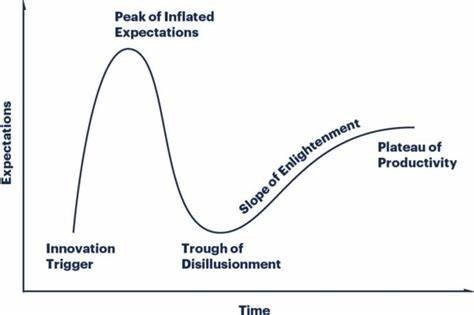
This model looks very similar to the Technology Adoption Life Cycle, but ironically it is time-shifted such that at the Peak of Inflated Expectations, which is an Early Market phenomenon, many become convinced that the category is instead inside the tornado and commit to massive investments just as they are about to hit the chasm. So, note to all you visionaries: When you get a vision of the future, which you are very good at doing, please look for a calendar to find out what year it is.
That’s what I think. What do you think?
— Image credit: Gemini
 Sign up here to join 17,000+ leaders getting Human-Centered Change & Innovation Weekly delivered to their inbox every week.