From Episodic to Perpetual
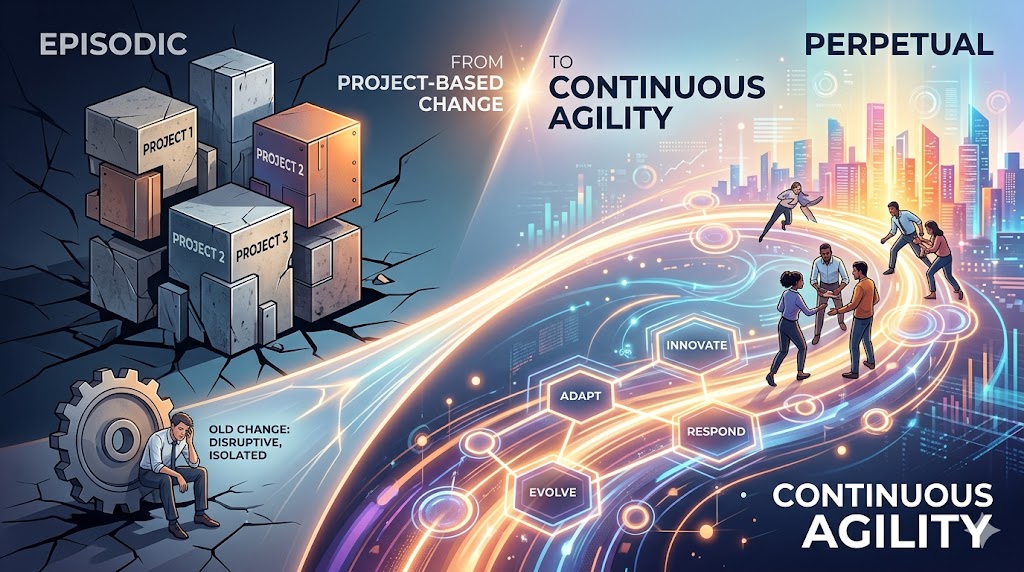
GUEST POST from Art Inteligencia
The Myth of the “Post-Change” Plateau
For decades, organizational leaders have operated under a comforting illusion: that change is a temporary disruption. We have been trained to view transformation as a bridge to be crossed, a painful but finite journey from an old way of working to a stable, predictable new equilibrium. This mindset promises a “post-change” plateau—a comfortable resting place where the team can catch its breath, look back at the milestone achieved, and return to business as usual. But in today’s hyper-accelerated, AI-driven business landscape, that plateau is a mirage.
The traditional model of change management—most famously encapsulated by Kurt Lewin’s classic “Unfreeze-Change-Refreeze” framework—is no longer just outdated; it is actively harming modern organizations. The idea that we can melt down an organization’s behaviors, reshape them into a new configuration, and then “refreeze” them into a permanent state assumes a static environment that no longer exists. By the time a massive, top-down transformation project is successfully “frozen” into place, the market realities that triggered it have already shifted. We are trying to freeze water in the middle of a rapids.
“The traditional model of change management assumes a static environment that no longer exists. We are trying to freeze water in the middle of a rapids.”
When organizations rely on this episodic, project-based approach to change, they pay a massive psychological and operational tax:
- Change Fatigue: Employees experience transformation as a series of heavy, disruptive jolts. Because each project is treated as an extraordinary event, it requires immense kickoff inertia, resulting in organizational anxiety and eventual cynicism.
- The Churn of Disbanding Teams: Project-based change relies on temporary task forces and external consultants. When the project officially “ends” and the banners are taken down, the core team disbands. Without continuous care, the organization inevitably regresses to old habits, leading to what I call experience revenue leakage—where the intended value of the transformation quietly drains away.
- Reactive Innovation: Waiting for a formal “project” to fix a broken process means the organization is always reacting to past disruptions rather than anticipating future shifts.
To survive and thrive, we must abandon the theater of episodic transformation. True organizational agility requires a fundamental paradigm shift: treating change not as a discrete project to be managed, but as a core, human-centered organizational capability that runs continuously and invisibly in the background. We must move from managing change to architecting a perpetual state of readiness.
The Architectural Blueprint: Building the Continuous Change Infrastructure
A shift in mindset is meaningless without the structural scaffolding to support it. If your organization’s governance, funding, and team structures remain rigidly tied to traditional project boundaries, your people will naturally default back to episodic behaviors. To make agility perpetual, we must redesign the operational architecture—the plumbing of the enterprise—to support continuous, human-centered evolution.
Building this infrastructure requires dismantling the legacy silos that isolate change management and replacing them with three modern operational foundations:
1. De-Siloing Change Management: The Integrated Capability
For too long, change management has been treated as an ambulance that follows a project team around, patching up employee resistance after the strategy and technology decisions have already been made. True agility requires moving change practitioners out of isolated Project Management Offices (PMOs) and embedding them directly into product development, operations, and customer experience teams.
Change capability must become a decentralized, peer-to-peer function. Rather than relying on a central task force to swoop in and “manage” people through a milestone, we must equip frontline managers and team leads with the skills, tools, and autonomy to facilitate micro-changes in real time. When change expertise is woven directly into the daily workflow, the friction of transformation drops precipitously.
2. Perpetual Feedback Loops and Experience Measurement
To adjust continuously, an organization needs to feel what is happening on the front lines instantly. Waiting for an annual engagement survey or a post-project review means you are steering the ship by looking at the wake. Continuous agility relies on real-time feedback loops that capture both the Voice of the Employee (VoE) and the Voice of the Customer (VoC).
We must transition from lagging operational metrics to leading Experience Level Measures (XLMs). By consistently monitoring friction points in software usability, workflow bottlenecks, and employee sentiment, leadership can identify exactly where micro-adjustments are needed before they accumulate into a crisis that requires a macro-intervention. This proactive tuning prevents experience revenue leakage—the steady loss of productivity, engagement, and customer retention caused by clunky, outdated processes.
“Change management should not be an ambulance that patches up resistance after decisions are made. It must be embedded directly into the daily architecture of how we design work.”
3. Dynamic Resource Allocation and Capabilities Funding
The traditional corporate budgeting cycle is the ultimate enemy of agility. When capital is locked into rigid, multi-year project plans, pivoting becomes an bureaucratic nightmare. If a team discovers a better way to solve a problem mid-year, but cannot access funds because the budget is anchored to an inflexible project charter, innovation dies.
Perpetual organizations fund capabilities, value streams, and permanent product teams rather than static projects. By adopting a dynamic resource allocation model, leadership can adjust funding levels, reallocate talent, and shift priorities incrementally based on real-world outcomes and shifting market conditions. This ensures that capital and human talent flow smoothly to where they can deliver the highest value, rather than being trapped in a declining project plan.
By integrating change capability into teams, installing continuous feedback loops, and freeing capital from rigid cycles, organizations build a resilient framework. Change ceases to be a disruptive corporate event—it becomes the natural, fluid rhythm of daily operations.
The Role of the Human-Centered Leader in a Perpetual State
When change becomes a permanent condition rather than a temporary project, the traditional playbook for leadership becomes obsolete. The era of the top-down executive command—the leader who stands at a podium during a quarterly town hall, announces a sweeping five-year transformation plan, and demands compliance—is over. In a state of continuous agility, leaders cannot command commitment; they must design an environment that naturally invites it.
To guide an organization through perpetual evolution without inducing widespread panic and fatigue, leaders must evolve into experience architects. This requires an intentional pivot in how authority is leveraged, how culture is modeled, and how performance is measured across three vital dimensions:
1. From Mandated Directives to Intent Orchestration
In an episodic change environment, leadership dictates the exact steps of a transformation. In a perpetual environment, doing so creates a massive bottleneck. Human-centered leaders practice what I call Intent Orchestration—clearly defining the strategic “North Star,” the guardrails, and the desired outcomes, while radically decentralizing the execution to the frontline teams.
Instead of managing tasks, the leader’s job is to ensure absolute clarity of purpose. When teams deeply understand the *why* behind the organization’s direction, they possess the autonomy to co-create the *how* in real time. This democratic approach to change completely reframes the employee experience: people rarely sabotage a strategy they helped build.
2. Moving from Risk Mitigation to Experimentation Safespaces
Legacy leadership models are fundamentally hardwired for risk avoidance, treating deviations from a plan as failures. But if continuous adaptation is your goal, treating every mistake as a flaw will instantly paralyze your workforce. Leaders must actively de-risk the concept of failure by building bounded experimentation spaces.
This means normalizing small-scale, rapid prototyping where hypotheses can be tested with low stakes. When an experiment fails to yield the expected result, a human-centered leader reframes it not as a performance failure, but as a critical data-gathering exercise. By celebrating the insights gained from these micro-failures, leadership strips away the vulnerability that typically prevents people from trying new ways of working.
“People rarely sabotage a strategy they helped build. When leaders orchestrate intent and decentralize execution, adaptation becomes a collaborative act.”
3. Redesigning Performance Architecture to Reward Adaptability
An organization will always optimize for what is measured and rewarded. If your human resource structures and performance reviews still evaluate employees solely on their adherence to fixed annual goals, your culture will remain rigidly resistant to change. Leaders must work to intentionally redesign the performance architecture.
Continuous agility requires that we begin evaluating, promoting, and compensating individuals based on their capacity to pivot, their commitment to continuous learning, and their cross-functional collaboration skills. We must shift our recognition systems to reward:
- Unlearning Agility: The ability to quickly discard outdated practices and adopt new methodologies or technologies.
- Value-Stream Collaboration: Breaking down functional silos to solve problems dynamically across traditional department lines.
- Mentorship in Change: Championing and supporting peers through structural and technological transitions.
By transforming from direct controllers into cultural architects, leaders provide the psychological anchor their teams need. They prove that a commitment to continuous agility doesn’t mean hanging over a cliff—it means being equipped with the trust, safety, and autonomy to navigate the future together.
Overcoming the Pitfalls of Perpetual Agility
While the benefits of continuous agility are undeniable, executing this shift carelessly can create its own set of organizational hazards. When everything is constantly moving, it is easy for an organization to spin out of control. Without intentional guardrails, “perpetual change” can quickly degenerate into two dangerous pathologies: chronic employee burnout or aimless, chaotic pivoting. As experience designers, we must anticipate these friction points and architect the safeguards to prevent them.
Navigating a continuous state of readiness requires actively mitigating two primary structural and psychological pitfalls:
1. Combating Continuous Fatigue: Designing “Rest Stops” in the Current
The most common objection to continuous change is simple: “We are already exhausted.” If leaders merely accelerate the cadence of traditional, heavy project demands, the workforce will collapse under the weight of change fatigue. Continuous agility must not mean relentless, unpaced sprinting. It requires a predictable operational rhythm that builds recovery directly into the system.
To keep the human engine running sustainably, we must design strategic “rest stops” within our continuous workflows. This involves:
- Establishing Predictable Rhythms: Utilizing stable, cyclical cadences (such as fixed sprint cycles or quarterly synchronization intervals) so employees always know when intense focus is required and when a stabilization period is coming.
- Celebrating Micro-Wins: In episodic change, celebration only happens at the massive “Go-Live” milestone. In a perpetual state, leaders must deliberately pause to surface, share, and celebrate small, iterative improvements to keep morale high.
- Protecting Cognitive Slack: Intentionally allocating time for teams to step away from delivery to focus on reflection, documentation, and personal upskilling. Slack is not wasted time; it is the shock absorber that prevents burnout.
2. Avoiding “Motion Without Progress”: Anchor to the North Star
The second pitfall is structural: an organization becomes so obsessed with pivoting that it forgets where it is going. When a company mistakes activity for progress, it suffers from strategic whiplash. Teams constantly change direction based on the latest micro-signal, creating a fragmented employee experience and a confusing customer journey.
“Continuous agility without a fixed destination isn’t innovation—it’s just organizational vertigo. Agility requires an immovable anchor.”
To prevent continuous evolution from fracturing into aimless chaos, the entire ecosystem must be tightly anchored to an unchanging, overarching purpose—the **Strategic North Star**. While our software, our processes, and our short-term tactics must remain completely fluid, our deep organizational mission, values, and long-term vision must remain absolute constants. Every micro-change proposed by a frontline team must be explicitly mapped back to this North Star. If a pivot doesn’t bring the organization closer to fulfilling its core purpose, it is rejected as background noise.
By protecting human energy with sustainable cadences and shielding strategic focus with an unyielding North Star, leaders ensure that perpetual change remains a disciplined, empowering capability rather than an exhausting corporate tax.
Conclusion: The Ultimate Competitive Advantage
The acceleration of our business environment is not going to slow down. The convergence of advanced AI tools, volatile market shifts, and evolving customer expectations means that the organizations relying on legacy, project-based transformation models will increasingly find themselves trapped in a state of perpetual catch-up. They will continue to launch heavy, disruptive initiatives to solve yesterday’s problems, paying a steep tax in employee burnout and lost momentum.
The future belongs to the organizations that realize the ultimate competitive advantage is no longer about executing a single project perfectly. It is about building a human-centered ecosystem where adaptation is so fluid, so deeply integrated into the daily culture, that change itself becomes invisible. It ceases to be an extraordinary corporate event and simply becomes the way work gets done.
“The ultimate competitive advantage is no longer about executing a single project perfectly. It is about making change invisible because it is simply part of your daily operational fabric.”
This transition doesn’t happen overnight by executive decree; it is built through the accumulation of small, deliberate choices. If you want to break the exhausting cycle of episodic change and start architecting a perpetual state of readiness within your own organization, you can start today with one simple, human-centered micro-shift:
The Next Step: At your very next team alignment or leadership meeting, intentionally banish the phrase “when things get back to normal.” Replace it with a collective focus on identifying just one operational bottleneck or friction point that your team can iteratively improve or automate over the next two weeks. By decentralizing the authority to change and celebrating that first micro-evolution, you begin dismantling the illusion of the plateau—and you plant the seeds for a culture of continuous agility.
Frequently Asked Questions
To help teams navigate this paradigm shift, here are answers to the most common questions about moving from project-based change to continuous agility, structured for both human readers and search technologies.
1. How do you prevent employee burnout if change never actually stops?
Continuous agility does not mean working at a frantic, non-stop pace. Instead, it prevents burnout by replacing massive, high-stress “jolts” of project-based change with small, manageable micro-adjustments. To make this sustainable, leaders must design structured rhythms—such as stable sprint cycles—that include built-in recovery periods, protect “cognitive slack” time for reflection, and actively celebrate small, iterative wins along the way.
2. What is the difference between genuine agility and aimless corporate pivoting?
The difference lies in having a fixed destination. Aimless pivoting occurs when an organization reacts erratically to every short-term signal without a clear strategy, leading to organizational whiplash. Genuine agility pairs a fluid, adaptable execution strategy with an unchanging, rock-solid Strategic North Star (the core organizational mission and long-term vision). Every micro-change must actively advance the team toward that permanent anchor.
3. How do you measure the return on investment (ROI) of an ongoing, continuous capability?
Traditional, static ROI metrics are designed for fixed project scopes and timelines. For continuous capabilities, forward-thinking organizations measure the Value of Innovation (VOI) and track an Adaptability Index. This involves assessing leading Experience Level Measures (XLMs)—such as how quickly teams pivot based on user feedback, the reduction of operational drag, and the speed at which value-stream improvements eliminate experience revenue leakage.
Image credit: Gemini
 Sign up here to get Human-Centered Change & Innovation Weekly delivered to your inbox every week.