How to Keep the Augmented Workforce from Leaving the Unaugmented Behind
GUEST POST from Art Inteligencia
I. Introduction: The Emerging Organizational Fracture
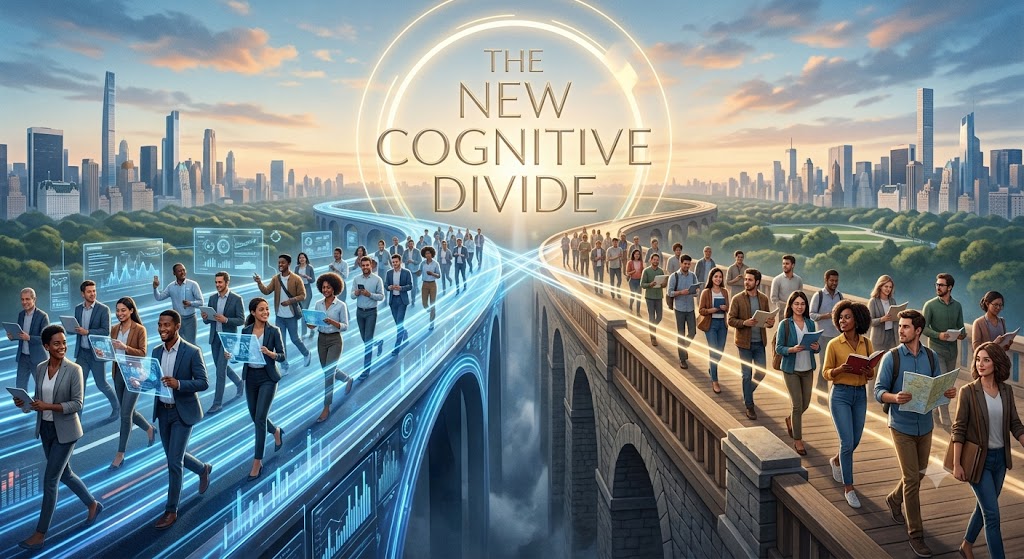
When we talk about artificial intelligence and automation in the workplace, the conversation almost always gravitates toward technology adoption curves, software rollouts, or fears of job displacement. But from a Human-Centered Change™ perspective, the real risk facing modern organizations isn’t just technological disruption—it’s the widening Cognitive Divide.
As AI tools, generative systems, and intelligent agents permeate daily workflows, we are witnessing the emergence of a stark, two-tier organizational reality:
- The Augmented Workforce: Employees equipped with cognitive tools who operate at hyper-velocity, elevating their capacity for problem-solving, strategic synthesis, and rapid execution.
- The Unaugmented Workforce: Employees who—whether due to role constraints, lack of access, digital literacy gaps, or organizational inertia—remain stranded in legacy, manual workflows.
This divide is not merely an IT rollout delay or an HR training backlog; it is a fundamental experience design challenge. When a segment of your team operates with superhuman speed while others feel tethered to traditional methods, the resulting friction erodes psychological safety, fuels cultural resentment, and fractures organizational alignment.
If change is managed strictly as a project deadline rather than a human adoption process, this cognitive gap will undermine your culture and paralyze innovation. To build a resilient, future-ready organization, leaders must design experiences that elevate the entire workforce—ensuring no one is left behind in the unaugmented past.
II. Weak Signals & FutureHacking™: Mapping the Disruption
To navigate turbulent transitions, leaders cannot afford to wait for trends to become glaringly obvious. Through FutureHacking™ foresight and weak signal scanning, we can already spot the early indicators of organizational friction caused by cognitive acceleration—well before they show up in quarterly engagement surveys or exit interviews.
Scanning the Weak Signals in the Modern Workplace
The subtle indicators of the widening divide are already present in forward-looking enterprises if you know where to look:
- The Rise of “Shadow AI”: A subterranean split where tech-savvy employees covertly utilize unsanctioned generative tools to outperform peers, creating hidden disparities in output quality and speed.
- Emerging Productivity Elitism: A cultural shift where augmented workers view unaugmented colleagues as operational bottlenecks, leading to subtle condescension and team friction.
- Information Asymmetry & Asynchronous Drift: Augmented employees synthesizing vast amounts of data in seconds, leaving unaugmented team members struggling to keep pace during strategic alignment discussions.
The Danger of Perpetual Change Fatigue
When technological capability outpaces human adaptation, the resulting state isn’t high performance—it’s cognitive overload. Rapid acceleration heightens uncertainty across the organization, triggering classic change resistance mechanisms. When unaugmented workers feel overwhelmed by the velocity around them, they don’t just slow down; they disengage to protect their own psychological safety.
Scenario Planning: The Cost of a Fractured Culture
Consider the organizational trajectory when 30% of your workforce operates at 10x speed while 70% remains bound to traditional methods:
| Organizational Pillar | The Augmented Reality | The Unaugmented Vulnerability |
|---|---|---|
| Culture & Morale | High empowerment, rapid experimentation, elevated autonomy. | Alienation, fear of displacement, acute change fatigue. |
| Knowledge Sharing | AI-prompt library hoarding, individualized workflows. | Reliance on legacy documentation, slower consensus-building. |
| Innovation Velocity | Rapid prototyping and iterative hypothesis testing. | Bottlenecks during cross-functional handoffs and execution. |
Foresight isn’t about predicting a singular, fixed future; it’s about identifying these divergence points early enough to intervene. Leaders who proactively bridge this gap will harness collective intelligence, while those who ignore it will find their organizational velocity constrained by internal friction.
III. The Nine Innovation Roles in the Age of Augmentation
Innovation is never a solo endeavor or a commodity task—it depends on individuals fulfilling distinct functions across the full lifecycle of an idea. Through the lens of the Nine Innovation Roles™, every person excels at a dominant role that contributes uniquely to organizational capacity:
- Revolutionary: Constantly shaking things up, eager to challenge norms, and generating a high volume of ideas.
- Conscript: Possesses great ideas and execution talent, but rarely shares them voluntarily without a push or clear invite.
- Connector: Bridges people, insights, and disciplines—linking a Conscript’s quiet insight with a Revolutionary or an Artist.
- Artist: Refines and elevates concepts, taking raw ideas and making them visually, functionally, or conceptually better.
- Customer Champion: Anchors innovation in real user needs, behaviors, and empathetic context.
- Troubleshooter: Solves critical technical or operational roadblocks that stand between an idea and viability.
- Judge: Evaluates commercial viability, profitability, and marketplace feasibility to separate signal from noise.
- Magic Maker: Translates abstract concepts into reality by orchestrating execution and lining up required resources.
- Evangelist: Educates stakeholders, builds internal buy-in, and articulates value to ensure adoption.
As cognitive tools and AI capabilities enter the workplace, they alter the cadence and dynamic across all nine roles. If unmanaged, the Cognitive Divide threatens to distort how these roles collaborate.
Rethinking Role Velocity and the Risk of “Cognitive Silos”
When augmented team members—such as an AI-powered Revolutionary or Artist—can generate dozens of concepts, visual mockups, or project variations in seconds, the overall speed of ideation leaps exponentially. However, if unaugmented team members filling roles like the Judge, Troubleshooter, or Customer Champion are operating with traditional, manual tools, critical friction occurs:
- The augmented Revolutionary risks overwhelming the Judge with a firehose of AI-generated concepts, paralyzing evaluation criteria.
- The Conscript, who is already hesitant to share insights, feels further silenced as hyper-augmented peers dominate every conversation with rapid AI outputs.
- The Customer Champion’s deep human empathy risks being bypassed in favor of fast, synthetic persona data generated by augmented team members.
Building Synergy Across the Augmented and Unaugmented Roles
To prevent cognitive acceleration from leaving essential roles behind, leaders must intentionally orchestrate cross-role synergy:
- Empower the Connector: Leverage Connectors to intentionally pair tech-forward Revolutionaries with quiet Conscripts, ensuring AI tools amplify hidden expertise rather than suppressing it.
- Augment Evaluation and Execution: Provide tailored cognitive assistance to Troubleshooters, Judges, and Magic Makers so that downstream validation and real-world implementation keep pace with front-end ideation.
- Anchor in Human Empathy: Require Evangelists and Customer Champions to validate AI outputs against authentic human experiences, maintaining trust and psychological safety across the team.
True organizational capability doesn’t come from turning every employee into an AI prompt engineer—it comes from ensuring all Nine Innovation Roles work in harmony to move ideas seamlessly from inspiration to impact.
IV. Bridging the Divide with Human-Centered Change™
Too often, leaders approach technology adoption through a pure project management lens—focusing almost exclusively on feature rollouts, software licenses, and technical milestones. But technology never transforms an enterprise on its own; people do. Bridging the Cognitive Divide requires a shift from technical deployment to Human-Centered Change™, prioritizing how people experience, internalize, and build momentum around new ways of working.
Reframing AI Integration: From IT Rollout to Human Adoption
When cognitive tools are dropped into an organization without intentional change design, two predictable reactions occur: eager adoption by tech-forward early movers, and anxiety-driven withdrawal by the rest. Human-Centered Change™ reframes augmentation from an efficiency mandate into an capability-building opportunity that elevates everyone.
Visual Collaboration with the Change Planning Canvas™
To keep the augmented workforce from pulling away from unaugmented colleagues, teams need a shared space to map out the human dynamics of transition. Utilizing visual tools like the Change Planning Canvas™ allows leaders and cross-functional teams to collaborate transparently on key human adoption variables:
- Stakeholder Impact: Mapping precisely who is being augmented, who is currently left unaugmented, and where operational bottlenecks or cultural friction will naturally manifest.
- Empathy & Adoption Barriers: Uncovering the root causes holding unaugmented workers back—whether it’s fear of obsolescence, lack of structured training, strict role permissions, or sheer change fatigue.
- Shared Language & Values: Establishing clear organizational norms around AI usage, transparency, data integrity, and shared ownership so augmentation is viewed as a collaborative asset rather than a competitive edge.
- Capacity Building: Defining clear learning pathways that help unaugmented team members build digital confidence at a manageable, sustainable pace.
Democratizing Augmentation Across the Organization
Organizations must avoid creating isolated “AI elite” task forces or restricted pilot groups that widen cultural divides. Instead, leaders should democratize access to cognitive tools while actively pairing augmented champions with unaugmented peers. When employees help co-create the blueprints for how AI enhances their daily work, change stops feeling like something being done to them and starts feeling like something built with them.
V. Experience Design for the Hybrid-Cognitive Workplace
Closing the Cognitive Divide isn’t just a matter of issuing new software licenses or scheduling mandatory training sessions—it requires a deliberate focus on Experience Design. As workplaces evolve into hybrid-cognitive environments where augmented and unaugmented employees collaborate daily, leaders must design workflows, environments, and cultural norms that reduce friction and elevate the collective employee experience.
Designing the Modern Employee Journey
When cognitive capabilities vary across a team, standard operational workflows quickly break down. By mapping the daily employee journey through an experience design lens, leaders can pinpoint and redesign critical touchpoints where cognitive bottlenecks and cultural friction occur:
- Input Asymmetry: Redesigning intake and planning processes so that team members using manual research methods aren’t overwhelmed by peers generating hyper-speed AI syntheses.
- Hand-off Protocols: Establishing clear, standardized hand-off guidelines between augmented and unaugmented roles so context, prompt logic, and underlying data sources remain completely transparent.
- Recognition & Performance Metrics: Evolving evaluation criteria beyond raw output volume or speed to reward critical thinking, strategic judgment, collaboration, and empathetic leadership.
Building Psychological Safety in a Dynamic Workplace
Employees cannot adapt to change when they are operating in fear. When unaugmented workers worry that asking for help or making mistakes will expose them as obsolete, they naturally retreat into defensive compliance. Experience design prioritizes psychological safety by creating low-stakes sandbox environments where teams can experiment with cognitive tools, test hypotheses, and fail safely without fear of judgment or job insecurity.
Embedding Continuous Learning Loops
Capabilities fade rapidly if learning is treated as a one-time event rather than a continuous daily habit. Bridging the divide requires embedding dynamic feedback and learning loops directly into work processes:
- Micro-Demonstrations: Encouraging augmented champions to share real-world “prompt recipes” and workflow shortcuts during regular team standups.
- Peer-to-Peer Coaching: Pairing tech-forward experimenters with experienced domain experts to blend digital speed with institutional wisdom.
- Iterative Workflow Refinement: Frequently auditing team experiences to refine tools, adjust pacing, and remove friction points before they harden into cultural divides.
When experience design guides the transformation, cognitive augmentation ceases to be a wedge that divides teams and instead becomes a shared platform that empowers every individual to perform at their best.
VI. Conclusion & Call to Action: Continuous Innovation for All
The rise of artificial intelligence and cognitive augmentation represents one of the most profound shifts in workplace dynamics of our generation. Yet, as history has repeatedly taught us across every major technological revolution, tools do not transform enterprises—people do. The ultimate determinant of organizational success in this new era will not be the raw capability of your algorithms, but the cohesion and adaptability of your culture.
The Modern Leadership Imperative
To succeed today, leaders must master a double-handed challenge: managing the operational reality of the present while simultaneously inventing the future. Allowing a widening Cognitive Divide to fracture your organization into two distinct tiers—the hyper-accelerated augmented and the lagging unaugmented—is a recipe for cultural stagnation, change fatigue, and lost potential.
Bridging this gap requires moving beyond mere software deployment and embracing Human-Centered Change™, applying FutureHacking™ foresight, and thoughtfully balancing the talents across all Nine Innovation Roles™. When you prioritize experience design and psychological safety, cognitive augmentation stops being a wedge that drives teams apart and becomes an inclusive engine that lifts the entire workforce.
A Call to Action for Leaders
Do not wait for change friction to manifest in turnover or missed goals. Take proactive steps today to design an augmented future that empowers everyone:
- Audit Your Divide: Map your organization to identify where cognitive gaps, access barriers, and velocity mismatches are actively causing friction.
- Democratize Capability: Transition from isolated pilot groups to cross-functional, collaborative learning environments that give every employee a pathway to growth.
- Co-Create the Future: Bring augmented champions and domain experts together using visual collaboration frameworks to map out workflows that value human wisdom as much as algorithmic speed.
Change sticks when people help build it. Make sure your entire workforce is part of the blueprint.
Frequently Asked Questions
What is the “Cognitive Divide” in the workplace?
The Cognitive Divide is the widening organizational gap between employees who utilize AI tools and automated agents to operate at hyper-velocity, and those who remain bound to legacy, manual workflows due to role constraints, lack of access, or training gaps.
Why is technology deployment alone insufficient to bridge this gap?
Software rollouts focus on technical access rather than human adoption. Without Human-Centered Change™ and experience design, rapid cognitive acceleration creates change fatigue, psychological safety breakdown, and cultural friction between augmented and unaugmented team members.
How can leaders ensure unaugmented employees are not left behind?
Leaders must democratize AI access, use visual collaboration tools like the Change Planning Canvas™ to map human adoption barriers, and pair tech-forward team members with domain experts to harmonize AI speed with institutional wisdom across all Nine Innovation Roles™.
Bottom line: Futurists are not fortune tellers. They use a formal approach to achieve their outcomes, but a methodology and tools like those in FutureHacking™ can empower anyone to be their own futurist.
Image credit: Gemini
 Sign up here to get Human-Centered Change & Innovation Weekly delivered to your inbox every week.