How Tech Monopolies Are Rewriting the Social Contract
GUEST POST from Chateau G Pato
The Shift from Platforms to Polities
For centuries, the social contract was a well-understood, if invisible, agreement: citizens granted authority and yielded certain liberties to governments in exchange for the protection of their rights, the maintenance of public infrastructure, and the preservation of the public square. If the system broke, democratic mechanisms — or at least geographic realities — offered a path toward accountability. Today, that foundational agreement is being quietly yet fundamentally rewritten without a single vote being cast.
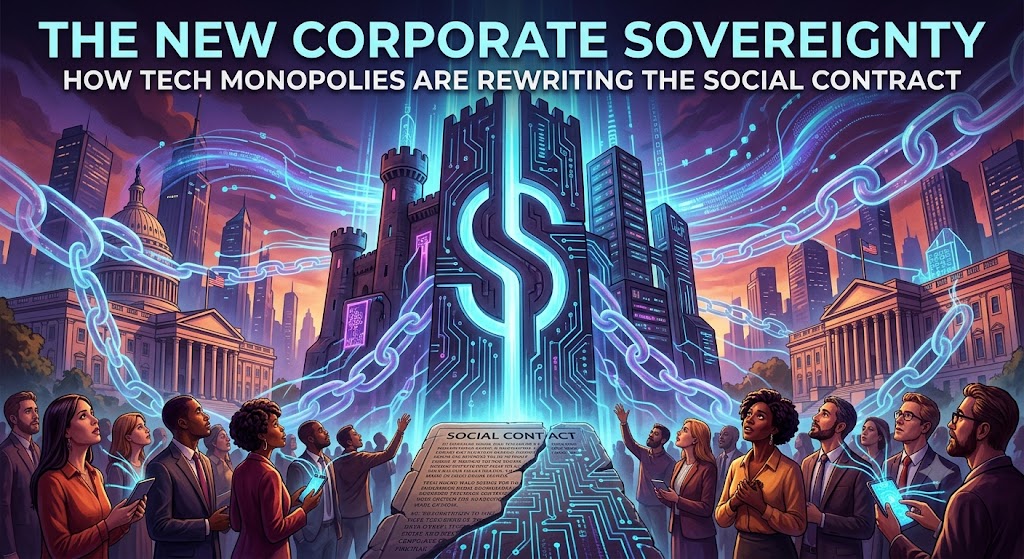
We have entered the era of the new corporate sovereignty. A handful of global technology monopolies have evolved far beyond their original mandates as product builders or marketplace facilitators. By controlling the digital layer upon which modern life, commerce, and communication occur, these ecosystems now function as pseudo-sovereign entities. They dictate the boundaries of acceptable speech, control the flow of economic opportunity, and manage the digital identities of billions of people — commanding populations and geopolitical influence that rival or exceed most nation-states.
When we evaluate this shift through the twin lenses of human-centered innovation and futurology, a critical question emerges: Who is designing this future, and are humans still its primary stakeholders? As experience designers and strategists, we must look past the seductive convenience of frictionless interfaces to examine the structural power dynamics underneath. If the systems that govern our daily realities are built solely to optimize for engagement and platform lock-in, we risk trading true civic agency for a new form of digital vassalage. It is time to audit the new corporate social contract before its architectures become permanent.
I. Infrastructure as Government: The New Public Utilities
In the physical world, the markers of sovereignty are obvious: roads, bridges, electrical grids, and water systems. These are the foundational utilities that make society function. In the digital age, however, the critical infrastructure required for societal survival has been completely enclosed by private enterprise. Cloud computing fabrics, mobile operating systems, and centralized identity protocols are no longer just optional consumer products — they are the modern public utilities, completely owned and operated by a handful of corporate entities.
This reality exposes a profound failure in human-centered innovation. True human-centered design should empower individuals and foster long-term resilience. Instead, the tech ecosystem has mastered the “experience design trap.” By engineering hyper-frictionless experiences, seamless single-sign-on (SSO) ecosystems, and predictive cross-device synchronization, these platforms have made systemic dependency completely invisible. We willingly swap traditional civic friction for the intoxicating convenience of corporate lock-in, unaware that we are trading accountability for convenience.
When an ecosystem controls the very pipes through which commerce, communication, and identity flow, its operational choices cease to be mere business decisions. If a platform alters an algorithm, it can instantly decimate entire industries or obscure vital public information. If it revokes an account, it can effectively erase an individual’s digital existence. When corporate policy wields the power to enforce digital exile, it is no longer practicing corporate governance — it is exercising sovereign power.
II. Algorithmic Law and Private Courts
Constitutions were designed to limit power, protect rights, and outline clear frameworks for justice. In the digital realm, however, traditional constitutional protections have been effectively supplanted by Terms of Service (ToS) agreements. Billions of user-citizens check a box to “agree” to legal frameworks they have never read, entering a private jurisdiction where traditional legal protections — like due process, free speech, and the presumption of innocence — do not apply. The corporate user agreement has become the default constitution of the twenty-first century.
Within these corporate fiefdoms, the rule of law is maintained not by transparent courts, but by automated moderation algorithms. These systems act as a hyper-efficient police force, judge, and jury, processing millions of behavioral violations every second. Because these algorithms operate on proprietary code, their logic remains entirely opaque, leaving individuals and small businesses with zero democratic oversight or viable paths to appeal when their digital livelihoods or voices are suddenly stripped away.
From an experience design perspective, this is a systemic failure of the highest order. When design teams prioritize engagement optimization and behavioral velocity over long-term civic health, the resulting architecture naturally favors outrage over nuance. By automating the policing of human discourse using blunt, profit-driven metrics, tech monopolies haven’t just broken the public square — they have redesigned it to ensure social cohesion remains permanently fragmented.
III. The Data Tithe and The Surveillance Social Contract
Every historic feudal system relied on a foundational exchange: the peasant surrendered a significant portion of their harvest to the lord in exchange for physical security and access to the land. Today, we participate in a strikingly similar arrangement, though the currency has changed. We pay a continuous “data tithe.” In order to access the essential infrastructure of modern connection, productivity, and commerce, we must continually surrender the granular details of our behavioral, emotional, and spatial lives.
This surveillance social contract operates on a massive asymmetry of information and power. While users experience these platforms as convenient, “free” utilities, the underlying business architecture treats human experience as raw material destined for behavioral modification markets. The depth of predictive analytics held by these corporate sovereigns creates a profound power imbalance. They understand user vulnerabilities, biases, and triggers far better than any traditional government ever could, effectively reducing active citizens to predictable, monetizable digital assets.
Looking at this dynamic through a futurist lens, the danger goes far beyond targeted advertising. We are witnessing the maturation of systems capable of mass behavioral orchestration. When a handful of entities control the inputs, notifications, and information feeds of billions of people, they possess the levers to subtly shape societal norms, steer purchasing habits, and influence geopolitical outcomes. Innovation that treats human autonomy as a resource to be harvested is inherently unsustainable; we must urgently redesign the relationship between human data and corporate privilege.
IV. The Borderless State vs. The Geographic Nation
Traditional geopolitics is entirely bound by geography, relying on physical borders, sovereign soil, and national treaties. Tech monopolies, however, have built borderless digital empires that operate completely detached from geographic constraints. With user bases that number in the billions, these digital polities command populations vastly larger than any historical empire and wield concentrated economic and informational influence that rivals — and often terrifies — traditional superpowers.
This borderless nature enables a sophisticated strategy of regulatory arbitrage and systemic evasion. When a corporate entity’s infrastructure is distributed globally, its intellectual property sheltered in tax havens, and its operational hub located half a world away, traditional nation-states find their domestic laws toothless. These organizations do not merely lobby governments; they routinely out-navigate them, treating local regulations not as binding societal mandates, but as minor operational frictions to be optimized away or legally out-resourced.
We are now witnessing open confrontations where tech monopolies treat sovereign states as peers — or subordinates — rather than authorities. Whether it is an ecosystem cutting off news access to an entire continent to protest local copyright laws, or a platform refusing to comply with supreme court directives regarding algorithmic transparency, the power dynamic has fundamentally flipped. When private corporations can effectively veto national legislation through technical non-compliance, the geographic social contract is no longer just being rewritten — it is being subordinated to the terms of the platform.
V. Futurology: Three Horizons of Corporate Sovereignty
To truly understand how this power dynamic will evolve, we must look beyond the immediate horizon. By applying a futurist framework to the trajectory of corporate sovereignty, we can map out how the relationship between humans, corporations, and states is likely to shift across three distinct time horizons.
Horizon 1: Deep State-Corporate Interdependence (Present – 3 Years)
In the immediate term, we are seeing an accelerating trend of governments outsourcing their core civic duties. Lacking the technical agility to build advanced infrastructure, nation-states increasingly rely on tech monopolies to manage critical systems — ranging from health-tracking ecosystems and identity verification protocols to the very cloud fabrics that power military and judicial databases. The boundary between public authority and private infrastructure is blurring, creating a symbiotic reliance where the state protects the monopoly, and the monopoly runs the state.
Horizon 2: The Emergence of Platform Jurisdictions (3 – 7 Years)
As we move into the medium term, corporate sovereignty will likely transition from digital control to physical and financial self-governance. We can anticipate the rise of corporate-managed digital jurisdictions — often referred to as “network states” — where individuals align their primary loyalty, legal disputes, and community structures with an ecosystem rather than a geographic nation. This era will be marked by the mainstreaming of private, platform-specific currencies and tokens that bypass central banks entirely, allowing tech giants to dictate monetary policy for their respective populations.
Horizon 3: The Fragmentation of Lived Reality (7+ Years)
In the long term, the ultimate expression of corporate sovereignty will be the total fragmentation of human reality itself. As competing tech monopolies mature their proprietary artificial intelligence ecosystems, spatial computing layers, and immersive realities, they will no longer just control the information we read — they will control the reality we perceive. Citizens will find themselves locked into entirely different sensory, historical, and factual universes depending on which tech stack they inhabit. At this point, corporate sovereignty is no longer just political or economic; it becomes ontological, designing the very parameters of human experience.
Conclusion: Redesigning the Social Contract
The rise of corporate sovereignty presents a defining challenge for the future of human-centered innovation. For too long, the tech industry has measured success through the narrow lenses of market capitalization, user acquisition, and interface speed. We have treated the steady erosion of civic agency as an acceptable trade-off for unprecedented convenience. But when corporate platforms begin to dictate the terms of human discourse, control the foundational utilities of society, and fragment our shared reality, convenience becomes an incredibly dangerous narcotic.
As strategists, experience designers, and innovators, we must intentionally pivot from building tools of passive dependency to designing frameworks of active empowerment. Innovation can no longer be decoupled from ethics. If we are to reclaim the social contract, we must design systems that prioritize interoperability over walled gardens, data portability over corporate lock-in, and algorithmic transparency over black-box manipulation. We need to actively transition our mindset — and the architectures we build — from treating people merely as monetization targets or “users,” and start treating them as digital citizens possessing unalienable rights.
Ultimately, if global technology monopolies are going to wield the power of sovereigns, they must be held to the exact same standards of accountability, justice, and human dignity that we demand from our finest democratic institutions. The future is not a predetermined destination; it is an ongoing design project. It is well within our power to reject a future of digital vassalage and instead build an ecosystem where technology serves to expand human potential, protect human autonomy, and honor the true social contract.
Frequently Asked Questions
- What is “corporate sovereignty” in the context of modern technology?
- Corporate sovereignty refers to the shift where technology monopolies evolve beyond mere businesses into pseudo-sovereign entities. By controlling the digital infrastructure essential for daily life, identity, commerce, and communication, these platforms effectively write their own social contracts, governing public discourse and societal behavior without democratic oversight.
- How do tech monopolies override traditional national laws?
- Tech giants leverage their borderless digital nature to practice regulatory arbitrage, distributing infrastructure globally and locating operational hubs dynamically. Because their user populations outnumber geographic nation-states, they can negotiate with governments as geopolitical peers or bypass local regulations entirely through technical non-compliance.
- What role does experience design play in this new social contract?
- Experience design acts as a tool for invisible dependency. By engineering hyper-frictionless, convenient interfaces (such as single-sign-on ecosystems), platforms encourage users to voluntarily opt into corporate lock-in, masking the systemic power asymmetry and the continuous surrender of personal data.
Image credit: Gemini
 Sign up here to get Human-Centered Change & Innovation Weekly delivered to your inbox every week.