by Braden Kelley and Art Inteligencia
Most organizations plan for the future by extrapolating from the past. They look at last year’s revenue, last quarter’s trends, and last decade’s competitive dynamics — and build strategies that assume tomorrow will be a more advanced version of today. For much of the 20th century, this approach worked reasonably well. In an era of accelerating technological disruption, shifting geopolitical structures, and genuinely nonlinear change, it is increasingly insufficient.
Strategic foresight is the discipline that fills the gap between conventional strategic planning and the genuine uncertainty of complex futures. It doesn’t claim to predict what will happen. It builds the organizational capability to think rigorously about what could happen, to prepare for a range of futures rather than a single expected one, and to act with greater confidence and creativity in the present as a result.
After two decades of applying futures thinking inside organizations — and developing the FutureHacking™ methodology specifically to make strategic foresight accessible to business leaders and their teams — I’ve developed a clear view of what strategic foresight actually is, how it differs from adjacent disciplines, and what it takes to make it genuinely useful inside a real organization.
What is Strategic Foresight?
Strategic foresight is the practice of systematically exploring multiple possible futures in order to make better decisions and take more effective actions in the present. It combines methods from futures studies — scenario planning, horizon scanning, weak signal detection, trend analysis — with the strategic management discipline of translating insight into organizational action.
The OECD defines strategic foresight as “a systematic approach to thinking about, debating, and shaping the future.” The key word is systematic. Strategic foresight is not intuition, extrapolation, or speculation — it is a structured methodology for expanding the range of futures an organization prepares for and building the adaptive capacity to navigate uncertainty regardless of how it unfolds.
Strategic foresight answers three questions that conventional strategic planning consistently underserves:
- What could happen that we are not currently expecting? — surfacing emerging signals, discontinuities, and wild cards that fall outside the normal planning horizon
- How would we respond if several different futures unfolded? — developing robust strategies that work across multiple scenarios rather than optimizing for a single expected one
- What actions should we take now to shape the future we want? — identifying the interventions available today that improve the probability of preferred futures and reduce the probability of preventable ones
Strategic Foresight vs Adjacent Disciplines
Strategic foresight sits at the intersection of several related disciplines. Understanding how it differs from each clarifies both what it offers and where its limits lie.
Strategic Foresight vs Strategic Planning
Strategic planning typically takes a known, expected future as its starting point — building a roadmap from current state to a defined desired state. It is inherently backward-looking in its inputs (historical data, current trends) and forward-looking only within a relatively constrained range of expected variation.
Strategic foresight takes the uncertainty of the future as its starting point. Rather than planning for a single expected future, it deliberately explores multiple plausible futures — including ones that are significantly different from today — and builds strategies that are robust across that range. Strategic planning answers “how do we get there from here?” Strategic foresight first asks “where might ‘there’ turn out to be?”
The most effective organizations use both: strategic foresight to understand the landscape of possible futures and identify the most strategically important uncertainties, then strategic planning to build the roadmap for navigating toward the preferred future within that landscape.
Strategic Foresight vs Market Forecasting
Market forecasting uses quantitative methods — trend extrapolation, statistical modeling, regression analysis — to predict future states of specific variables within a defined, relatively stable market context. It works well when the underlying dynamics are understood and relatively stable. It fails systematically when discontinuities, disruptions, or structural shifts occur — precisely the scenarios that matter most for strategic decision-making.
Strategic foresight explicitly addresses the limitations of forecasting by embracing rather than suppressing uncertainty. Rather than attempting to predict a single most-likely future, it builds scenarios that span the range of plausible futures, identifies the signals that indicate which scenario is emerging, and prepares the organization to respond to any of them.
Strategic Foresight vs Scenario Planning
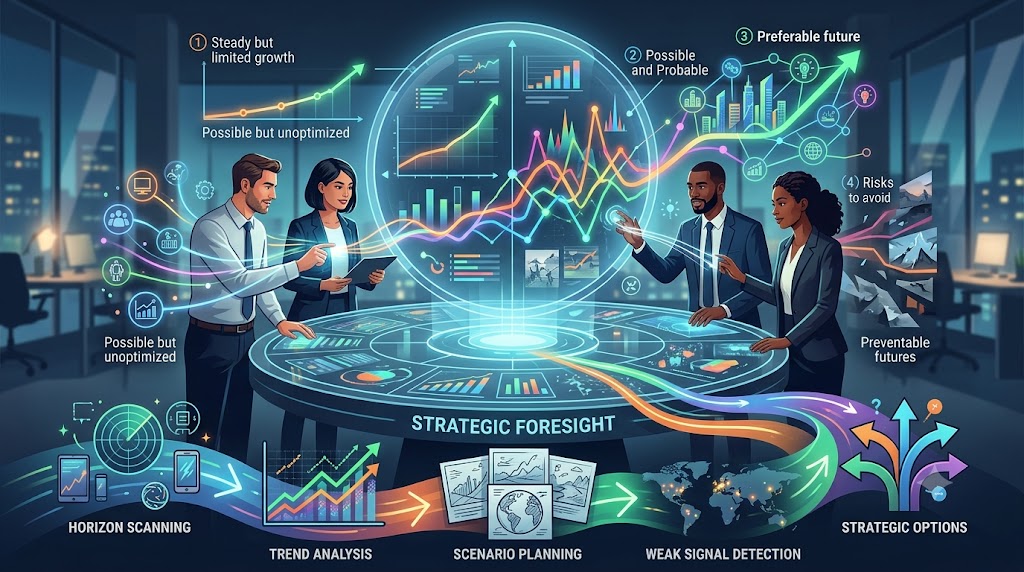
Scenario planning — associated particularly with Shell Oil’s pioneering work in the 1970s and Pierre Wack’s foundational methodology — is one of the core tools within strategic foresight. A full strategic foresight practice is broader: it includes horizon scanning (systematic monitoring of weak signals across multiple domains), environmental scanning, trend analysis, the identification and exploration of wildcards and discontinuities, and the translation of scenario insights into strategic options and organizational learning.
Scenario planning answers “what might the future look like?” Strategic foresight also asks “what signals tell us which scenario is emerging, what should we do about it now, and what capabilities do we need to build regardless of which future unfolds?”
The Core Methods of Strategic Foresight
Horizon Scanning
Systematic monitoring of signals, trends, and emerging developments across multiple domains — technology, society, economy, environment, politics, values — to identify potential drivers of change before they become mainstream. Horizon scanning is the early warning system of strategic foresight: it surfaces the weak signals that indicate emerging disruptions while there is still time to respond proactively rather than reactively.
Effective horizon scanning is not the same as reading the news. It requires deliberate attention to the edges — the fringe technologies, the minority behaviors, the marginal social movements — that are typically invisible in mainstream information channels but often indicate where the mainstream is heading.
Trend Analysis
The systematic identification and analysis of patterns of change across relevant domains. Unlike market forecasting, which uses trend analysis primarily for quantitative prediction, strategic foresight uses it to understand the driving forces shaping the future landscape and to identify where those forces are stable, accelerating, decelerating, or likely to interact with each other in unexpected ways.
Scenario Development
The construction of multiple, internally consistent narratives about plausible futures — typically built around two or three high-uncertainty, high-impact drivers of change that are selected from the trend and scanning analysis. Each scenario describes a different world that could plausibly emerge, the forces that would drive it, and what it would mean for the organization’s markets, customers, competitors, and capabilities.
Good scenarios are not predictions. They are tools for expanding organizational thinking, stress-testing strategies, and developing the adaptive capacity to navigate uncertainty. The value of scenario planning is not in getting the scenario right — no scenario will match exactly what happens. The value is in the strategic conversations it enables and the organizational learning it produces.
Weak Signal Detection
The identification of early indicators that a potentially significant development may be emerging — before there is enough data for conventional analysis to confirm it. Weak signals are inherently ambiguous and easy to dismiss; the skill of strategic foresight is developing the discipline to take them seriously as potential harbingers of structural change rather than dismissing them as anomalies.
Organizations that act on weak signals — that invest in understanding an emerging technology, entering an adjacent market, or building a new capability before competitive pressure makes it obvious — consistently outperform those that wait for strong signals to confirm what’s already happening.
Strategic Options Development
The translation of foresight insights into concrete strategic options — specific actions, investments, or capabilities that the organization could pursue to improve its position across multiple scenarios. The goal is not to produce a single foresight-informed strategy, but to identify the strategic moves that are robust across the range of plausible futures, the bets that are worth taking even under significant uncertainty, and the signals that would indicate when to accelerate or pivot.
The Four Futures Framework: Possible, Probable, Preferable, and Preventable
One of the most useful frameworks in strategic foresight is the distinction between four types of futures that practitioners work with simultaneously:
Possible futures — everything that could conceivably happen given current understanding of how the world works. Possible futures include low-probability developments that would be highly disruptive if they occurred — technologies that could emerge, geopolitical shifts that could unfold, social changes that could accelerate. Working with possible futures expands organizational thinking and surfaces risks and opportunities that conventional planning ignores.
Probable futures — futures that are likely to occur based on current trends, data, and trajectory analysis. These are the futures that conventional strategic planning focuses on. They provide the baseline against which more speculative possibilities can be evaluated. The limitation of focusing only on probable futures is strategic myopia — optimizing for the most likely scenario while remaining blind to the disruptions that are possible but not yet probable.
Preferable futures — futures that align with the organization’s goals, values, and vision. Strategic foresight is not a passive exercise in predicting what will happen; it is an active discipline of understanding what futures are possible and then taking actions to increase the probability of the ones the organization prefers. Identifying preferable futures and reverse-engineering the actions needed to influence their probability is one of the most strategically valuable applications of foresight.
Preventable futures — undesirable outcomes that the organization seeks to avoid. Understanding preventable futures requires the same horizon scanning and scenario work as understanding positive opportunities, but focused on risk: the technologies that could make the current business model obsolete, the regulatory changes that could constrain operations, the competitive moves that could erode market position. Building resilience against preventable futures is as important as building toward preferable ones.
Why Most Organizations Fail at Strategic Foresight
Strategic foresight is widely acknowledged as valuable and consistently underinvested in. Several structural and cultural patterns account for this gap:
Short-term performance pressure crowds out long-term thinking. Quarterly reporting cycles, annual planning processes, and performance management systems that reward near-term results systematically disadvantage the kind of long-term, ambiguous thinking that strategic foresight requires. Organizations know they should invest in understanding the future; they just can’t find the space to do it when the present is so demanding.
Uncertainty is uncomfortable. Strategic planning provides the psychological comfort of a defined roadmap. Strategic foresight explicitly embraces uncertainty — it produces scenarios and options rather than answers, and this ambiguity is genuinely uncomfortable for leadership teams that prefer clarity. Organizations that can tolerate strategic ambiguity are significantly more capable of effective foresight than those that need to convert uncertainty into certainty before they can act.
Foresight is treated as an event rather than a capability. Many organizations engage in scenario planning once — often triggered by a crisis or major disruption — and then return to conventional strategic planning once the immediate uncertainty has passed. Effective strategic foresight is not an event; it is an ongoing organizational capability, built over time through consistent practice, embedded processes, and leadership behavior that treats the future as a legitimate management concern rather than an occasional topic for off-site retreats.
The tools are perceived as inaccessible. Strategic foresight has historically been practiced by specialist consulting firms, government think tanks, and dedicated foresight units at large organizations. The perception that it requires specialist expertise, significant time investment, and resources available only to large organizations has kept it out of reach for most leadership teams — even when they recognize its value.
FutureHacking™: Making Strategic Foresight Accessible
The primary limitation I observed in two decades of helping organizations think about the future was not a lack of interest in strategic foresight — it was a lack of accessible, practical tools that made it possible for normal leadership teams, without specialist foresight expertise, to engage in genuine futures thinking as a regular part of their strategic work.
That limitation is what FutureHacking™ was designed to address. FutureHacking™ is a structured methodology — built around a set of visual, collaborative tools including FutureSignals™, NowBuilder™, and FutureCanvas™ — that makes the core practices of strategic foresight accessible to cross-functional leadership teams without requiring specialist foresight expertise.
The methodology follows four steps:
- Scan — systematically identify the weak signals and emerging trends that may indicate significant future change in your environment
- Analyze — assess the potential impact and uncertainty of the most significant signals, and identify the driving forces most likely to shape your future landscape
- Prototype — build visual representations of multiple plausible futures, exploring what each would mean for your organization, your markets, and your customers
- Act — identify the strategic options available now, the actions worth taking regardless of which future emerges, and the signals that would indicate when to accelerate specific bets
The goal is not to turn every leadership team into professional futurists. It is to give them enough structured futures thinking to make materially better strategic decisions — to expand their range of preparation, identify the weak signals that matter before competitors do, and build the adaptive capacity that lets them respond to uncertainty with confidence rather than surprise.
Frequently Asked Questions About Strategic Foresight
What is strategic foresight?
Strategic foresight is the practice of systematically exploring multiple possible futures in order to make better decisions and take more effective actions in the present. It combines methods from futures studies — scenario planning, horizon scanning, weak signal detection, trend analysis — with the strategic management discipline of translating insight into organizational action. Unlike strategic planning, which typically optimizes for a single expected future, strategic foresight explicitly embraces uncertainty, building strategies that are robust across a range of plausible futures rather than brittle to unexpected change.
What is the difference between strategic foresight and scenario planning?
Scenario planning is one of the core tools within strategic foresight, but a full strategic foresight practice is broader. Strategic foresight includes horizon scanning, weak signal detection, trend analysis, the development of strategic options across multiple scenarios, and the ongoing organizational capability to monitor emerging signals and update strategy accordingly. Scenario planning answers “what might the future look like?” Strategic foresight also asks “what signals tell us which scenario is emerging, what should we do now, and what capabilities do we need regardless of which future unfolds?”
How is strategic foresight different from forecasting?
Forecasting uses quantitative methods to predict future states of specific variables — revenue, market share, demand — within a defined, relatively stable context. It works well when underlying dynamics are understood and stable. Strategic foresight explicitly addresses the limitations of forecasting by embracing rather than suppressing uncertainty. Rather than predicting a single most-likely future, it builds scenarios spanning the range of plausible futures, identifies signals of which scenario is emerging, and prepares organizations to respond to any of them. The two are complementary: forecasting for near-term planning within defined parameters, foresight for navigating structural uncertainty and genuine discontinuity.
What are the main methods used in strategic foresight?
The core methods of strategic foresight include horizon scanning (systematic monitoring of weak signals and emerging developments across multiple domains), trend analysis (identifying patterns of change and their driving forces), scenario development (building multiple internally consistent narratives about plausible futures), weak signal detection (identifying early indicators of potentially significant developments before they become mainstream), and strategic options development (translating foresight insights into concrete actions and investments that are robust across multiple scenarios).
How can organizations build strategic foresight capability?
Building strategic foresight capability requires three things: regular practice (treating futures thinking as an ongoing management discipline rather than a one-time event), accessible tools and frameworks that make structured futures thinking possible for leadership teams without specialist expertise, and leadership behavior that treats long-term uncertainty as a legitimate management concern rather than a distraction from near-term execution. FutureHacking™ — Braden Kelley’s structured foresight methodology — is designed specifically to provide the tools and framework that make strategic foresight accessible to cross-functional leadership teams, enabling genuine futures thinking without requiring specialist foresight consultants.
Ready to bring strategic foresight into your organization’s strategy process? Learn more about FutureHacking™ →
FutureHacking™ Is Coming
FutureHacking™ is Braden Kelley’s strategic foresight methodology — and a paid download and training program is launching soon. Register your interest now to be the first to know when it’s available, and get early access pricing.
Image credits: Google Gemini
Content Authenticity Statement: The topic area, key elements to focus on, etc. were decisions made by Braden Kelley, with a little help from Claude and Google Gemini to clean up the article, add images and create infographics.
 Sign up here to get Human-Centered Change & Innovation Weekly delivered to your inbox every week.