Another AI Soft Landing Scenario Exploration
LAST UPDATED: June 7, 2026 at 11:44 AM
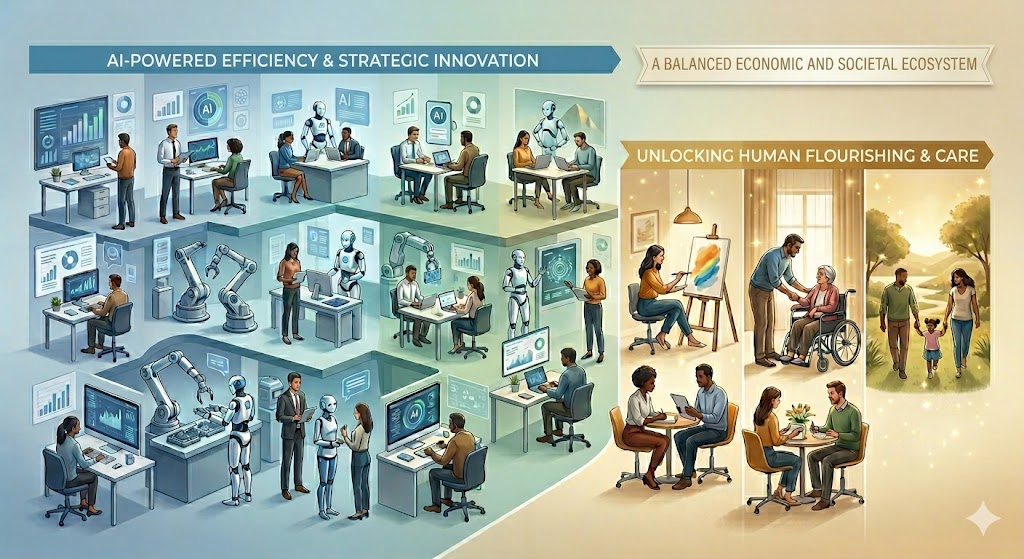
by Braden Kelley and Art Inteligencia
But artificial intelligence may finally force a different outcome — not because organizations suddenly become altruistic, but because the social, demographic, and economic pressures become impossible to ignore.
We’ve looked at some of these potential outcomes in the previous articles in this series:
- The Victorian Hypothesis: Exploring a return to artisanal value and the “Human Premium.”
- The Human Premium Renaissance: Economic value will migrate to the “biological origin” — the hand-carved, the human-thought, and the uniquely flawed.
- The AI New Deal: Government as the employer of first resort.
- The Micro-Enterprise Explosion: Entrepreneurship or bust?
- Cognitive Enhancement and the Augmented Worker: Exploring the neurological frontier.
- Founding an American AI Sovereign Wealth Fund: The Digital Commons Dividend.
- The Coming Tribal Fragmentation: City-States and the Patchwork Polity.
So, what if AI doesn’t create a permanent unemployment crisis? What if instead it accelerates the transition from a five-day workweek to a three-day one?
I. The Doom Narrative Assumes Productivity Gains Must Eliminate Workers
A. The Dominant Fear
Most AI displacement narratives operate under a rigid assumption: companies maximize efficiency, workers become redundant, structural unemployment rises, wealth concentrates further, and governments fail to respond. While this scenario is entirely plausible, it is by no means inevitable.
B. The Hidden Assumption
The flaw underneath most AI doom scenarios is the belief that productivity gains must translate directly into workforce reduction. Historically, however, societies have routinely converted massive productivity leaps into reduced labor hours rather than mass unemployment. Consider the precedents:
- The structural decline from 70-hour industrial workweeks
- The cultural and legal emergence of the weekend
- The institutionalization of paid vacations and overtime protections
- The establishment of standardized parental leave
Key Takeaway: The future of work is a socially negotiated outcome, not a technologically predetermined fate.
II. AI May Create Too Much Productivity for the Existing Work Model
A. The Coming Efficiency Shock
AI systems are moving past simple automation and are beginning to rapidly compress core operational layers: analysis, content generation, software development, coordination, research, customer support, and administrative work. Organizations will soon face a stark realization: the exact same operational output can now be achieved with dramatically fewer labor hours.
B. The Problem Companies Will Face
Initially, standard corporate reflex will drive many firms to pursue predictable paths: reducing headcount, intensifying output expectations, or chasing unlimited scaling. However, this traditional playbook triggers severe second-order consequences that are difficult to manage:
- Acute workforce burnout and collapsing employee engagement
- Severe political backlash and regulatory scrutiny
- A structural drop in consumer demand and widespread social instability
The Economic Paradox: A society cannot sustain mass productivity if its citizens lack the purchasing power, meaning, or time required to participate in civic life and fuel the consumer economy.
III. The Demographic Crisis Changes the Equation
A. Aging Populations
Many advanced economies are already hitting a structural wall, facing an unprecedented convergence of declining birth rates, aging populations, acute caregiving shortages, and shrinking workforce participation. The industrial-era assumption of an endless, expanding supply of labor hours is no longer viable.
B. AI Creates an Opportunity
Rather than triggering mass displacement, AI arrived precisely when societies needed a pressure valve. The technology offers an opportunity to maintain or increase economic output while allowing humans to claw back time for essential, non-automated societal pillars:
- Family caregiving and intergenerational support
- Early childhood and continuing education
- Active community participation and local stewardship
- Personal health, wellness, and lifelong learning
The Strategic Pivot: The central economic question of the AI era shifts from “How do we maximize labor?” to “How do we maximize societal resilience?”
IV. The Transition Won’t Arrive All At Once
A. The Early Adopters
The shift away from the traditional schedule will begin unevenly across the economic landscape. Knowledge-intensive industries — where cognitive load is high and AI integration is easiest — will serve as the testing ground. These sectors will likely pioneer the transition in waves:
- Moving first to compressed four-day workweeks
- Transitioning to explicit 30-hour structural caps
- Evolving ultimately toward pure, outcome-based work models
B. Competitive Pressure Reverses
In the initial phase of AI adoption, companies will compete fiercely on raw productivity and margin expansion. However, once that baseline efficiency becomes commoditized, the battlefield shifts. Top-tier talent will no longer optimize for salary alone; they will flock to organizations offering time autonomy, flexibility, and protection against cognitive overload. Corporate sustainability, retention, and the human experience will become the ultimate competitive advantages.
C. Governments Eventually Incentivize the Shift
As the workplace changes, public policy will have to evolve to stabilize the labor market. Rather than relying on radical disruptions like Universal Basic Income (UBI) or a post-work utopia, states are more likely to deploy targeted regulatory mechanisms to catalyze labor-sharing structures:
- Progressive payroll tax reforms favoring reduced-hour employers
- Tax credits for dedicated caregiving time
- Direct fiscal incentives for standardizing shortened workweeks
- Targeted AI productivity taxes to offset workforce transitions
The Operational Reality: This transition is not about a sudden, revolutionary end to labor. It is a structured, gradual redistribution of time designed to keep the economic engine balanced.
V. The Real Transformation Is Cultural
A. Society Equates Work With Worth
The most formidable barrier to a shortened workweek isn’t economic or technological — it is deeply psychological. Modern societies have spent generations conditioning individuals to anchor their identity, social status, and self-worth entirely to their professional productivity. Stripped of the traditional five-day grind, many people face a sudden existential void, simply because they do not know who they are outside the context of their labor.
B. AI Forces a New Question
As machines increasingly master optimization, pattern recognition, and routine cognitive tasks, the definition of valuable human contribution must pivot. Human value will detach from mere administrative throughput and re-center around uniquely human capabilities:
- Radical creativity and abstract conceptualization
- Deep relational empathy and emotional intelligence
- Environmental and organizational stewardship
- Collaborative meaning-making and proactive community building
The Core Challenge: The ultimate test of the AI era is existential: Can our social institutions redefine human purpose and self-worth before the pace of technological disruption outpaces our psychological adaptation?
VI. The Risks and Tensions
A. Unequal Access and the Digital Divide
The transition to a three-day workweek will not be distributed evenly at the start. Highly optimized knowledge workers, affluent nations, and AI-native industries will likely capture these time dividends first. Meanwhile, frontline, service, and manual labor sectors could face a starkly different reality: intensified labor extraction, gig-economy fragmentation, and deepening economic precarity as legacy structures resist change.
B. The Threat of Hyper-Intensification
There is a distinct danger that organizations will misinterpret efficiency gains. Rather than reducing required hours, many corporate structures will default to demanding vastly more output per hour. If left unchecked, this could transform a potential time dividend into an era of hyper-presenteeism, where the remaining working hours become dense, high-pressure environments that accelerate burnout rather than relieving it.
C. Institutional Inertia and Legacy Leadership
A significant bottleneck to this cultural shift lies within corporate leadership itself. Millions of managers remain culturally and psychologically attached to industrial-era metrics: visibility, seat time, and presenteeism. Overcoming this deeply ingrained management logic will require more than just data; it will likely require a profound generational leadership change across major institutions.
The Operational Risk: Without deliberate guardrails and progressive organizational design, the default trajectory of AI adoption will favor capital concentration over the equitable redistribution of human time.
VII. Why This Represents a “Soft Landing”
A “soft landing” does not mean that technological disruption completely vanishes or that the transition will be entirely frictionless. Instead, it means that society actively chooses to gradually convert AI-driven productivity into time, structural flexibility, systemic resilience, and human flourishing — rather than allowing 100% of the economic gains to accumulate solely as concentrated capital.
In this balanced future state, the core elements of human drive remain intact:
- Humans still work and find fulfillment in solving hard problems
- Professional ambition and merit still exist and are rewarded
- Innovation and strategic breakthroughs still matter deeply
The fundamental shift is that labor is no longer culturally or economically expected to consume the vast majority of a human life.
The Ultimate Paradigm Shift: AI does not end work. It changes the role work plays in civilization.
Closing Thought
For centuries, human technological progress has been fundamentally measured by a single metric: how much more we could produce. We engineered tools to maximize throughput, optimize supply chains, and squeeze every ounce of efficiency out of the working day.
The artificial intelligence era breaks this linear trajectory. Because the efficiency gains of AI are exponential rather than incremental, they force us to choose between a crisis of human obsolescence or an era of human liberation.
Ultimately, a successful transition means changing our yardstick for civilizational success. The next era of progress should not be measured by how much more humans can produce, but by how much more fully humans are finally allowed to live.
Frequently Asked Questions
1. Will AI actually create a 3-day workweek, or will it just lead to massive layoffs?
While the immediate corporate reflex might be headcount reduction, a purely displacement-driven model creates severe second-order crises, including collapsing consumer demand and intense political backlash. The “Soft Landing” hypothesis argues that social, demographic, and economic pressures—such as an aging global workforce—will force societies to convert AI productivity gains into reduced working hours rather than mass unemployment, mirroring historical shifts like the creation of the 5-day workweek.
2. How does an aging demographic prevent widespread AI unemployment?
Many advanced economies are facing structural labor shortages due to declining birth rates and aging populations. Instead of completely replacing humans, AI-driven automation will act as an economic buffer. It will allow societies to sustain necessary economic output and GDP growth with fewer total human labor hours, freeing up individuals to focus on essential, non-automatable human sectors like family caregiving, community resilience, and continuing education.
3. What is the difference between this transition and Universal Basic Income (UBI)?
Universal Basic Income often implies a “post-work” society where citizens are compensated because their labor is no longer economically viable. The 3-day workweek transition is a model of labor-sharing and time redistribution. In this future, human labor, ambition, and innovation remain central to society, but the productivity dividends of AI are used to purchase time autonomy and reduce cognitive burnout, rather than decoupling humans from work entirely.
EDITOR’S NOTE: This is a visualization of but one possible future. I will be publishing other possible futures as they crystallize in my mind (or as you suggest them for me to explore).
Image credits: Google Gemini
Content Authenticity Statement: The topic area, key elements to focus on, etc. were decisions made by Braden Kelley, with a little help from Google Gemini to clean up the article, add images and create infographics.
 Sign up here to get Human-Centered Change & Innovation Weekly delivered to your inbox every week.