What’s the Difference and Why It Matters
by Braden Kelley and Art Inteligencia
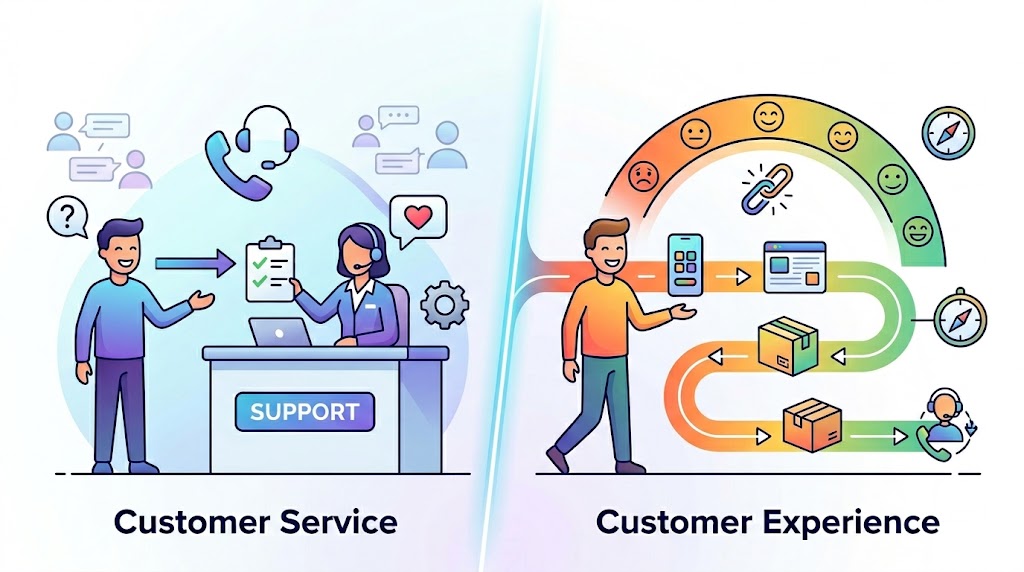
Customer service and customer experience are used interchangeably in most organizations. They are not the same thing — and the confusion between them is costing organizations significant competitive ground.
When leaders conflate customer service with customer experience, they make a predictable set of investment mistakes: they pour resources into contact center optimization while ignoring the upstream experience failures that are generating the contacts; they measure satisfaction at service touchpoints while missing the cumulative journey experience that determines loyalty; and they try to compensate for poor product, onboarding, and process experiences with better service recovery — an expensive and ultimately losing strategy.
Understanding the difference between customer service and customer experience is not semantic. It determines where you look for problems, where you invest for improvement, and how you measure whether you are winning or losing on the dimension that drives customer retention and revenue growth.
What is Customer Service?
Customer service is the direct assistance and support an organization provides to customers before, during, and after a purchase — the interactions where customers seek help, ask questions, resolve problems, or make requests. It is reactive by nature: a customer has a need or a problem, and customer service responds to it.
Customer service touchpoints include:
- Support calls and chat interactions
- Technical help desk and troubleshooting
- Billing inquiries and disputes
- Returns and complaints handling
- In-store associate interactions
- Onboarding assistance and training
- Account management touchpoints
Customer service is critically important — 99% of consumers say customer service influences their buying decisions, with 74% rating it “very important or essential.” But it is one component of the total customer experience, not a synonym for it.
What is Customer Experience?
Customer experience (CX) is the sum total of every interaction, perception, and emotion a customer has with an organization across the entire relationship — from first awareness through purchase, use, service, renewal, and advocacy. It is the holistic impression customers carry of your organization, shaped by every touchpoint they encounter, whether those touchpoints involve a human being or not.
Customer experience encompasses:
- How easy it is to discover and evaluate your product or service
- How smooth and confidence-building the purchase process is
- How effective onboarding is at helping customers achieve value quickly
- How intuitive and reliable the product or service is in daily use
- How well the brand communicates proactively — not just when something goes wrong
- How effectively customer service handles the moments when problems arise
- How renewal and expansion conversations feel — transactional or relational
- The cumulative emotional impression that determines whether a customer recommends you
Customer service is a component of customer experience — a critically important one, but only one. 81% say customer service is the #1 decision factor, ahead of brand image and ethical commitments — but that figure reflects how much service recovery matters when things go wrong, not that service alone constitutes the full experience.
The Key Differences: Customer Service vs Customer Experience
| Customer Service | Customer Experience | |
|---|---|---|
| Scope | Specific touchpoints where customers seek help | The entire relationship across all touchpoints |
| Nature | Primarily reactive — responding to customer needs | Proactive and reactive — designing the full journey |
| Ownership | Customer service / support team | Entire organization — every function contributes |
| Measurement | CSAT, FCR, handle time, resolution rate | NPS, CLV, churn rate, share of wallet, advocacy |
| When it matters | When something goes wrong or a customer needs help | At every moment of the relationship |
| Investment focus | People, training, tools, processes for support | Journey design, product, onboarding, culture, service |
| Goal | Resolve issues efficiently and satisfactorily | Build lasting loyalty and advocacy |
Why the Distinction Matters in Practice
Mistake 1: Investing in service to compensate for experience failures
The most expensive and common mistake organizations make is treating customer service as the primary lever for improving customer satisfaction — throwing more people, better training, and faster response times at problems that are being caused upstream by poor product design, broken onboarding, or friction-laden processes.
56% of customers leave quietly without filing a complaint — meaning the majority of customers who have poor experiences never reach your service team at all. They simply leave. A world-class service organization cannot retain customers whose experience has already failed them at touchpoints service never sees.
The organizations that achieve the lowest service volumes are not those with the best service teams — they are those with the best-designed experiences. When the product works reliably, onboarding is effective, and processes are frictionless, the service team handles exceptions rather than managing a continuous flow of avoidable contacts.
Mistake 2: Measuring service satisfaction as a proxy for experience quality
CSAT scores at service touchpoints measure how well a specific interaction was handled. They do not measure whether the customer’s overall experience is building loyalty, driving advocacy, or protecting revenue. A customer can give a service interaction a 5-star rating and still churn — because the experience that led them to need service was frustrating, because the product isn’t delivering the value they expected, or because a competitor’s experience simply requires less effort overall.
Companies that prioritize customer experience generate 4–8% higher revenue than competitors — not companies with the best service scores. The financial return is in the total experience, not the service component alone.
Mistake 3: Assigning experience ownership to the service team
Customer experience is everyone’s responsibility — product, marketing, sales, operations, technology, and service all contribute to it. When experience ownership is assigned to the customer service team, two things happen: the service team gets blamed for experience failures they didn’t cause and can’t fix, and the functions that actually cause those failures have no accountability for them.
Excellent customer experience requires cross-functional alignment around the customer journey — a shared understanding of where the experience is strong and weak, and shared accountability for improving it. This cannot be owned by a single team.
How Customer Service and Customer Experience Work Together
The relationship between customer service and customer experience is not competitive — it is hierarchical. Customer experience is the broader strategic objective; customer service is one of its most important execution components.
When customer experience is designed well, customer service operates in a context that supports excellent outcomes:
- Fewer contacts because the experience is designed to prevent avoidable problems
- More context because the service team has visibility into the customer’s full journey (via Customer Journey Mapping), not just the current interaction
- Higher recovery rates because a strong positive experience baseline means a single service failure is easier to recover from
- Greater loyalty impact because excellent service within an already-excellent experience reinforces commitment rather than merely repairing damage
Over 85% of customers say they’re more loyal to a company if customer service is consistently improved, and 87% say they’re more loyal with fast, effective customer service. These numbers represent the ceiling of what excellent service can contribute to loyalty — and they are only achievable when service operates within a well-designed overall experience, not in isolation from it.
The Role of Each in a Complete Customer Strategy
Customer service strategy should focus on: speed and accessibility of support across channels; first contact resolution rates and escalation reduction; agent empowerment to resolve issues without unnecessary process friction; proactive outreach at high-risk moments in the customer journey; and service recovery processes that go beyond adequate resolution to genuine relationship repair.
Customer experience strategy should focus on: mapping and designing the full customer journey across all touchpoints; identifying and closing the experience gaps that generate avoidable contacts, drive churn, and suppress loyalty; aligning all functions around shared experience standards and accountability; building the measurement infrastructure to track experience quality continuously; and investing in the specific moments of truth that have the greatest impact on customer loyalty and revenue.
The two strategies are most powerful when they are integrated — when the experience strategy defines the journey that the service strategy supports, and when service insights inform the experience improvements that reduce contact volume and improve overall satisfaction.
How an Experience Audit Addresses Both
A customer experience audit examines both dimensions — evaluating the full customer journey to identify the experience failures generating service contacts and driving churn, while also assessing how well service touchpoints are performing within the broader journey context.
This dual lens is what distinguishes an experience audit from a service quality review. A service review evaluates how well the service team is performing. An experience audit evaluates whether the experience your customers have with your organization — including but not limited to service — is competitive, loyalty-building, and revenue-protecting.
The result is a complete picture of where the experience is falling short of competitive standards, prioritized by revenue impact — giving leaders the insight they need to invest in the right improvements rather than optimizing one component of the experience while missing the failures that matter most.
Frequently Asked Questions: Customer Service vs Customer Experience
What is the difference between customer service and customer experience?
Customer service is the direct assistance and support an organization provides to customers at specific moments — typically when customers seek help, ask questions, or resolve problems. It is reactive and owned by a specific team. Customer experience is the sum total of every interaction, perception, and emotion a customer has with an organization across the entire relationship — from first awareness through purchase, use, service, renewal, and advocacy. Customer service is one component of customer experience. Investing in excellent customer service while neglecting the broader experience is one of the most common and expensive mistakes in customer strategy.
Is customer service part of customer experience?
Yes — customer service is one component of customer experience, but not a synonym for it. Customer experience encompasses every touchpoint a customer has with an organization, including product and service quality, onboarding, digital and physical channel interactions, communications, billing, renewal conversations, and service recovery. Customer service specifically refers to the assisted support interactions where customers seek help or resolution. Excellent customer service contributes significantly to overall customer experience quality, but a strong service team cannot compensate for experience failures in other parts of the journey.
Which is more important — customer service or customer experience?
Customer experience is the broader strategic objective of which customer service is a critical component — so the question is less about which is more important and more about understanding that they operate at different levels. That said, organizations that invest in improving the overall customer experience — not just the service component — consistently generate greater financial returns. Companies that prioritize customer experience generate 4–8% higher revenue than competitors. The organizations that achieve the best results treat customer service excellence and customer experience design as complementary investments, not competing priorities, and competitive experience benchmarking can help you measure your performance.
Who owns customer experience in an organization?
Customer experience should be owned by the entire organization — every function that touches the customer journey contributes to it. In practice, accountability is often assigned to a Chief Customer Officer, Chief Experience Officer, or Chief Marketing Officer, with cross-functional governance to ensure that product, operations, technology, and service teams are all aligned around shared experience standards. Assigning experience ownership exclusively to the customer service team is one of the most common organizational mistakes — it holds the service team accountable for failures they didn’t cause and can’t fix alone, while allowing other functions to operate without accountability for their contribution to the customer experience.
How do you measure customer experience vs customer service?
Customer service is typically measured through transactional metrics: Customer Satisfaction Score (CSAT) at service touchpoints, First Contact Resolution (FCR) rate, average handle time, and escalation rates. Customer experience is measured through relationship metrics: Net Promoter Score (NPS), customer lifetime value (CLV), churn rate, share of wallet, and advocacy rates. The key distinction is that service metrics measure how well specific interactions are handled, while experience metrics measure the cumulative relationship outcome that determines revenue and retention. Both are necessary — but organizations that only measure service metrics are missing the broader experience signals that predict revenue performance.
Want to understand how both customer service and customer experience are performing in your organization? Learn more about the Experience Audit →
Content Authenticity Statement: The topic area, key elements to focus on, etc. were decisions made by Braden Kelley, with a little help from Claude and Google Gemini to clean up the article, add images and create infographics.
Image credits: Google Gemini
 Sign up here to get Human-Centered Change & Innovation Weekly delivered to your inbox every week.