Another AI Soft Landing Scenario Exploration — The Digital Commons Dividend
LAST UPDATED: May 23, 2026 at 10:32 PM
by Braden Kelley and Art Inteligencia
- The Victorian Hypothesis: Exploring a return to artisanal value and the “Human Premium.”
- The Human Premium Renaissance: Economic value will migrate to the “biological origin” — the hand-carved, the human-thought, and the uniquely flawed.
- The AI New Deal: Government as the employer of first resort.
- The Micro-Enterprise Explosion: Entrepreneurship or bust?
- Cognitive Enhancement and the Augmented Worker: Exploring the neurological frontier.
I. Introduction: The Silent Enclosure of the Digital Commons
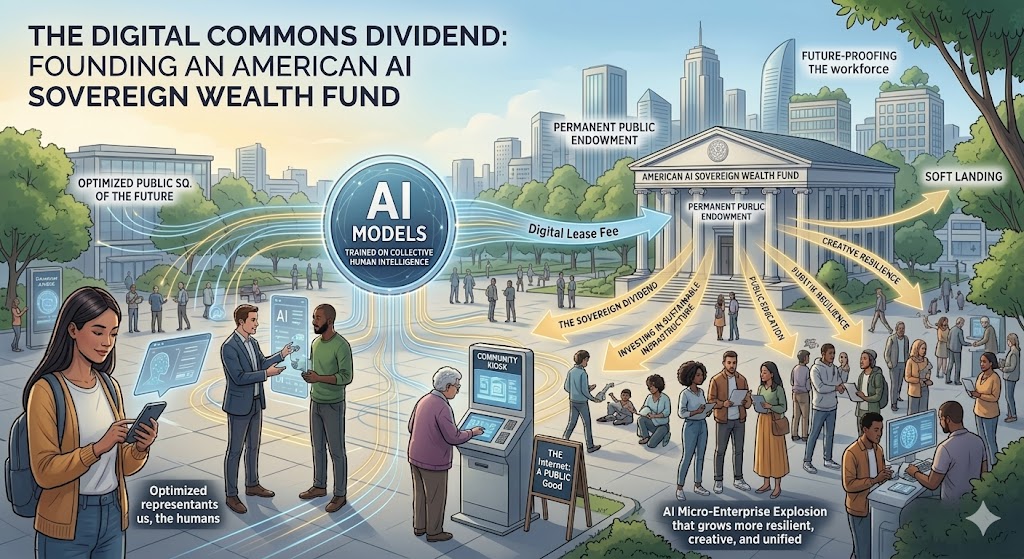
The modern internet was built as a decentralized, public town square — a collective monument to human knowledge, cultural expression, and daily creativity. For decades, billions of individuals contributed their thoughts, art, code, and conversations under the shared assumption that they were participating in a living global community. Today, however, this vast digital landscape is being quietly enclosed and mined as the ultimate raw material for proprietary corporate infrastructure.
Large Language Models and generative AI systems do not exist in a vacuum. They are entirely dependent on the cumulative output of humanity; they cannot think, synthesize, or generate without the foundation of our collective history. As tech enterprises rapidly financialize this knowledge, we face a fundamental imbalance: the data is ours, but the immense financial dividend is theirs alone.
Rather than chasing this paradigm with endless, stagnant copyright litigation or choking progress with reactive, heavy-handed regulation, America needs a proactive framework of economic experience design. We must establish an American AI Sovereign Wealth Fund. By shifting the model from unchecked data extraction to a structured public lease agreement, we can transform corporate data consumption into a permanent public endowment that ensures human innovation and economic stability go hand in hand.
III. The Mechanism: From “Data Scraping” to “Model Leasing”
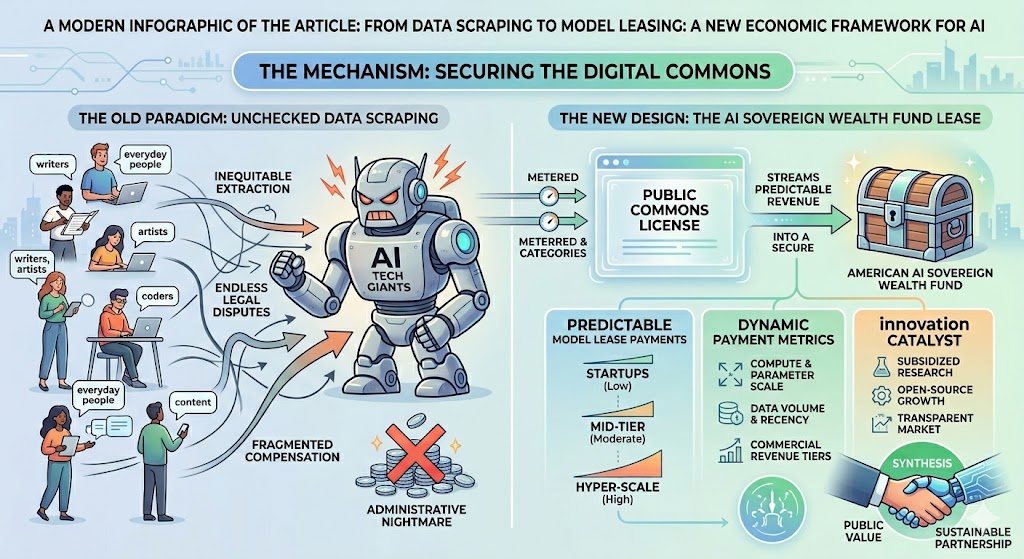
Trying to protect the digital commons by paying individual users micro-cents for every tweet, review, or article is an administrative nightmare and a functional dead end. The value of human data does not reside in a single isolated post; it emerges from the collective synthesis of the entire public web. Therefore, the regulatory mechanism must treat the public web as a unified national asset, shifting the paradigm from transactional data purchasing to a systemic “Model Leasing” framework.
Under this design, any enterprise operating commercial AI models within the United States would be required to secure a Public Commons License. Instead of a one-time purchase of static datasets, this license functions as an ongoing lease. The lease payments would be structured dynamically to mirror the scale of the extraction, scaling across clear, predictable metrics:
- Compute and Parameter Scale: Higher baseline fees for frontier models requiring massive infrastructure and massive ingestion footprints.
- Data Volume and Recency: Fees tied to the continuous scraping and integration of real-time human data feeds.
- Commercial Revenue Tiers: A sliding scale ensuring that monetized enterprise AI platforms contribute proportionally to their commercial success.
Crucially, this framework is designed to foster innovation rather than stifle it. By creating a transparent, predictable cost structure, we can offer low-cost or subsidized lease tiers for academic research, open-source developers, and early-stage startups. The heaviest financial responsibility will naturally rest on the hyper-scale tech giants who are driving the most aggressive commercialization of human output, turning a chaotic regulatory battlefield into a structured, reliable market mechanism.
IV. Designing the American AI Sovereign Wealth Fund
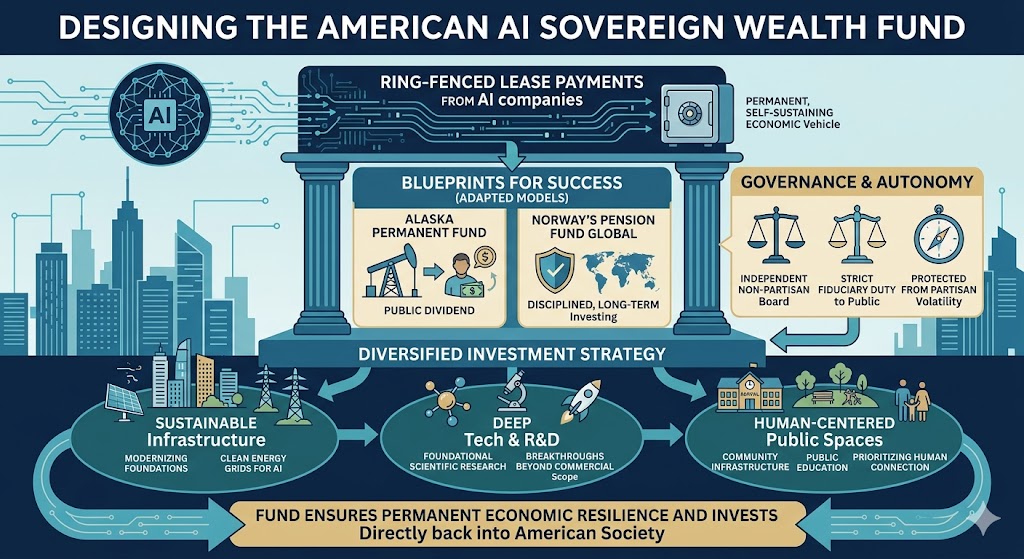
An innovative revenue mechanism is only as effective as the architecture built to manage it. The digital lease payments collected from AI operators cannot simply disappear into the general federal budget to patch short-term deficits. Instead, they must be funneled directly into a dedicated, ring-fenced economic vehicle: the American AI Sovereign Wealth Fund. This fund will transform the temporary, fast-moving revenues of the technology boom into a permanent, self-sustaining financial legacy for all citizens.
While the United States has never established a national-level wealth fund, we have highly successful, battle-tested blueprints to draw from. The Alaska Permanent Fund has successfully turned non-renewable oil wealth into a continuous public dividend for decades, while Norway’s Government Pension Fund Global demonstrates how disciplined, long-term global investing can secure the financial future of an entire nation. The American AI Sovereign Wealth Fund will adapt these principles for the intangible, fast-growing digital asset class.
To protect the fund from political volatility and short-term legislative maneuvering, it must be established as an autonomous institution. It will be managed by an independent, non-partisan board of professionals with a strict fiduciary duty to the American public. The fund’s investment strategy will be diversified across a broad spectrum of resilient assets, including:
- Sustainable Infrastructure: Directing capital into modernizing the physical foundations of the country, including clean energy grids capable of supporting next-generation computing.
- Deep Tech and R&D: Investing in foundational scientific research and breakthroughs that lie outside the immediate commercial scope of venture capital.
- Human-Centered Public Spaces: Funding physical community infrastructure, public education, and parks to ensure that a digital-first economy still prioritizes tangible human connection.
By building a robust, independent investment engine, the fund ensures that the immense wealth generated by AI efficiency is compound-invested directly back into the fabric of American society, establishing a foundation of permanent economic resilience.
V. The Human-Centered Dividend: Navigating the Great American Contraction
As artificial intelligence scales, it will fundamentally reorder the relationship between capital, productivity, and human labor. We are entering an era of unprecedented efficiency, yet this transition brings the distinct challenge of structural labor shifts — a phase of economic recalibration where traditional employment models will face intense pressure. In this environment, corporate productivity will skyrocket, but the traditional mechanism for distributing that wealth through 40-hour workweeks will become heavily disrupted.
The American AI Sovereign Wealth Fund is designed to serve as the critical macroeconomic cushion for this transition. The financial returns generated by the fund will be distributed directly to citizens as a Sovereign Dividend. It is vital to frame this payout correctly: this is not a welfare program or a government handout. It is a rightful return on investment for the citizen-creators whose collective human intelligence, data, and cultural history built the foundational engine of the entire AI economy. It treats the American public as shareholders in the technological future they co-created.
By providing a reliable, baseline dividend, we can orchestrate a “soft landing” that prevents widespread economic precarity. Instead of leaving individuals stranded by automation, this human-centered dividend provides the financial security needed to spark an explosion of grass-roots entrepreneurship. When citizens are unburdened from survival-level economic anxiety, they are empowered to take risks — funding local services, launching specialized consultancies, and building micro-enterprises. This safety net transforms a threat of labor contraction into an expansion of human creativity, allowing individuals to focus on what they do best: innovate, care for one another, and design unique human experiences.
VI. Conclusion: A New Social Contract for the Synthesized Age
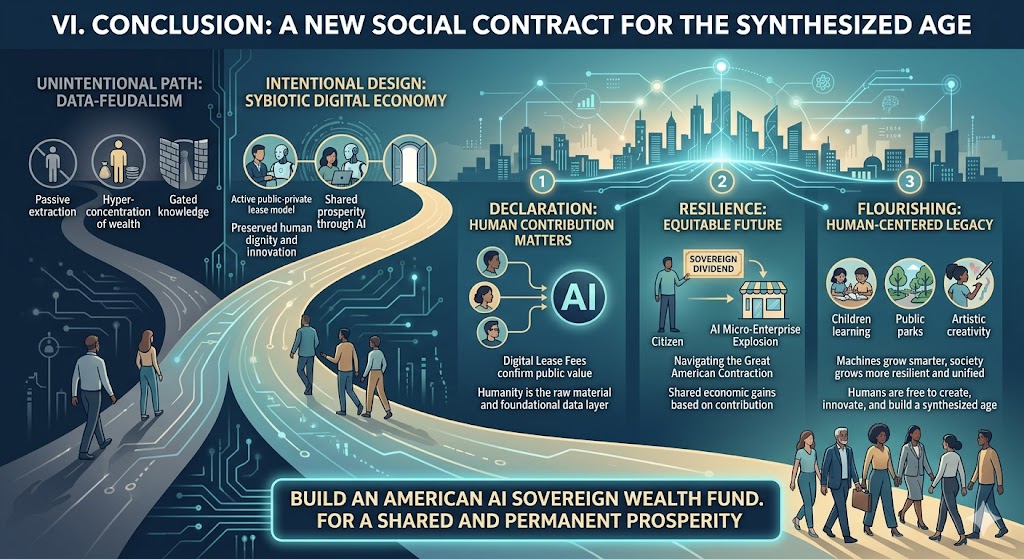
We stand at a critical crossroads in the evolution of the digital economy. The rapid maturation of artificial intelligence has made it clear that the passive laissez-faire approach to data extraction is no longer sustainable. We can either slide quietly into a hyper-concentrated system of data-feudalism — where a handful of corporate entities gatekeep and monetize the synthesized sum of human knowledge — or we can intentionally design a system where technological progress directly funds human flourishing.
The creation of an American AI Sovereign Wealth Fund funded by model lease agreements is not a radical departure from American economic tradition; it is its logical evolution. It recognizes that innovation thrives when public assets are respected, valued, and paid for. By establishing this fund, we declare that human contribution is foundational, permanent, and worthy of equitable compensation.
As our machines grow smarter and more capable, our primary focus must remain on ensuring our society grows more resilient, unified, and creatively alive. By building this new macroeconomic bridge, we can navigate the structural shifts of the coming decades with confidence, transforming the immense promise of the AI era into a lasting, human-centered legacy that lifts up every single citizen who helped build it.
Frequently Asked Questions
1. Why should AI companies pay to use public internet data?
The modern internet is a public good built on government-funded infrastructure and decades of collective human contribution. AI models cannot generate value without training on the billions of articles, photos, and open-source code blocks created by real people. Just as a mining company pays a lease to extract minerals from public land, AI companies should pay a digital lease fee to extract value from the public digital commons.
2. Will a “Model Leasing” framework crush tech innovation?
No. The lease framework is designed to be tiered and predictable, specifically protecting early-stage startups and open-source developers. Subsidized or low-cost license tiers will ensure that academic research and grassroots innovation thrive, while the heaviest financial responsibility falls on hyper-scale tech giants who are generating massive commercial revenues directly from human data extraction.
3. How is the Sovereign Dividend different from traditional welfare?
The Sovereign Dividend is not a handout; it is a rightful return on investment. Because every citizen’s collective data and cultural history formed the foundational training material for AI, the American public acts as the foundational shareholders of the AI economy. Payouts from the fund are corporate-backed dividends reflecting the value of what humanity co-created.
EDITOR’S NOTE: This is a visualization of but one possible future. I will be publishing other possible futures as they crystallize in my mind (or as you suggest them for me to explore).
Image credits: Google Gemini
Content Authenticity Statement: The topic area, key elements to focus on, etc. were decisions made by Braden Kelley, with a little help from Google Gemini to clean up the article, add images and create infographics.
 Sign up here to get Human-Centered Change & Innovation Weekly delivered to your inbox every week.