Designing a Frictionless World
LAST UPDATED: May 22, 2026 at 4:59 PM
GUEST POST from Art Inteligencia
The Hidden Friction in Connected Ecosystems
While the Internet of Things (IoT) promises a fully interconnected world, traditional deployments consistently hit a hard wall of operational friction: battery lifecycles, replacement logistics, and mounting e-waste. This infrastructure overhead creates a subtle but persistent cognitive load and operational anxiety for organizations, ultimately limiting the true scale of digital transformation.
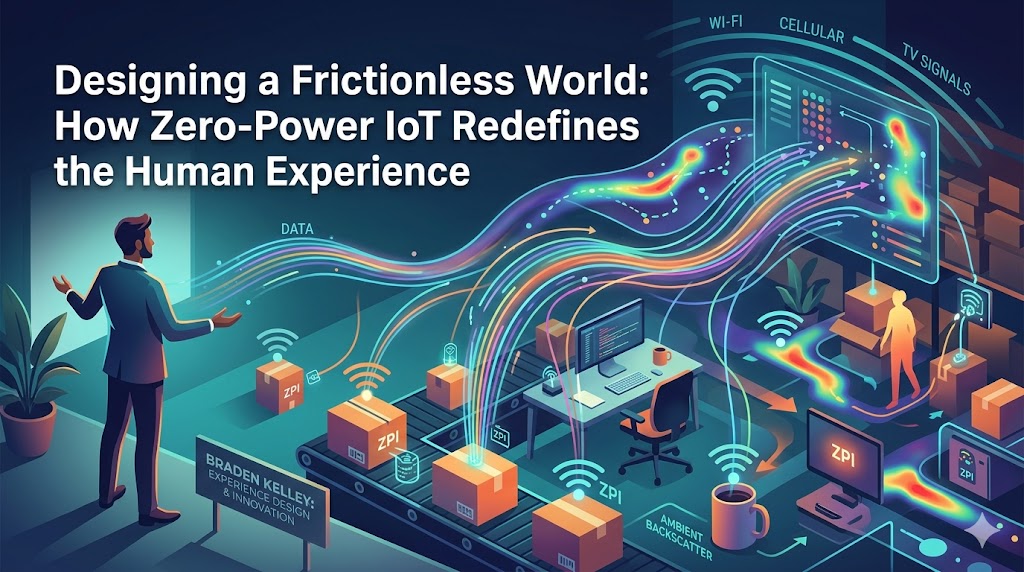
Ambient backscatter communication completely solves this friction point. By allowing tiny, battery-free devices to communicate by reflecting existing, ambient radio waves — such as Wi-Fi, cellular signals, or TV broadcasts — rather than generating their own signals, we enter the era of Zero-Power IoT.
By eliminating the power infrastructure barrier, ambient backscatter transitions IoT from an engineering challenge into a seamless, human-centered experience design tool. It allows us to embed frictionless, self-sustaining intelligence directly into the fabric of our physical world.
1. The Technology Shift: From Active Generation to Ambient Reflection
To truly understand the power of ambient backscatter, it helps to look at a simple analogy. Traditional wireless devices operate like someone trying to signal a friend in the dark using a heavy flashlight — it requires constant, active battery power to generate that beam of light. Ambient backscatter, on the other hand, is like handing that person a tiny mirror. Instead of creating light, they simply catch the sunlight already bouncing around the environment and tilt the mirror to flash a message.
By shifting from active signal generation to passive ambient reflection, we completely remove the constraints of wiring, charging docks, and scheduled maintenance. Devices no longer need to be designed around the size and weight of a battery, unlocking entirely new form factors that can seamlessly blend into physical environments.
This shift also marks a massive win for sustainability. True digital transformation cannot come at the expense of planetary health. By eliminating the need for billions of small, disposable batteries, Zero-Power IoT drastically reduces heavy-metal e-waste and cuts the hidden carbon footprint of our digital infrastructure.
2. The Innovation Angle: Democratizing Data Collection
The real innovation of ambient backscatter isn’t just technical — it is economic and operational. By entirely removing the ongoing maintenance costs and physical labor associated with battery replacement, this technology effectively democratizes data collection. Organizations are no longer forced to strictly ration their IoT deployments based on the long-term operational expense of maintaining them.
This economic shift moves us rapidly away from a world where we only track “premium assets” — like expensive industrial machinery or fleet vehicles — and allows us to embed intelligence into everyday objects. We can now consider adding self-sustaining tracking elements to individual consumer packaging, temporary workspaces, or critical medical supplies moving through a hospital.
When the cost of data collection drops to near-zero, the scale of innovation expands exponentially. Leaders can shift their mindset from simply capturing sporadic, isolated data points to visualizing a continuous, hyper-scale stream of ecosystem health. This unlocks an unprecedented level of visibility into how value actually flows through an organization.
3. Redefining Journey Mapping and Experience Design
From an experience design perspective, the greatest value of Zero-Power IoT is its complete invisibility. Exceptional human-centered design focuses on removing friction, yet traditional data gathering often introduces it — requiring users to scan badges, log inputs, or carry bulky hardware. By embedding ambient backscatter elements directly into workspaces, assets, or packaging, we create an environment of continuous context without requiring a single conscious action from employees or consumers.
This shifts how we approach journey mapping. Traditional journey maps are often static, heavily reliant on retrospective self-reporting, qualitative surveys, or fragmented digital touchpoints. Zero-Power IoT provides an uninterrupted stream of behavioral truth, allowing organizations to construct highly detailed, real-time visual maps of how products and people naturally navigate physical ecosystems.
By capturing these organic interactions without infrastructure overhead, we eliminate the traditional blind spots of experience design. Designers and strategists no longer have to guess where the friction lies in a hospital triage flow, a manufacturing plant floor, or a retail environment — the physical space itself tells the story.
4. Operationalizing the Data: Driving True Digital Transformation
Gathering frictionless data is only half the battle; the true transformation happens when we operationalize it to design highly adaptive, human-centered environments. When physical spaces can continuously interpret movement and asset utilization without battery failure, we move away from static layouts and toward responsive ecosystems. Office spaces, supply chain routing, and retail environments can automatically adjust on the fly to better serve the people moving through them.
As futurists, we can anticipate a profound shift in how humans interact with their surroundings. The environments around us will become “living” systems that organically anticipate human intent. Instead of forcing people to adapt to the rigid constraints of a physical workspace, the workspace dynamically conforms to optimize collaboration, safety, and comfort based on real-time behavioral data.
This creates an incredible co-creation opportunity for cross-functional teams. By uniting experience designers, organizational change leaders, and operations managers around a shared, uninterrupted data loop, organizations can move past guessing games. Together, they can continuously iterate on the human experience, turning real-world feedback into immediate, empathetic design improvements.
Conclusion: A World Without Plugs
The ultimate goal of technology has never been to force human attention toward screens and charging cables, but rather to disappear seamlessly into the fabric of everyday life. As long as our digital transformation strategies remain tethered to battery lifecycles and heavy infrastructure overhead, our ability to design truly empathetic, responsive environments will remain constrained.
Ambient backscatter communication breaks these boundaries wide open. By untethering IoT from the plug and the battery, it fundamentally transforms data collection from a logistically complex utility into a fluid, frictionless design medium.
The call to action for today’s change leaders, experience designers, and innovators is clear: we must look at Zero-Power IoT not merely as an engineering optimization, but as a catalyst for human-centered design. By capturing the unvarnished truth of how people and assets move through the physical world, we unlock the power to build a more intuitive, sustainable, and profoundly adaptive future.
Frequently Asked Questions
What exactly is Ambient Backscatter Communication?
It is a wireless communication method where tiny, battery-free devices transmit data by reflecting existing radio frequency signals (like Wi-Fi, cellular, or TV broadcasts) already present in the environment, rather than generating their own power-hungry radio signals.
How does Zero-Power IoT impact experience design and journey mapping?
By completely removing batteries, these tracking elements become completely invisible and maintenance-free. Experience designers can embed them into packaging, workspaces, and physical assets to build hyper-accurate, continuous, real-time maps of how people and products move without introducing any human friction or self-reporting bias.
Is Ambient Backscatter technology a sustainable choice for digital transformation?
Yes. Traditional IoT deployments require scaling up to billions of small batteries, which creates massive chemical e-waste and heavy operational overhead. Zero-Power IoT eliminates battery lifecycles entirely, aligning organizational agility with sustainable planetary health.
Disclaimer: This article speculates on the potential future applications of cutting-edge scientific research. While based on current scientific understanding, the practical realization of these concepts may vary in timeline and feasibility and are subject to ongoing research and development.
Image credits: Gemini
 Sign up here to get Human-Centered Change & Innovation Weekly delivered to your inbox every week.