LAST UPDATED: April 24, 2026 at 3:13 PM
GUEST POST from Art Inteligencia
I. Introduction: Why Resilience is the New Efficiency
In the modern corporate landscape, innovation is often treated as a fair-weather luxury. When the economy is booming and budgets are flush, organizations invest heavily in “labs,” “incubators,” and “moonshot” projects. However, the moment market volatility strikes or a quarterly earnings miss occurs, these initiatives are frequently the first to be dismantled. This represents a fundamental misunderstanding of innovation’s role in a sustainable enterprise.
The Fragility of Innovation
Most organizations suffer from “Accidental Innovation“ — a state where progress is dependent on individual heroics, specific charismatic leaders, or temporary surplus capital. This fragility creates a “stop-start” cycle that destroys institutional knowledge, demoralizes top talent, and ensures that the organization is always reacting to the future rather than shaping it.
Defining Innovation Resilience
Innovation Resilience is the systemic ability of an organization to maintain its innovation velocity, quality, and impact regardless of internal or external shocks. It is the shift from innovation as a department to innovation as a durable capability. A resilient system doesn’t just survive a crisis; it leverages the pressure to accelerate necessary change.
The Thesis: A Systemic Approach
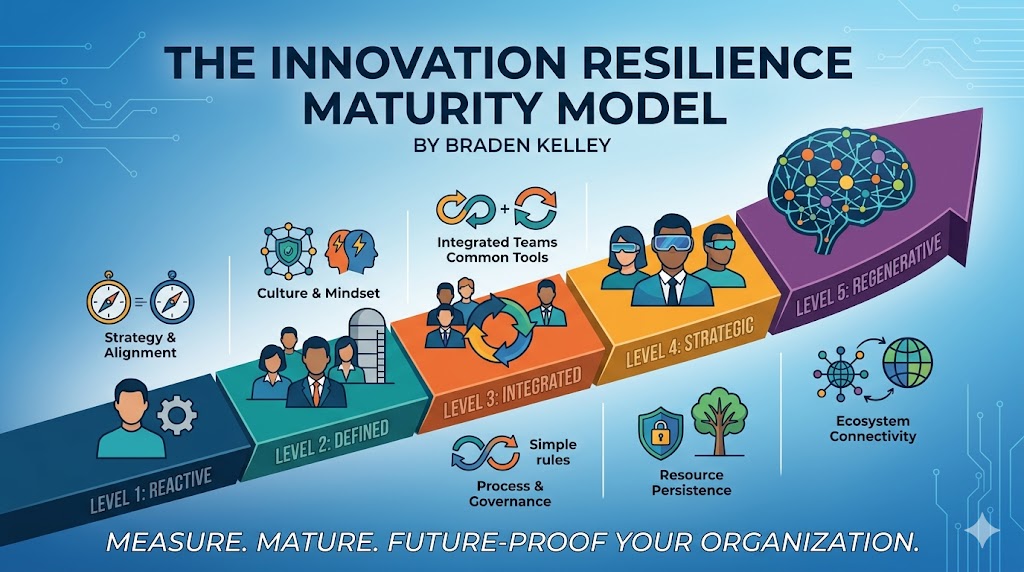
The Innovation Resilience Maturity Model (IRMM) provides a roadmap for this transformation. By moving away from episodic projects and toward a measured, matured capability, leaders can ensure that their organization remains “future-ready.” We must stop asking how much innovation costs and start measuring how much resilience it provides to the total business ecosystem.
II. The Five Pillars of the IRMM
To build an innovation engine that doesn’t stall during a downturn, we must move beyond surface-level aesthetics and focus on five foundational pillars. These dimensions determine the structural integrity of your innovation capability.
1. Strategy & Alignment
Innovation cannot exist as a “side-car” to the business; it must be the engine. Resilient organizations align their innovation portfolio directly with their long-term strategic intent. When innovation is seen as the primary vehicle for achieving corporate goals, it becomes indispensable rather than optional.
2. Culture & Mindset
A resilient culture is built on Psychological Safety and Cognitive Diversity. It requires an environment where failure is viewed as a data point in a larger experiment. Without a mindset that embraces uncertainty, the organization will naturally retreat to the “safe” status quo the moment pressure increases.
3. Process & Governance
Rigid, bureaucratic stage-gate processes are the enemy of resilience. Resilient organizations utilize fluid, data-driven experimental loops that allow for rapid pivoting. Governance should focus on enabling speed and removing friction, rather than acting as a barrier to entry for new ideas.
4. Resource Persistence
Resilience is measured by how talent and funding are protected during lean cycles. This involves creating “protected” innovation budgets or utilizing flexible resource models that allow the organization to scale efforts up or down without losing core institutional knowledge or momentum.
5. Ecosystem Connectivity
No organization is an island. A resilient model leverages a broad network of external partners, startups, academic institutions, and customers. By distributing the “innovation load” across an ecosystem, the organization can share risks, reduce costs, and maintain a pulse on external market shifts.
III. The Maturity Levels: From Reactive to Regenerative
To evolve your organization, you must first identify your current baseline. The Innovation Resilience Maturity Model (IRMM) categorizes organizations into five distinct levels, each defined by how they respond to stress and uncertainty.
Level 1: Reactive (The “Ad-Hoc” Stage)
At this initial level, innovation is sporadic and often chaotic. It is typically driven by a single visionary leader or “hero” within the company. Because there is no formal system, innovation is entirely dependent on the presence of these individuals and the availability of excess time or capital.
Resilience Factor: Extremely Low. If the champion leaves or a budget cut occurs, the innovation “flame” is immediately extinguished.
Level 2: Defined (The “Siloed” Stage)
The organization has recognized the need for innovation and has created dedicated roles or a separate “Innovation Lab.” However, these teams often operate in a vacuum, disconnected from the core business units and the daily P&L realities.
Resilience Factor: Moderate. While the function is documented, it is viewed as an “extra” and is often the first target for cost-cutting during corporate restructuring.
Level 3: Integrated (The “Connected” Stage)
Innovation is no longer a separate island. It is integrated into the business units, with metrics tied directly to departmental KPIs. There is a common language and set of tools (like the Eight I’s of Infinite Innovation) used across the company.
Resilience Factor: High. Because innovation is solving immediate, tangible business problems, it is seen as a vital tool for survival and growth.
Level 4: Strategic (The “Adaptive” Stage)
At Level 4, the organization utilizes strategic foresight and futurology to anticipate market shifts. Innovation is not just about the “now,” but about the “next.” The organization has a “Stable Spine” of operations that allows the rest of the company to be highly flexible and adaptive.
Resilience Factor: Very High. The organization doesn’t just react to change; it pivots ahead of the curve, turning potential disruptions into competitive advantages.
Level 5: Regenerative (The “Antifragile” Stage)
This is the pinnacle of the IRMM. The organization is built to disrupt itself. Innovation is decentralized and embedded in the DNA of every employee. It is a “human-centered” system where everyone is empowered to identify signals of change and act upon them.
Resilience Factor: Absolute. Much like a biological organism, the system actually gains strength and intelligence from stressors and volatility.
IV. Moving Up the Curve: Key Transition Strategies
Scaling the maturity curve is not about doing more of the same; it is about fundamentally changing how the organization perceives risk, value, and human potential. To move from one level to the next, leadership must apply specific surgical interventions.
From Level 1 to 2: Formalizing the Foundation
The leap from Reactive to Defined requires moving away from “hero-based” innovation. Organizations must document tribal knowledge and establish a repeatable “Idea-to-Value” workflow. By creating a common language and visible pipeline, innovation transitions from a mystery to a manageable business process.
From Level 2 to 3: Breaking the Silos
To move from Defined to Integrated, the “Innovation Lab” must lower its walls. This involves solving the “Not Invented Here” syndrome by involving business unit leaders in the ideation phase. The goal is to align innovation projects with actual P&L pressures, ensuring that the work being done is relevant to those who have to scale it.
From Level 3 to 4: Embracing Foresight
Strategic maturity requires a shift from looking at the dashboard to looking through the windshield. Organizations should implement FutureHacking™ methodologies, empowering employees to identify “weak signals” in the market. By integrating futurology into the strategic planning cycle, the organization builds the muscle to pivot before a crisis necessitates it.
From Level 4 to 5: Cultivating the Regenerative DNA
Reaching the pinnacle of maturity requires a commitment to Human-Centered Design at scale. This means decentralizing innovation so that it is no longer a “task” but a “mindset” held by every employee. At this stage, the organization focuses on Experience Level Measures (XLMs) over traditional metrics, ensuring that the company evolves in lockstep with the human needs of its customers and workforce.
The Transformation Principle: Maturity isn’t about the size of the innovation budget; it’s about the depth of the innovation integration.
V. Conclusion: The Future-Proof Organization
Building innovation resilience is not a one-time project or a seasonal initiative; it is the ultimate insurance policy for the modern enterprise. As we have explored through the Innovation Resilience Maturity Model (IRMM), the transition from a reactive posture to a regenerative one requires more than just capital — it requires a fundamental shift in how we value human potential and organizational agility.
The Call to Action: Audit Your Maturity
The first step toward resilience is a radical, honest assessment of where you stand today. Are you dependent on a “Stable Spine” that allows for flexibility, or is your organization so rigid that it cracks under pressure? Leaders must audit their current maturity level, identifying the gaps in strategy, culture, and process that leave their innovation efforts vulnerable to the next market contraction.
The Bottom Line
In an era defined by exponential change and AI-driven disruption, resilience is no longer just about surviving — it is the only way to lead. Organizations that treat innovation as a fair-weather luxury will inevitably be outpaced by those that have integrated it into their DNA. By focusing on human-centered design and systemic durability, you ensure that your organization doesn’t just withstand the future, but actively creates it.
Key Takeaway: Innovation resilience is achieved when the cost of not innovating is finally perceived as higher than the risk of the experiment itself.
It’s time to stop building fragile labs and start building resilient futures.
Bonus: Are You Innovation Resilient?
Understanding the Innovation Resilience Maturity Model is the first step, but knowing exactly where your organization sits on that curve is where the real transformation begins. Most leaders guess at their maturity; the best leaders measure it.
Take the Free Innovation Maturity Assessment
I have developed a rigorous Innovation Audit designed to help you move past “accidental innovation.” This diagnostic tool features fifty targeted questions specifically designed to pinpoint exactly where your group or organization stands and identifies the “revenue leakage” in your current innovation pipeline.
By taking this assessment, you will:
- Identify which of the Five Pillars of Resilience need immediate attention.
- Discover if your innovation efforts are truly integrated or merely siloed.
- Receive a baseline to begin your journey toward a Level 5 Regenerative state.
Stop guessing. Start measuring. Let’s build your “Stable Spine” together.
Frequently Asked Questions
What makes an innovation model “resilient”?
Innovation resilience is the ability of an organization to maintain its innovation velocity and impact despite external market volatility or internal leadership changes. It moves innovation from a “luxury project” to a durable, systemic capability embedded in the company’s operational DNA.
How do I know which maturity level my organization is at?
Maturity is measured across five pillars: Strategy, Culture, Process, Resource Persistence, and Ecosystem Connectivity. Level 1 organizations are reactive and hero-dependent, while Level 5 organizations are “antifragile,” meaning they actually gain strength and market share during periods of stress.
Why is Human-Centered Design critical for maturity?
To reach higher maturity levels, innovation must move beyond technical metrics to human outcomes. By focusing on Experience Level Measures (XLMs), organizations ensure their innovation efforts are solving real human problems, which creates deeper loyalty and more sustainable value than purely technical service levels.
Image credit: Google Gemini
 Sign up here to get Human-Centered Change & Innovation Weekly delivered to your inbox every week.