LAST UPDATED: April 3, 2026 at 3:45 PM
GUEST POST from Chateau G Pato
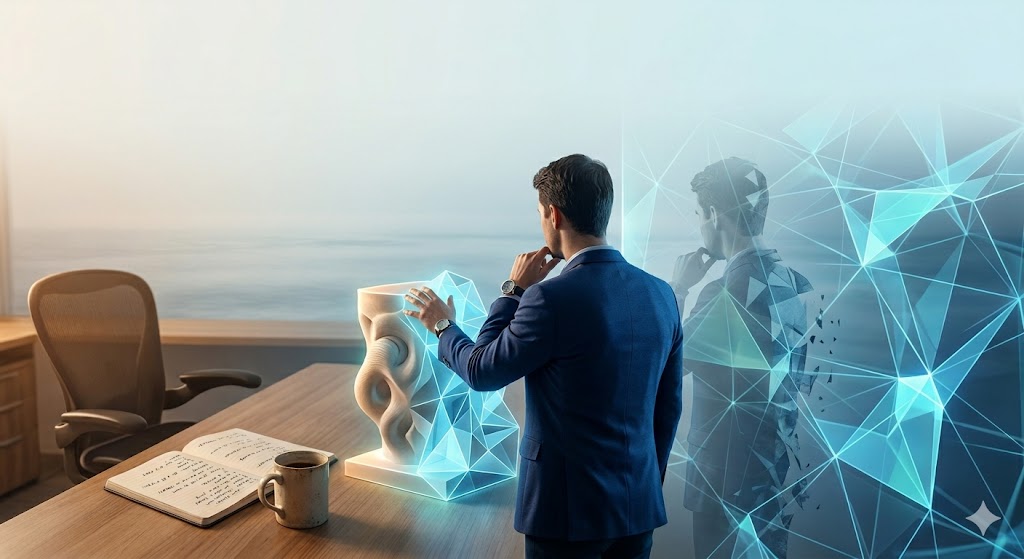
The Mirror and the Machine
The 21st century is witnessing a profound identity crisis as we transition from using tools that merely assist our labor to interacting with systems that mimic our core expertise. This shift marks a departure from the traditional industrial and digital revolutions, moving into an era where the boundary between human contribution and algorithmic output becomes increasingly blurred.
At the heart of this transition is a critical tension: the friction between human-centered design — which prioritizes the needs, dignity, and growth of people — and algorithmic efficiency, which prioritizes speed, optimization, and scale. As AI assumes more cognitive and creative responsibilities, we must address the psychological fallout of this collision.
The fundamental thesis of this exploration is that AI is not just a productivity multiplier; it is a disruptor of the self. By automating tasks once reserved for human intellect, AI is destabilizing the three traditional pillars of work identity:
- Competence: The sense of mastery over a specific craft or knowledge base.
- Autonomy: The freedom to direct one’s own actions and decisions.
- Purpose: The belief that one’s work provides unique value to the world.
“The threat to work identity precedes the threat to employment — and it arrives silently, often before a single role has been eliminated.” — Braden Kelley
The Erosion of Expertise as an Identity Anchor
For decades, professional identity has been anchored in the acquisition of specialized knowledge. We define ourselves as coders, analysts, or designers based on the “hard skills” we’ve spent years mastering. However, as AI demonstrates a growing capacity for high-level cognitive tasks — from legal synthesis to complex diagnostic work — the specialist faces a profound dilemma: If a machine can perform my core function, what am I?
This shift forces a psychological migration from the role of the “Doer” to that of the “Reviewer.” When the active phase of creation is compressed by a prompt, many professionals experience a perceived loss of craft. The satisfaction derived from “getting your hands dirty” in a spreadsheet or a design file is replaced by the passive oversight of an algorithmic output.
Furthermore, we are seeing the rise of a specific “Imposter Syndrome Loop.” In this cycle, professionals fear that their perceived value is no longer derived from their innate skill or experience, but solely from their ability to use a specific tool. To maintain a healthy work identity, we must move beyond technical execution and recognize that human expertise now lies in the nuance, the context, and the ethical judgment that algorithms cannot replicate.
Autonomy and the Algorithmic Manager
The psychological health of any professional depends heavily on agency — the ability to influence one’s own environment and outcomes. As AI-driven workflows become more prevalent, many workers feel a diminishing sense of control, often feeling more like “cogs in a black box” than autonomous creators. When a system provides the “best” path forward based on data we cannot see, the human element of strategic intuition begins to atrophy.
We are also entering the era of the “Quantified Self” at work. The psychological pressure of being constantly monitored by performance-tracking algorithms creates a state of perpetual hyper-vigilance. There is a deep-seated anxiety in being judged by an entity that understands metrics and speed, but fails to grasp the messy, human context of creative problem-solving or relationship building.
Ultimately, the struggle for creative control is the new frontier of employee engagement. To prevent total disengagement, we must intentionally design systems that leave room for human “interference.” Maintaining a sense of ownership over the final outcome is essential; otherwise, the work ceases to be an expression of the individual and becomes merely a byproduct of the system.
Redefining Purpose: From Output to Outcomes
As AI masters the ability to generate “outputs” — the reports, the code, the initial drafts — humans are being pushed toward a deeper search for meaning. If the value of our labor is no longer measured by the volume of what we produce, our work identity must shift toward the “why” behind the work. This is where we transition from being creators of things to orchestrators of value.
The human-centered pivot requires us to double down on the qualities that machines struggle to simulate: deep empathy, ethical discernment, and strategic vision. Our professional worth is moving away from technical execution and toward our ability to navigate the complex emotional landscapes of stakeholders and customers.
This evolution is a form of Experience Design for the Self. By intentionally offloading repetitive cognitive tasks to AI, we create the “white space” necessary to focus on high-touch, high-emotion interactions. The goal is to redesign our roles so that we are not competing with the machine, but rather using it to amplify our uniquely human capacity for connection and purpose.
Building Psychological Resilience and “Change Readiness”
Thriving in the age of AI requires more than just technical upskilling; it demands a fundamental shift from a “fixed” work identity to a “fluid” one. When our sense of self is tied to a static job description, automation feels like a threat. When it is tied to our capacity for continuous re-imagination and learning, automation becomes an opportunity for evolution.
Organizational leadership plays a pivotal role in this transition by applying experience design principles to the employee journey. Leaders must guide their teams through the “neutral zone” of change — that uncomfortable middle ground where the old ways of working have vanished but the new ones aren’t yet fully formed. This requires a deliberate focus on empathy and transparent communication to minimize the “identity friction” caused by new technology.
Ultimately, the goal is to foster a culture of psychological safety. Employees must feel empowered to experiment with AI, to fail, and to iterate without fearing that their professional value is being audited out of existence. By creating an environment where humans are encouraged to explore the boundaries of human-machine collaboration, we ensure that the workforce remains agile, engaged, and anchored in their uniquely human contributions.
Conclusion: Reclaiming the Human Narrative
As we have explored, AI is far more than a simple productivity tool; it is a catalyst for a profound human evolution. It challenges our traditional definitions of expertise, autonomy, and purpose, forcing us to look in the mirror and ask what truly makes our contribution valuable. While the machine can mimic our logic and patterns, it cannot replicate the soul of human-centered innovation.
The call to action for today’s leaders and professionals is clear: we must design the integration of AI with intentionality. This means putting “human-centeredness” at the core of every implementation, ensuring that technology serves to amplify our identity rather than erase it. We must move from a fear of replacement to a focus on augmentation and orchestration.
The final word on our work identity is one of empowerment. Our ultimate value is not found in what we can do that a machine can do faster or more accurately. Instead, our value resides in what we can imagine, the empathy we can extend, and the complex “why” we can define — all things that a machine, by its very nature, cannot possess. By reclaiming this narrative, we don’t just survive the age of AI; we lead it.
Frequently Asked Questions
Does AI replacement of tasks mean a replacement of professional identity?
Not necessarily. While AI may automate specific “outputs,” professional identity is shifting toward “outcomes.” Value is increasingly found in strategic orchestration, ethical judgment, and human-centered empathy rather than just technical execution.
How can leaders maintain employee autonomy in an AI-driven workplace?
Leaders must design “human-in-the-loop” systems that allow for human intervention and creative control. Autonomy is preserved when AI acts as a co-pilot that enhances decision-making rather than a “black box” that dictates actions.
What is the biggest psychological risk of AI integration?
The primary risk is the “erosion of craft,” where professionals feel like passive observers of automated processes. Counteracting this requires a shift in work design to focus on high-touch, high-emotion tasks that machines cannot replicate.
Image credits: Gemini
 Sign up here to join 17,000+ leaders getting Human-Centered Change & Innovation Weekly delivered to their inbox every week.