A Human-Centered Approach
LAST UPDATED: March 23, 2026 at 2:35 PM

GUEST POST from Art Inteligencia
Section I: The Anatomy of the Misstep
In a human-centered organization, a misstep is rarely just a technical error; it is a rupture in the social contract between the leadership and the people who power the vision. To repair trust, we must first diagnose the specific nature of the breach. Not all failures are created equal, and the remedy must match the ailment.
1.1 Defining the Breach: Competence vs. Integrity
To move toward a solution, we must categorize the failure. Organizational friction usually stems from one of two core areas:
- Competence Failures: These occur when the organization had the right intentions but lacked the skill, resources, or timing to execute. People are generally more forgiving of “getting it wrong” if they believe the effort was genuine.
- Integrity Failures: These are far more damaging. They occur when there is a perceived gap between stated values and actual behavior. When an organization “does the wrong thing,” it signals a breakdown in empathy and ethics, requiring a much deeper level of restorative work.
1.2 The Impact on Cognitive Load and Friction
When trust is high, communication is shorthand; when trust is low, every interaction requires a “tax.” A major organizational misstep significantly increases the Cognitive Load on employees. Instead of focusing on innovation, their mental energy is diverted toward:
- Hyper-vigilance: Constantly looking for “the other shoe to drop.”
- Second-guessing: Questioning the intent behind new directives or leadership pivots.
- Bureaucratic Hedging: Creating excessive documentation or seeking multiple approvals to avoid being blamed for future errors.
1.3 Identifying the “Experience Gap”
The “Experience Gap” is the delta between the brand’s promise — how we told people they would feel — and the reality of their current emotional state. To measure this gap, we look past traditional KPIs (which often hide human pain) and look for:
- Resonance Mismatch: Where the official narrative no longer aligns with the lived experience of the team.
- Validation Deficit: The feeling among stakeholders that their frustrations have been ignored or minimized by the organization.
“You cannot innovate in an environment of fear. Every misstep that goes unaddressed adds a layer of ‘organizational scar tissue’ that eventually numbs the creative spirit of the collective.” — Braden Kelley
Section II: The Empathy-First Protocol
The moments immediately following a misstep are the most critical. While the instinct of many organizations is to retreat into legal review or defensive posturing, a human-centered approach requires leaning into the discomfort. The goal of this protocol is not to “fix” the problem instantly, but to stop the bleeding of trust and validate the lived experience of those affected.
2.1 Radical Transparency: Beyond the “Corporate Filter”
Trust cannot be rebuilt on a foundation of ambiguity. Radical transparency means sharing not just what happened, but why it happened, including the internal pressures or systemic frictions that contributed to the failure. This involves:
- Jargon-Free Communication: Stripping away “corporate-speak” that feels like a shield. Use plain language that demonstrates accountability.
- The “Known/Unknown” Framework: Clearly stating what the organization knows, what it doesn’t know yet, and exactly when stakeholders can expect the next update.
- Closing the Information Loop: Ensuring that internal teams hear the news before (or at the same time as) the public to prevent “insider-outsider” resentment.
2.2 Active Acknowledgement and the Anatomy of an Apology
A human-centered apology is a diagnostic tool, not just a social grace. For an apology to resonate and begin the repair process, it must contain three specific elements:
- Validation: Explicitly naming the harm caused (e.g., “We recognize this caused significant overtime and stress for the engineering team”).
- Ownership: Accepting full responsibility without pivoting to external excuses or “unforeseen circumstances.”
- Commitment to Presence: Showing that leadership is not hiding, but is present and available to hear the fallout directly from those impacted.
2.3 Prioritizing Psychological Safety
A misstep often triggers a “threat response” in the organizational brain, leading to silence and fear. To move back toward a culture of innovation, we must restore Psychological Safety immediately:
- The “No-Blame” Zone: Openly stating that the focus is on fixing the system, not punishing individuals who were operating within a flawed process.
- Safe Feedback Channels: Creating anonymous or third-party avenues for employees to share their frustrations without fear of career repercussions.
- Leader Vulnerability: When leaders model vulnerability by admitting their own role in the oversight, it signals to the rest of the organization that it is safe to be human again.
“Empathy isn’t a soft skill; it’s a hard requirement for recovery. You cannot navigate a way out of a crisis if you refuse to acknowledge the emotional reality of the people standing in it with you.” — Braden Kelley
Section III: The Architecture of Repair
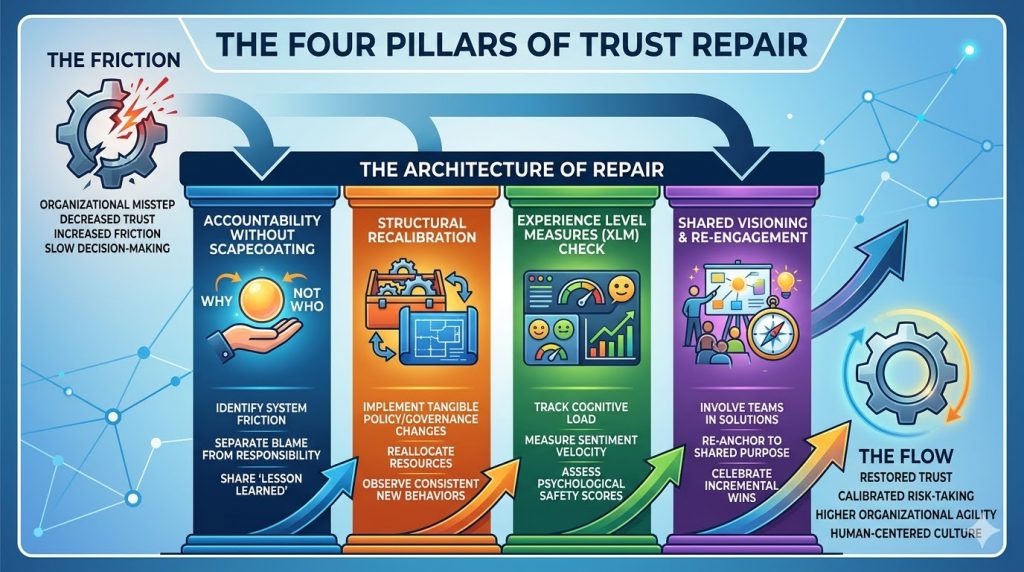
Recovery is not a linear process; it is a structural one. Once the initial “bleeding” of trust has been stabilized through empathy, the organization must move into the rigorous work of redesigning the systems that allowed the misstep to occur. This phase shifts the focus from sentiment to systems, ensuring that repair is not just a promise, but a measurable reality.
Pillar 1: Accountability Without Scapegoating
True accountability in a human-centered organization focuses on “the ‘How’ and the ‘What'” rather than “the ‘Who’.” Blaming individuals for systemic failures only drives friction underground. To build a healthier architecture, we must:
- Perform a Friction Audit: Identify the specific bottlenecks, lack of resources, or misaligned incentives that contributed to the error.
- Decouple Blame from Responsibility: Ensure that those responsible for fixing the problem have the agency and safety to do so without fear of career-ending consequences.
- Publicly Share the “Lesson Learned”: Transforming a private failure into a public piece of organizational wisdom.
Pillar 2: Structural Re-calibration
Trust is rebuilt through the observation of consistent, new behaviors. This requires a physical or procedural change to the way work happens. Re-calibration might include:
- Governance Adjustments: Implementing new “safety valves” or review stages that prioritize human impact over speed.
- Resource Reallocation: Moving budget or talent to the areas that were previously under-supported, proving that the organization is “putting its money where its mouth is.”
- Policy Evolution: Updating the “Organizational Playbook” to reflect a more nuanced understanding of the risks involved in innovation.
Pillar 3: The “Experience Level Measure” (XLM) Check
Traditional KPIs like “uptime” or “quarterly revenue” are lagging indicators that rarely capture the health of a relationship. To repair trust, we must monitor Experience Level Measures (XLMs). Unlike SLAs (Service Level Agreements), which track technical compliance, XLMs track human resonance:
- Cognitive Load Tracking: Are employees finding it easier or harder to get their work done post-misstep?
- Sentiment Velocity: How quickly is the internal or external perception of the brand moving from “skeptical” to “cautiously optimistic”?
- Psychological Safety Scoring: Measuring the willingness of team members to voice concerns early in the project lifecycle.
Pillar 4: Shared Visioning and Re-Engagement
The final pillar is about moving from the past to the future. Repair is complete only when the team can look past the misstep and see themselves in the organization’s next chapter. This involves:
- Collaborative Pathfinding: Inviting those most impacted by the misstep to help design the “Version 2.0” of the project or process.
- Re-anchoring to Purpose: Reminding the collective of the why — the core human-centered mission that transcends any single failure.
- Celebrating Incremental Wins: Explicitly pointing out when the new, repaired system works as intended to reinforce the new narrative of reliability.
“The strongest structures are those that have been reinforced at their weakest points. An organization that repairs trust effectively doesn’t just return to its previous state; it evolves into a more resilient version of itself.”
Section IV: Sustaining the Rebound
Repairing trust is not a “one-and-done” event; it is a continuous practice of organizational hygiene. Once the architecture of repair is in place, the challenge shifts from crisis management to long-term sustainability. To prevent “trust decay,” leadership must move away from reactive fixes and toward a proactive culture of transparency and empathy-driven oversight.
4.1 The Perpetual Trust Audit
Organizations often wait for a crisis to measure trust. A human-centered leader treats trust as a dynamic asset that requires regular auditing. This involves:
- Relational Health Checks: Moving beyond annual engagement surveys to quarterly “pulse checks” that specifically measure the strength of the social contract.
- Identifying “Friction Hotspots”: Proactively looking for areas where communication is breaking down or where “workarounds” have replaced official processes.
- The “Say/Do” Ratio: Auditing leadership’s public commitments against actual resource allocation to ensure consistency remains high.
4.2 Incentivizing Radical Candor
The greatest threat to sustained trust is silence. If employees feel that pointing out a potential “iceberg” will lead to professional repercussions, they will stay quiet until the impact is unavoidable. Sustaining the rebound requires:
- Rewarding the “Early Warning”: Publicly celebrating (with permission) instances where a team member flagged a potential misstep before it scaled.
- Lowering the Cost of Truth: Streamlining the process for reporting concerns so that it doesn’t require “extra” emotional labor or administrative hurdles.
- Causal Analysis as Standard Practice: Making “blame-free post-mortems” a regular part of every project cycle, not just the failed ones.
4.3 Institutionalizing Feedback Loops
Feedback must be a loop, not a one-way street. To sustain trust, stakeholders need to see that their input directly influences organizational evolution. This is achieved through:
- Visible Iteration: Explicitly stating when a policy or product change was made based on stakeholder feedback (e.g., “We heard you, and here is how we’ve adjusted”).
- The “Experience Level Measure” (XLM) Dashboard: Making human-centered metrics a standing item in executive board meetings, ensuring they carry the same weight as financial performance.
- Community of Practice: Creating internal forums where different departments can share their own trust-building successes and failures, fostering cross-functional empathy.
“Sustainable trust is built in the ‘boring’ moments between crises. It is the cumulative result of a thousand small promises kept, and the courage to address friction while it is still a spark, rather than waiting for the fire.”
Conclusion: The Innovation Dividend of Restored Trust
In the high-stakes world of digital transformation and organizational change, missteps are not just possibilities — they are statistical certainties. However, the true measure of a human-centered organization isn’t the absence of failure, but the velocity and empathy of its recovery. When we approach trust repair as a strategic framework rather than a PR hurdle, we unlock what I call the Innovation Dividend.
From Friction back to Flow
An organization that has successfully navigated the architecture of repair is often more resilient than one that has never been tested. By addressing the “Experience Gap” and reducing the cognitive load caused by uncertainty, you create a culture where:
- Risk-Taking is Calibrated: Teams understand the safety nets are real, allowing for bolder experimentation.
- Empathy is Operationalized: Leadership moves from “managing people” to “designing experiences” that foster loyalty.
- Agility is Sustained: High-trust environments move faster because they don’t waste energy on the “friction tax” of second-guessing.
Final Thought
Organizations don’t change; people do. Every policy, product, and pivot is ultimately an exchange of value between human beings. Repairing trust is the ultimate human-centered innovation because it restores the one ingredient essential for any future-ready enterprise: the belief that we are all moving toward the same “why,” together.
“The strongest bond isn’t one that has never been stretched; it’s the one that has been pulled to the breaking point and intentionally re-woven with greater care.”
Bonus: The Human-Centered Trust Repair Checklist
To move from theory to execution, use this checklist as a diagnostic tool for your leadership team. It is designed to ensure no part of the “Experience Gap” is left unaddressed.
Phase 1: The Empathy Response
- [ ] Have we issued a statement that uses “human language” instead of legal or corporate jargon?
- [ ] Has leadership explicitly acknowledged the emotional impact (stress, confusion, etc.) on the team?
- [ ] Have we communicated what we currently know, what we don’t know, and when the next update will arrive?
Phase 2: Systemic Diagnosis
- [ ] Have we identified the systemic friction that allowed the error to occur?
- [ ] Are we focusing on fixing the process (the “How”) rather than punishing an individual (the “Who”)?
- [ ] Have we consulted the front-line employees who are most affected for their perspective on the root cause?
Phase 3: Structural Change
- [ ] Have we implemented a tangible change in policy or governance to prevent a recurrence?
- [ ] Have resources (time, budget, or talent) been reallocated to support the repair?
- [ ] Is there a clear, observable “new behavior” that leadership is modeling?
Phase 4: Measuring the Rebound
- [ ] Are we tracking Experience Level Measures (XLMs) like cognitive load and sentiment velocity?
- [ ] Do we have a safe, anonymous channel for ongoing feedback?
- [ ] Have we scheduled a “Trust Audit” 90 days from today to ensure the repair has held?
“A checklist doesn’t replace a conversation, but it ensures that the conversation covers the ground necessary to build a bridge back to innovation.”
Frequently Asked Questions: Trust Repair
1. What is the difference between a Competence Failure and an Integrity Failure?
A Competence Failure occurs when an organization has the right intentions but lacks the skill or resources to execute, which is often easily forgiven. An Integrity Failure happens when there is a gap between stated values and actual behavior, requiring much deeper restorative work to repair the social contract.
2. What are Experience Level Measures (XLMs)?
Unlike traditional KPIs that track technical or financial data, XLMs measure human resonance. They track qualitative factors like cognitive load (how hard it is to get work done), sentiment velocity, and the level of psychological safety felt by the team during and after a crisis.
3. Why is “Radical Transparency” better than “Strategic Silence” after a mistake?
Strategic silence creates an information vacuum that people fill with their worst fears, increasing organizational friction. Radical Transparency reduces cognitive load by providing a clear “known/unknown” framework, which stops the bleeding of trust and allows the team to focus on solutions rather than rumors.
Image credit: Google Gemini
 Sign up here to get Human-Centered Change & Innovation Weekly delivered to your inbox every week.