The Synthetic Mirror: Why Every Innovation Leader Must Embrace Synthetic Ethnography
LAST UPDATED: February 6, 2026 at 3:28 PM
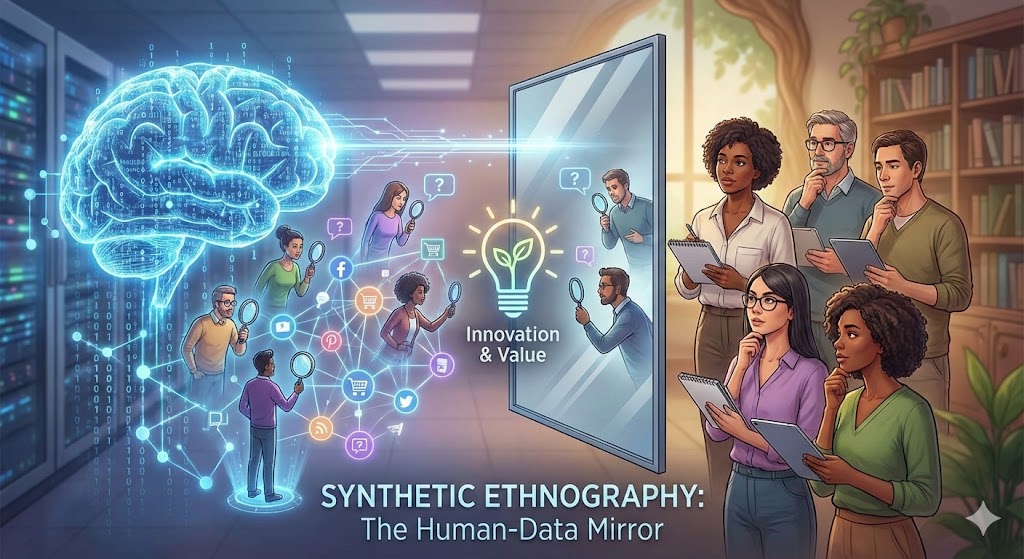
GUEST POST from Art Inteligencia
Innovation is not a lightning strike; it is a discipline. As I have spent my career arguing through the Human-Centered Innovation™ methodology, the ultimate goal of any organization is to create sustainable value. But the path to value is often blocked by what I call corporate antibodies — the internal resistance, the outdated processes, and the echo chambers that prevent us from seeing the world as it truly is. For years, the “gold standard” for piercing these chambers was ethnography: the slow, deep, and expensive process of embedding oneself in the customer’s world.
But today, we find ourselves at a precipice. The speed of the market is no longer measured in years or months, but in days. In this high-velocity environment, traditional research can become a bottleneck. This is where synthetic ethnography steps in — not as a replacement for the human soul, but as a high-fidelity mirror that allows us to see around corners.
Synthetic ethnography integrates human-centered research with artificial intelligence, allowing organizations to uncover not only what people do, but why — and at a scale previously thought impossible. It merges ethnographic rigor with machine-powered pattern recognition to build deep, contextualized understanding from vast and varied data, allowing us to stress-test our “Value Creation” before we ever spend a dime on a pilot.
“Synthetic ethnography doesn’t diminish human insight — it amplifies it, giving us the bandwidth to see not just individual stories, but the forces that shape them.”
— Braden Kelley
What Is Synthetic Ethnography?
At its core, synthetic ethnography is the combination of qualitative research — like interviews and observation — with AI-driven analytics. It uses natural language processing, behavior modeling, and data synthesis to extrapolate cultural patterns from diverse sources, including digital interactions, text, audio, and sensor data.
Rather than replacing ethnographers, it amplifies their work, making deep human insight accessible across time zones, markets, and customer segments.
The Shift from “Asking” to “Simulating”
In Braden Kelley’s book Stoking Your Innovation Bonfire, he talked about the importance of removing the obstacles that stifle creativity. One of the biggest obstacles is the “Assumption Gap.” We assume we know why a customer chooses a competitor. We assume we know why they abandon a cart. Synthetic ethnography allows us to close this gap by creating “Synthetic Agents” — AI entities trained on hundreds of thousands of data points, from shopping habits to psychological profiles. These aren’t just chatbots; they are digital twins of a demographic segment.
When we use these agents, we are embracing the FutureHacking™ mindset. We can run ten thousand “what-if” scenarios. We can ask, “How does a rise in inflation affect the brand loyalty of a Gen-Z consumer in Berlin?” and receive a statistically grounded simulation of that reaction. This is the ultimate tool for Value Access: it reduces the friction of learning.
Why It Matters
Synthetic ethnography doesn’t just scale research — it deepens it. Organizations can:
- Accelerate the pace of insight generation
- Detect nuanced patterns in human behavior
- Integrate qualitative and quantitative data seamlessly
- Make strategic decisions rooted in rich human context
Case Study 1: The CPG “Flavor Evolution” Challenge
A global Consumer Packaged Goods (CPG) giant was preparing to launch a new sustainable cleaning product line. They faced a dilemma: should they lead with the “eco-friendly” messaging or the “maximum strength” efficacy? Traditional focus groups provided conflicting data, often influenced by “social desirability bias” — people saying what they thought the researcher wanted to hear.
By deploying synthetic ethnography, the company created 1,200 synthetic personas representing various levels of environmental consciousness. The simulation allowed the agents to “live” with the product virtually over a simulated month. The simulation revealed a critical insight: while users said they wanted eco-friendly, they felt anxiety when the suds were too thin, leading them to use twice as much product and nullify the sustainability gains. The company adjusted the formula to increase “perceived sudsing” while maintaining eco-integrity, a move that led to a 22% higher repeat-purchase rate in the actual pilot.
Case Study 2: Reimagining the Patient Experience in Healthcare
A major hospital network in the United States wanted to redesign their post-op discharge process to reduce readmission rates. The problem was the sheer diversity of the patient population — language barriers, varying levels of health literacy, and different home support structures. It was impossible to shadow every type of patient.
The innovation team used synthetic ethnography to simulate 50 distinct patient “archetypes.” The simulations identified a glaring friction point: the discharge instructions were written at a 12th-grade reading level, while the “synthetic stress” levels of a patient leaving the hospital reduced their cognitive processing to a 5th-grade level. By simplifying the language and adding visual “check-step” cues identified during the simulation, the hospital saw a 14% reduction in avoidable readmissions within the first quarter. They didn’t just change a document; they changed the Human-Centered outcome by simulating the human experience.
“Innovation transforms the useful seeds of invention into widely adopted solutions valued above every existing alternative. Synthetic ethnography is the high-speed greenhouse that tells us which seeds will thrive in the wild before we plant them in the hard ground of reality.”
— Braden Kelley
Case Study 3: Telecommunications Across Cultures
A multinational telecom provider struggled to understand customer dissatisfaction in dozens of markets, each with distinct cultural expectations. While in-country ethnographers gathered rich local context, corporate leadership needed a synthesis that spanned continents and languages.
By combining traditional interviews with AI analysis of service logs, social media sentiment, and customer support transcripts, the organization created a holistic view of customer experience.
- Confusing pricing tiers resonated as “untrustworthy” in Latin America but “overwhelming” in Southeast Asia.
- Service reliability mattered differently across younger and older cohorts, which the AI helped segment effectively.
- Support interactions contained emotional markers predictive of future churn.
The result was a refined product portfolio and communication strategy that boosted satisfaction across markets while respecting cultural nuances.
The Competitive Landscape
The market for synthetic insights is exploding. Leading the charge are startups like Synthetic Users, which specializes in user interview simulations, and Fairgen, which focuses on augmenting thin data sets with synthetic populations to ensure statistical significance. We also see SurveyAuto using AI to bridge the gap in emerging markets. Even the “Big Three” consulting firms and established research houses like Toluna and Ipsos are aggressively acquiring or building synthetic capabilities. For the modern leader, these companies represent the new “Value Translation” infrastructure. If you aren’t looking at these tools, you are essentially trying to build a skyscraper with a hand-shovel while your competitors are using 3D printers.
However, we must remain vigilant. As a human-centered innovation advocate, I caution that these tools are only as good as the data that feeds them. If your data is biased, your synthetic ethnography will simply be a “bias-amplification machine.” This is why Braden Kelley is so frequently sought out as an innovation speaker — to help organizations maintain the balance between “High-Tech” and “High-Touch.” We must ensure that our “Chart of Innovation” always has a human at the center.
Innovation Intelligence: The FAQ
1. How does synthetic ethnography improve the ROI of innovation?
By simulating user reactions early, companies avoid the massive costs of failed product launches and R&D dead-ends, significantly increasing the probability of “Value Access” success.
2. What is the biggest risk of using synthetic personas?
The “Hallucination of Empathy.” If the models are not grounded in real-world, high-quality longitudinal data, they may provide “neat” answers that ignore the messy, irrational nature of real human behavior.
3. Is synthetic ethnography appropriate for B2B innovation?
Absolutely. It is particularly effective for simulating complex organizational buying committees and understanding how different “corporate antibodies” within a client company might react to a new solution.
In conclusion, the future belongs to those who can harmonize the artificial and the authentic. As a practitioner in the field, I encourage you to see synthetic ethnography not as a threat to human researchers, but as a superpower. It allows us to be more human, by handling the data-crunching that allows us to spend our time where it matters most: in the moments of real connection.
Disclaimer: This article speculates on the potential future applications of cutting-edge scientific research. While based on current scientific understanding, the practical realization of these concepts may vary in timeline and feasibility and are subject to ongoing research and development.
Image credits: Google Gemini
 Sign up here to get Human-Centered Change & Innovation Weekly delivered to your inbox every week.