Is Your Company Prepared?
LAST UPDATED: January 9, 2026 at 3:55PM
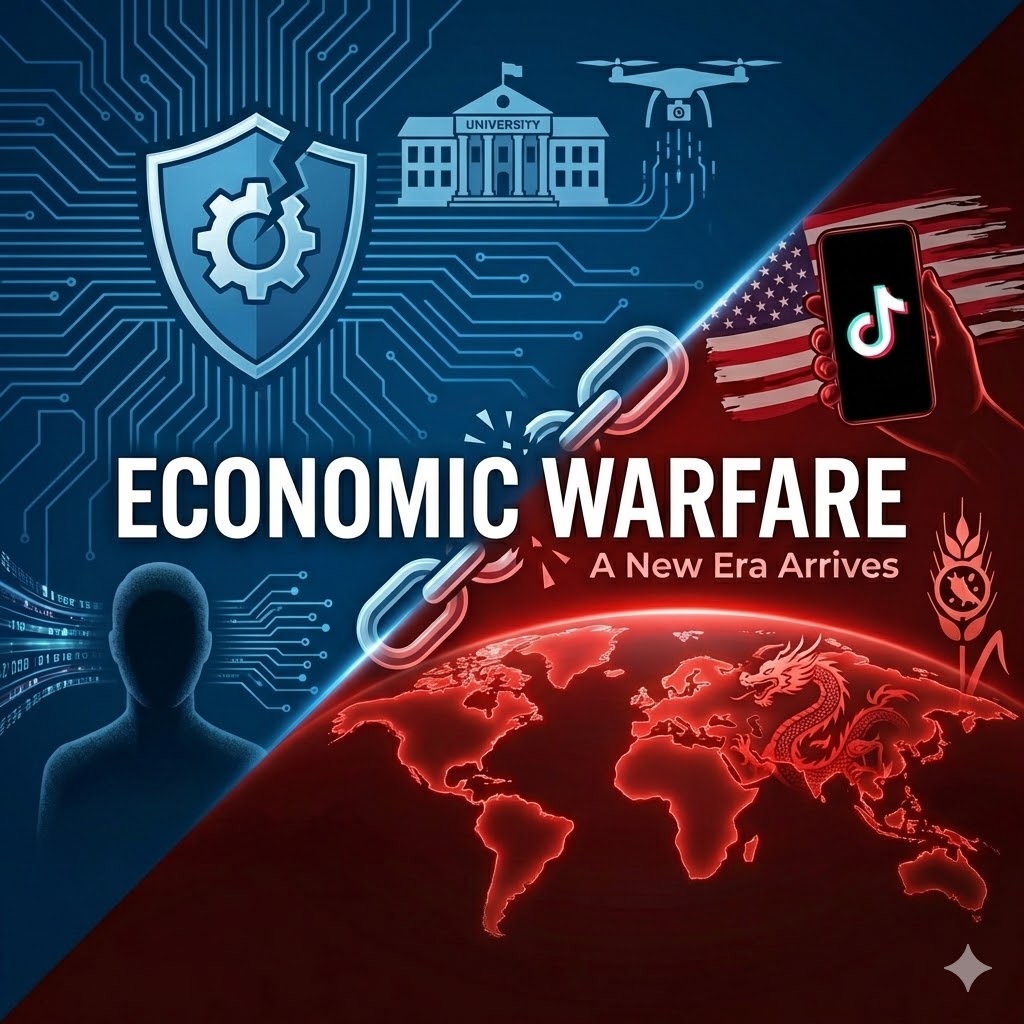
GUEST POST from Art Inteligencia
Economic warfare rarely announces itself. It embeds quietly into systems designed for trust, openness, and speed. By the time damage becomes visible, advantage has already shifted.
This new era of conflict is not defined by tanks or tariffs alone, but by the strategic exploitation of interdependence — where innovation ecosystems, supply chains, data flows, and cultural platforms become contested terrain.
The most effective economic attacks do not destroy systems outright. They drain them slowly enough to avoid response.
Weaponizing Openness
For decades, the United States has benefited from a research and innovation model grounded in openness, collaboration, and academic freedom. Those same qualities, however, have been repeatedly exploited.
Publicly documented prosecutions, investigations, and corporate disclosures describe coordinated efforts to extract intellectual property from American universities, national laboratories, and private companies through undisclosed affiliations, parallel research pipelines, and cyber-enabled theft.
This is not opportunistic theft. It is strategic harvesting.
When innovation can be copied faster than it can be created, openness becomes a liability instead of a strength.
Cyber Persistence as Economic Strategy
Cyber operations today prioritize persistence over spectacle. Continuous access to sensitive systems allows competitors to shortcut development cycles, underprice rivals, and anticipate strategic moves.
The goal is not disruption — it is advantage.
Skydio and Supply Chain Chokepoints
The experience of American drone manufacturer Skydio illustrates how economic pressure can be applied without direct confrontation.
After achieving leadership through autonomy and software-driven innovation rather than low-cost manufacturing, Skydio encountered pressure through access constraints tied to upstream supply chains.
This was a calculated attack on a successful American business. It serves as a stark reminder: if you depend on a potential adversary for your components, your success is only permitted as long as it doesn’t challenge their dominance. We must decouple our innovation from external control, or we will remain permanently vulnerable.
When supply chains are weaponized, markets no longer reward the best ideas — only the most protected ones.
Agricultural and Biological Vulnerabilities
Incidents involving the unauthorized movement of biological materials related to agriculture and bioscience highlight a critical blind spot. Food systems are economic infrastructure.
Crop blight, livestock disease, and agricultural disruption do not need to be dramatic to be devastating. They only need to be targeted, deniable, and difficult to attribute.
Pandemics and Systemic Shock
The origins of COVID-19 remain contested, with investigations examining both natural spillover and laboratory-associated scenarios. From an economic warfare perspective, attribution matters less than exposure.
The pandemic revealed how research opacity, delayed disclosure, and global interdependence can cascade into economic devastation on a scale rivaling major wars.
Resilience must be designed for uncertainty, not certainty.
The Attention Economy as Strategic Terrain and Algorithmic Narcotic
Platforms such as TikTok represent a new form of economic influence: large-scale behavioral shaping.
Regulatory and academic concerns focus on data governance, algorithmic amplification, and the psychological impact on youth attention, agency, and civic engagement.
TikTok is not just a social media app; it is a cognitive weapon. In China, the algorithm pushes “Douyin” users toward educational content, engineering, and national achievement. In America, the algorithm pushes our youth toward mindless consumption, social fragmentation, and addictive cycles that weaken the mental resilience of the next generation. This is an intentional weakening of our human capital. By controlling the narrative and the attention of 170 million Americans, American children are part of a massive experiment in psychological warfare, designed to ensure that the next generation of Americans is too distracted to lead and too divided to innovate.
Whether intentional or emergent, influence over attention increasingly translates into long-term economic leverage.
The Human Cost of Invisible Conflict
Economic warfare succeeds because its consequences unfold slowly: hollowed industries, lost startups, diminished trust, and weakened social cohesion.
True resilience is not built by reacting to attacks, but by redesigning systems so exploitation becomes expensive and contribution becomes the easiest path forward.
Conclusion
This is not a call for isolation or paranoia. It is a call for strategic maturity.
Openness without safeguards is not virtue — it is exposure. Innovation without resilience is not leadership — it is extraction.
The era of complacency must end. We must treat economic security as national security. This means securing our universities, diversifying our supply chains, and demanding transparency in our digital and biological interactions. We have the power to stoke our own innovation bonfire, but only if we are willing to protect it from those who wish to extinguish it.
The next era of competition will reward nations and companies that design systems where trust is earned, reciprocity is enforced, and long-term value creation is protected.
Frequently Asked Questions
What is economic warfare?
Economic warfare refers to the use of non-military tools — such as intellectual property extraction, cyber operations, supply chain control, and influence platforms — to weaken a rival’s economic position and long-term competitiveness.
Is China the only country using these tactics?
No. Many nations engage in forms of economic competition that blur into coercion. The concern highlighted here is about scale, coordination, and the systematic exploitation of open systems.
How should the United States respond?
By strengthening resilience rather than retreating from openness — protecting critical research, diversifying supply chains, aligning innovation policy with national strategy, and designing systems that reward contribution over extraction.
How should your company protect itself?
Companies should identify their critical knowledge assets, limit unnecessary exposure, diversify suppliers, strengthen cybersecurity, enforce disclosure and governance standards, and design partnerships that balance collaboration with protection. Resilience should be treated as a strategic capability, not a compliance exercise.
Image credits: Google Gemini
 Sign up here to get Human-Centered Change & Innovation Weekly delivered to your inbox every week.