GUEST POST from Chateau G Pato
1. Hook & Core Thesis: The Rearview Mirror Trap
The Opening Provocation
Traditional strategic planning often fails in non-linear environments because organizations spend up to 95% of their energy optimizing yesterday’s business model while getting blindsided by tomorrow’s reality. Treating strategy and change as reactions to the present is like driving down the highway while staring exclusively in the rearview mirror.
Forecasting vs. Foresight
To build durable adaptability, leaders must separate prediction from preparation:
- Forecasting tries to eliminate uncertainty by betting on a single, linear projection (“What will happen?”).
- Foresight embraces uncertainty by mapping multiple plausible futures (“What could happen, what is likely to happen, and what should we do about it?”).
The Human-Centered Imperative
Technology alone does not disrupt industries; shifting human behaviors, expectations, and experiences do. By connecting weak signals directly to FutureHacking™, Human-Centered Change™, and Experience Design, foresight stays anchored in the people whose lives and workflows are actually changing.
2. Demystifying Future Signals: Listening to the Edges
Defining Future Signals
Future signals (often called weak signals) are early, faint indicators of emergent change happening at the fringes before they reach mainstream trend reports or quarterly earnings calls. Spotting them early gives teams time to experiment and adapt long before competitors feel forced to react.
Signals vs. Trends vs. Noise
Effective foresight requires sorting everyday chatter from meaningful shifts in customer and employee behavior:
- Noise: Random fluctuations, one-off anomalies, or short-lived hype cycles that do not alter underlying behavior.
- Signals: Early, localized clues—such as unusual user workarounds, emerging micro-communities, or new regulatory drafts—that hint at a potential shift.
- Trends: Patterns backed by growing adoption and momentum across multiple signals that are beginning to reshape expectations and experiences.
Making Signal Scanning a Team Sport
Futures work fails when locked inside an ivory tower. Drawing on the Inspiration stage of the Eight I’s of Infinite Innovation and bringing together diverse perspectives across the Nine Innovation Roles turns signal scanning into a shared habit across frontline, product, operations, and leadership teams.
Where to Look (The STEEP+H Lens)
Scan systematically across Social, Technological, Economic, Environmental, Political, and Human Experience shifts—paying close attention to customer workarounds, hidden friction points, and unmet Jobs-to-be-Done.
3. Scenario Thinking: Stress-Testing Reality Before It Arrives
Why Scenarios Beat Predictions
A scenario is not a crystal ball designed to guess one exact outcome; it is a wind tunnel for stress-testing your strategy, customer experience, and operating model against multiple plausible futures before you have to bet real capital.
Building Plausible Worlds (The FutureHacking™ Approach)
Instead of settling for a single forecast, use a structured, collaborative process to explore distinct possibilities:
- Define the Focal Question: Anchor the exercise around a specific strategic challenge, customer journey, or business model horizon.
- Isolate Critical Uncertainties: Map key drivers of change and prioritize the forces that combine high potential impact with low predictability.
- Construct Distinct Future Worlds: Build 3–4 vivid, structurally different scenarios—deliberately avoiding the lazy “good, bad, and status quo” trap.
- Account for Wild Cards: Stress-test each world against low-probability, high-impact shocks that would break linear assumptions overnight.
From Abstract Worlds to Human Experience
Scenarios only become actionable when you step inside them from a human perspective. Walk through each future world through the eyes of a customer, an employee, and a competitor to ask: What feels broken here? What new value is demanded? What experiences become obsolete?
4. Bridging the Gap: From Foresight to Action
The Execution Chasm
Most scenario workshops end up as forgotten slide decks because organizations fail to translate future insight into today’s portfolio decisions and change roadmap. Foresight creates zero value if it remains an intellectual exercise disconnected from resource allocation and daily execution.
Designing Your Strategic Options
Rather than waiting for uncertainty to vanish, build a balanced portfolio of moves across your scenarios:
- No-Regret Moves: Investments, capability builds, and experience upgrades that pay off regardless of which future unfolds.
- Hedging Bets & Options: Small, time-boxed experiments that build organizational readiness without betting the farm too early.
- Signposts & Triggers: Specific real-world metrics, customer behaviors, and external signals that alert teams when a particular scenario is actively materializing.
Connecting FutureHacking™ to Human-Centered Change™
Innovation creates the new, while change enables adoption. By pairing FutureHacking™ with visual, collaborative alignment tools like the Change Planning Canvas™, teams can co-own the transformation required to meet the future—replacing top-down mandates with shared clarity, empathy, and momentum.
5. Conclusion & Call to Action: Becoming Future-Ready
Summary Shift
The organizations that thrive in volatile markets are not the ones with the luckiest predictions—they are the ones that build a repeatable muscle for sensing change early and adapting fast. By combining signal scanning, scenario thinking, and Human-Centered Change™, leaders move from passive future-takers reacting to disruption to active future-makers designing the experiences people will love next.
Three Immediate Next Steps for Readers
- Start a Shared “Future Signals” Channel: Create a cross-functional space this week where team members can drop customer workarounds, edge behaviors, and unexpected shifts they spot in the wild.
- Run a 90-Minute “What If?” Scenario Sprint: Gather a diverse group across the Nine Innovation Roles to pressure-test your biggest strategic assumption against three distinct future worlds.
- Audit One Core Journey on a 5-Year Horizon: Take a flagship customer or employee experience and ask which touchpoints will feel indispensable—and which will feel broken—five years from today.
Frequently Asked Questions: Foresight, Future Signals & Scenario Thinking
What is the difference between forecasting and strategic foresight?
Forecasting attempts to eliminate uncertainty by predicting a single, linear outcome based on historical data (asking “What will happen?”). Strategic foresight embraces uncertainty by scanning for early signals of change and mapping multiple plausible futures (asking “What could happen, what is likely to happen, and what should we do about it?”) so organizations can design resilient strategies and human-centered experiences before disruption hits.
How do teams distinguish weak signals from everyday noise?
Noise consists of isolated anomalies or fleeting hype cycles that do not change underlying human behavior. Weak signals are early, localized indicators of structural change—such as recurring customer workarounds, emerging micro-communities, or subtle shifts across Social, Technological, Economic, Environmental, Political, and Human Experience (STEEP+H) drivers—that point toward unmet Jobs-to-be-Done before they become mainstream trends.
How do you turn scenario thinking into real organizational action?
To avoid leaving scenarios trapped in a slide deck, translate them into a balanced portfolio of No-Regret Moves (investments that pay off across every scenario), Hedging Bets (small, time-boxed experiments), and Signposts (real-world triggers that indicate which scenario is unfolding). Pairing FutureHacking™ with visual, collaborative alignment tools like the Change Planning Canvas™ helps teams co-own the execution and adoption required to meet the future.
Bottom line: Futurology is not fortune telling. Futurists use a scientific approach to create their deliverables, but a methodology and tools like those in FutureHacking™ can empower anyone to engage in futurology themselves.
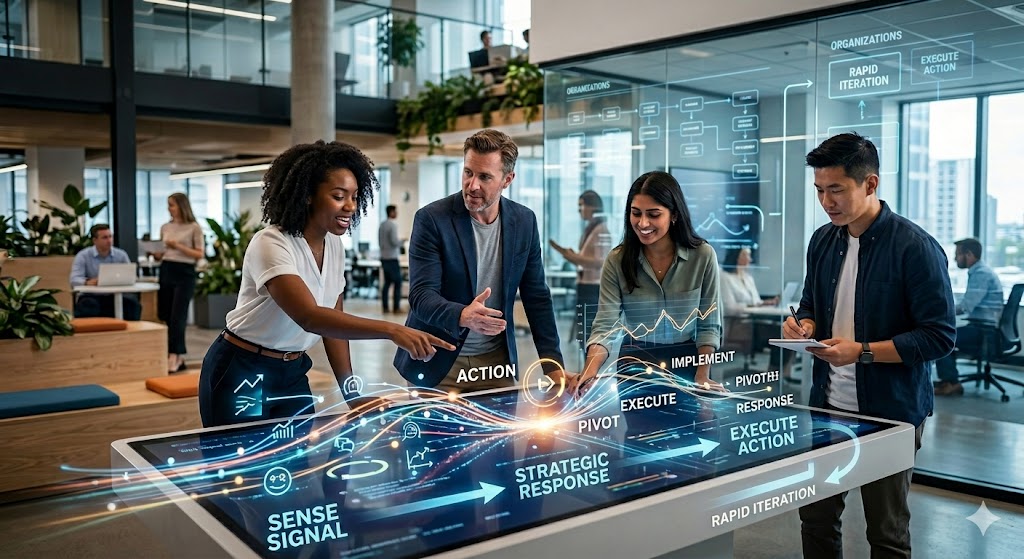
Image credit: Gemini
 Sign up here to get Human-Centered Change & Innovation Weekly delivered to your inbox every week.