GUEST POST from Art Inteligencia
I. The Death of the Rectangle (And Why That’s a Good Thing)
For the past forty years, we have operated under a quiet, unexamined tyranny: the tyranny of the glowing rectangle. From the beige CRT monitors of the 1980s to the sleek, edge-to-edge OLED slabs we carry in our pockets today, human-computer interaction has been defined by a single geometric constraint. Whenever we wanted to access information, connect with a colleague, or control our environment, we had to shrink our human intent down to fit inside a flat, two-dimensional box.
The Tyranny of the Glass
To be fair, the graphical user interface (GUI) was one of the greatest democratizing forces in modern history. By translating arcane command-line code into visual metaphors—desktops, folders, trash cans, and buttons—it unlocked the power of computing for billions of people.
Yet, that democratization came with an enormous, hidden cognitive tax. Every time we tap, pinch, zoom, or hunt through nested menus, we are performing mental translation work on behalf of the machine. Worse, the screen acts as a gravity well for human attention. It pulls our eyes downward, disconnects us from our physical surroundings, and fractures our presence into dozens of competing digital silos. We didn’t master the tool; we adapted our posture, our social norms, and our neurological wiring to serve the glass.
From “User” to “Human”
As the rectangle begins to dissolve, the very language of our profession must evolve. For decades, we have designed for “users.” Think about that word for a moment. Outside of technology, there is only one other industry that regularly refers to its customers as users—and it isn’t a flattering comparison.
People do not wake up in the morning excited to “use” an interface. They wake up wanting to solve a problem, express creativity, feel secure, or share a meaningful moment with someone they care about. Moving into the post-screen era requires a fundamental shift in mindset: we must stop optimizing for user engagement and start designing for human intent. When we design for humans rather than users, the goal is no longer to keep someone trapped inside an application; it is to fulfill their need as effortlessly as possible and return them to their lives.
The Evolution of Interaction
When we zoom out, the death of the rectangle isn’t a sudden rupture—it is the natural culmination of a decades-long journey toward greater human fluency:
- The Command Line Era: Humans had to speak the machine’s language through rigid syntax and memorized text strings.
- The Graphical Screen Era: Humans pointed at visual representations of machine logic using indirect peripherals like the mouse.
- The Touch Interface Era: We removed the peripheral, allowing direct manipulation of pixels—yet we were still confined to a flat plane of glass.
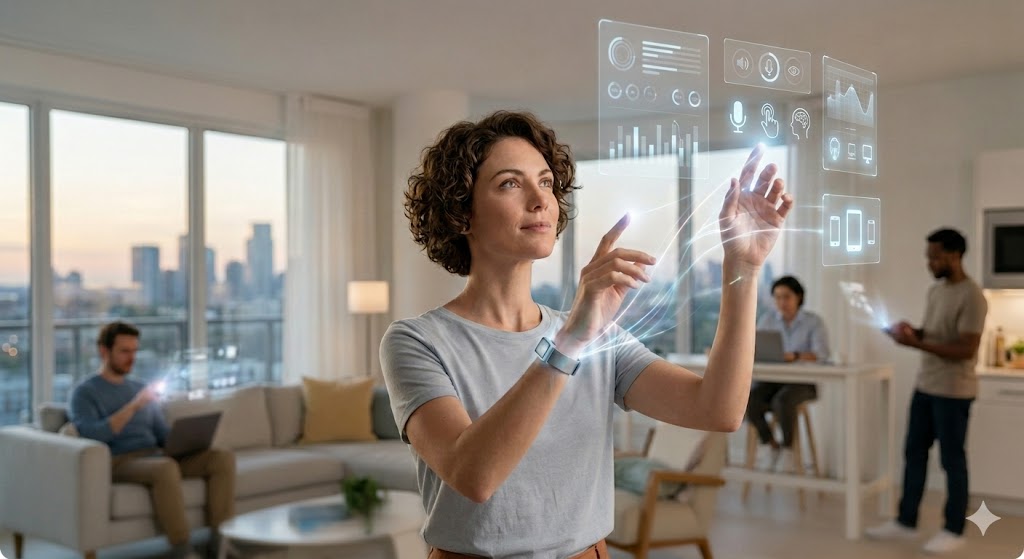
- The Ambient, Zero-UI Era: The interface disappears into the fabric of our environment. Systems understand context, voice, gesture, and biometric cues, responding to us in the physical world on human terms.
Letting go of the rectangle doesn’t mean losing control. It means finally graduating from an era where humans had to act like machines, into an era where technology finally learns how to behave like a thoughtful partner.
II. What is an Invisible Interface?
When people hear the phrase “invisible interface,” they often imagine a world stripped of technology—or worse, a sterile sci-fi movie where humans wave their hands wildly at empty air. In reality, an invisible interface is neither the absence of technology nor the replacement of screens with mid-air gymnastics. It is the deliberate weaving of computational intelligence into the physical and sensory fabric of everyday life so seamlessly that the mechanism of interaction disappears, leaving only the outcome.
Ambient Intelligence & Context Awareness
Traditional interfaces are fundamentally reactive and literal: they sit idle until a human issues an explicit command by clicking a button, typing a query, or tapping an icon. Invisible interfaces flip this dynamic from explicit command to implicit intent.
Powered by sensor fusion and edge AI, ambient systems understand context before you ever have to articulate it. They perceive proximity, posture, vocal cadence, schedule patterns, biometric shifts, and environmental conditions. When you walk into a conference room carrying a laptop and a cup of coffee, an ambient environment doesn’t make you hunt for an HDMI dongle or log into a control panel—it recognizes who is in the room, dims the glare on the glass, adjusts the acoustics, and surfaces the shared workspace automatically. The technology anticipates the human moment rather than interrupting it.
Multimodal Harmony
Screens forced us into a monoculture of visual attention. When the screen dissolves, experience design expands across the full spectrum of human senses. Instead of funneling every interaction through our eyes and thumbs, invisible interfaces orchestrate multimodal harmony—using the right sensory channel for the right moment:
- Conversational Voice & Spatial Audio: Natural dialogue for complex intent, paired with directional audio cues that guide attention gently without demanding a glance.
- Micro-Gestures & Tactile Haptics: Subtle physical movements—a slight pinch, a turn of the wrist—answered by nuanced tactile feedback that confirms action quietly and privately.
- Environmental Cues: Shifts in ambient lighting, surface temperature, or spatial projection that communicate system state peripherally without a single pop-up notification.
Calm Technology Reimagined
More than three decades ago, Xerox PARC chief scientist Mark Weiser coined the term Calm Technology—systems that inform without overburdening, moving effortlessly between the periphery of our attention and the center when needed. For years, the smartphone economy pushed us in the exact opposite direction, engineering loud, anxious interfaces designed to hijack human focus at every waking second.
In the post-screen era, Weiser’s vision finally becomes our north star. An invisible interface respects the scarcity of human attention. It operates quietly in the background, handling complexity on your behalf, and steps forward into your awareness only when human judgment, creativity, or emotional connection is truly required.
III. The New Rules of Human-Centered Experience Design
When the screen disappears, the traditional playbook of user experience design collapses right along with it. For decades, UX teams have operated like digital printmakers—obsessed with grid systems, responsive breakpoints, button states, and pixel-perfect mockups. But when there is no canvas, what exactly are we designing? In a post-screen world, experience design ceases to be an exercise in visual layout and becomes the discipline of choreographing human behavior, emotion, and trust across physical and digital space.
Choreographing Moments, Not Wireframes
You cannot wireframe a conversation, a shift in room lighting, or a subtle haptic pulse on a wrist. To thrive after the screen, experience designers must step outside the narrow walls of traditional software tools and borrow heavily from disciplines that have understood human space and time for centuries:
- Theater & Choreography: Designing pacing, cues, entrances, and exits so technology supports the human protagonist rather than upstaging them.
- Architecture & Spatial Design: Understanding how physical environments shape movement, acoustics, comfort, and social interaction.
- Behavioral Psychology & Service Design: Mapping end-to-end human journeys across touchpoints, focusing on emotional resonance rather than isolated screen flows.
The core artifact of the future isn’t a Figma frame—it is a behavioral storyboard that maps human intent, environmental context, system response, and emotional outcome over time.
Designing for Trust and Agency
Visibility has always been a shortcut for trust. When a person sees a toggle switch set to “Off,” or watches a progress bar fill across a screen, they feel a sense of control. When an interface becomes invisible, that visual reassurance evaporates—creating a dangerous opening for confusion, paranoia, or quiet manipulation.
To earn human trust without a screen, designers must engineer intentional “seams” into seamless experiences. People need effortless, unmistakable ways to perceive what an ambient system is sensing, understand why it took an action, and override or pause it in an instant. True human-centered innovation never traps people inside a black box of automation; it preserves human agency at every turn.
The Friction Paradox
Silicon Valley has spent twenty years treating friction as an unforgivable sin, striving to make every click, purchase, and decision instantaneous. Yet in a world of invisible interfaces, eliminating all friction isn’t liberating—it’s reckless.
Post-screen designers must master the distinction between bad friction and good friction. Bad friction wastes human energy—forcing someone to repeat information, navigate clumsy voice menus, or wrestle with broken sensors. Good friction, by contrast, is a deliberate pause designed to protect human intentionality. Whether it is a gentle tactile confirmation before authorizing a major financial transfer, or a moment of reflection before sharing sensitive personal data, thoughtful friction keeps humans conscious, accountable, and in command of their lives.
IV. Human-Centered Change: Overcoming the Adoption Chasm
Every breakthrough technology faces a moment of truth—not in the engineering lab, but in the messy reality of human adoption. As a change strategist, I have watched countless brilliant innovations stall because their creators treated adoption as a technical rollout rather than an emotional transition. Moving beyond the screen is no exception. Even when an invisible interface is objectively faster, smarter, and more intuitive, asking human beings to give up their screens means asking them to change deeply ingrained habits and psychological safety nets.
The Psychology of Letting Go of the Screen
Screens may trap our attention, but they also serve as a comforting security blanket. When we see a menu, an icon, or a glowing confirmation checkmark, our brains receive immediate visual proof that we are in command. Removing that glass barrier triggers a natural undercurrent of anxiety: Did the system hear me? Is it watching me right now? What happens if I make a mistake I can’t see?
Human-centered change requires honoring that emotional resistance rather than dismissing it as “user error.” Organizations cannot force people into zero-UI environments overnight. Instead, we must design graceful bridges—progressive experiences that pair subtle ambient intelligence with optional, on-demand visual reassurance until trust is earned and new mental models take root.
Designing for Diverse Human Realities
If we aren’t careful, post-screen technology could easily replace one set of barriers with another. A world governed exclusively by voice commands and precise hand gestures risks alienating people with speech differences, motor impairments, hearing loss, or neurodivergent processing styles—turning everyday spaces into obstacle courses of exclusionary “secret handshakes.”
True human-centered innovation treats accessibility as a catalyst for universal design, not an afterthought. When invisible interfaces offer genuine multimodal flexibility—allowing people to interact seamlessly through voice, subtle touch, gaze, adaptive wearables, or ambient environmental cues according to their unique abilities and contexts—we don’t just accommodate edge cases. We build a more humane, inclusive world for everyone.
Organizational Readiness
You cannot build a seamless, post-screen experience with a fragmented organization. Today, most enterprises still operate in rigid functional silos: digital UX teams design apps, industrial designers shape hardware, facility teams manage physical spaces, and data scientists train AI models in isolation.
To cross the adoption chasm, leaders must rewire how their teams collaborate and how they measure success:
- Cross-Disciplinary Fusion: Bring behavioral psychologists, spatial architects, service designers, hardware engineers, and AI ethicists together from day one around shared human outcomes.
- Evolving Success Metrics: Retire legacy vanity metrics like “time on screen” and “daily active clicks.” Replace them with human-centric KPIs—cognitive load reduced, task completion fluidity, emotional satisfaction, and time returned to meaningful human work.
- Continuous Change Co-Creation: Involve real humans early and iteratively in physical prototypes, observing not just whether the technology works, but how it makes people feel.
V. A Glimpse Into 2035: Everyday Invisible Experiences
Futurology is at its best not when it predicts shiny gadgets, but when it illuminates how everyday human moments will feel once technology gets out of the way. Fast-forward a decade to 2035. The smartphone is no longer the remote control for daily life, and our homes, offices, and cities are no longer cluttered with glowing touchscreens begging for attention. Instead, intelligence lives quietly inside the environments around us—sensing intent, orchestrating logistics, and elevating human connection.
The Adaptive Workplace
Walk into a collaborative studio in 2035 and the first thing you will notice is what isn’t there: there are no tangled conference room cables, no wall-mounted booking tablets, and no rows of employees hunched silently over laptops during a brainstorming session.
As a project team gathers around a physical table, the room itself responds as a quiet facilitator. Directional acoustics soften background noise from adjacent teams while clarifying voices across the table. Lighting shifts subtly from cool, energizing tones during rapid ideation to warmer hues during reflective synthesis. When someone sketches a rough concept on a physical surface or gestures toward an open question, an ambient AI companion captures the thread, surfaces relevant institutional knowledge onto the tabletop or nearby wall only when needed, and automatically updates project milestones after everyone leaves. People stay locked in eye contact with one another—not glued to status bars.
Preventative, Ambient Healthcare
Today, personal health management often feels like a part-time data entry job—filled with wearable dashboards, step-count guilt, and shrill smartphone alerts. By 2035, healthcare shifts from reactive tracking to continuous, compassionate prevention woven seamlessly into the home.
Passive sensors embedded in living spaces, bedding, and everyday objects detect subtle shifts in gait, respiratory cadence, sleep architecture, and vocal micro-tremors days or weeks before acute symptoms emerge. Rather than bombarding you with frightening biometric charts, the environment responds with gentle, human-centered nudges: subtly adjusting bedroom temperature to deepen recovery sleep, suggesting a lighter evening meal through a calm morning voice check-in, or quietly scheduling a telehealth consultation with your care team when a meaningful pattern appears. Health becomes something you live, not something you constantly monitor.
Frictionless Mobility and Retail
Consider the simple act of traveling through a city or picking up provisions for dinner. In the screen era, every transition required a digital transaction: unlocking a phone, scanning a QR code, tapping a payment terminal, and archiving a receipt.
In 2035, physical spaces recognize verified intent while preserving privacy. Stepping onto public transit or into a neighborhood market requires zero checkout choreography—secure, tokenized identity and spatial sensing handle routing and settlement invisibly in the background. Without cash registers, kiosks, or barcode scanners dominating the floor, retail spaces transform back into what they were always meant to be: places of discovery, hospitality, and human conversation, where staff are freed from operating terminals to genuinely serve people.
VI. The Designer’s Mandate for the Post-Screen Era
We stand at a rare inflection point in the history of innovation. For forty years, our ambition was to bring the digital world within arm’s reach—putting a screen on every desk, in every pocket, and on every wrist. We succeeded beyond our wildest imagination. Now, our mandate is the exact opposite: to dissolve the barrier we spent four decades building, and return human beings to the physical world with all of their attention, dignity, and agency intact.
A Call to Action for Innovators
As experience designers, product leaders, and change architects, we cannot carry the industrial-era habits of the attention economy into an ambient future. If we use invisible intelligence merely to harvest more behavioral data or inject frictionless impulse buying into every room, we will have squandered one of the greatest human-centered breakthroughs of our lifetime.
Instead, let us adopt a new scorecard for innovation—one grounded in human flourishing rather than machine engagement:
- Measure Attention Returned, Not Time Captured: Celebrate the moments when a customer completes an intent effortlessly and looks back up at the people around them.
- Measure Stress Reduced, Not Clicks Generated: Evaluate every ambient interaction by how much cognitive clutter and decision fatigue it removes from a person’s day.
- Measure Human Potential Unlocked: Build environments that amplify creativity, deepen empathy, and make space for the messy, unscripted brilliance that only humans can bring to the world.
Closing Thought
In the end, technology is never the hero of a human story—it is the stage lighting, the acoustics, and the architecture that allow the story to unfold. The greatest achievement of post-screen experience design won’t be celebrated in a gallery of sleek icons or lauded for its clever animations. It will be felt in the quiet relief of a mind unburdened, a conversation uninterrupted, and a world that finally understands us without asking us to stare at glass.
The best interface isn’t the one with the sleekest pixels—it’s the one that gets out of the way so life can happen.
Frequently Asked Questions: Post-Screen Experience Design
What is an invisible interface in experience design?
An invisible interface—also known as a zero-UI or ambient interface—is a human-computer interaction model where technology blends seamlessly into the physical environment rather than relying on screens, buttons, or menus. Powered by ambient intelligence, sensor fusion, and edge AI, invisible interfaces interpret implicit human intent through context, voice, micro-gestures, haptics, and spatial cues, fulfilling user needs in the background while keeping human attention focused on the real world.
How does experience design change when there is no screen?
Without a visual canvas, experience design shifts from arranging pixels and wireframes to choreographing human behavior, trust, and sensory cues across physical space and time. Designers must replace static screen flows with behavioral storyboards, balance multimodal feedback (audio, lighting, and haptics), engineer transparent “seams” so people retain control over automated actions, and distinguish between bad friction that wastes energy and good friction that protects intentionality.
Why is human-centered change management critical for adopting post-screen technology?
Screens provide a visual security blanket that reassures people they are in control of a system. Removing that glass barrier can trigger anxiety around privacy, system comprehension, and agency. Human-centered change management bridges this adoption chasm by introducing gradual, multimodal feedback loops, ensuring inclusive accessibility across diverse human abilities, and shifting organizational metrics from “time on screen” to attention returned and cognitive stress reduced.
Bottom line: Futurology is not fortune telling. Futurists use a scientific approach to create their deliverables, but a methodology and tools like those in FutureHacking™ can empower anyone to engage in futurology themselves.
Image credit: Gemini
 Sign up here to get Human-Centered Change & Innovation Weekly delivered to your inbox every week.