GUEST POST from Art Inteligencia
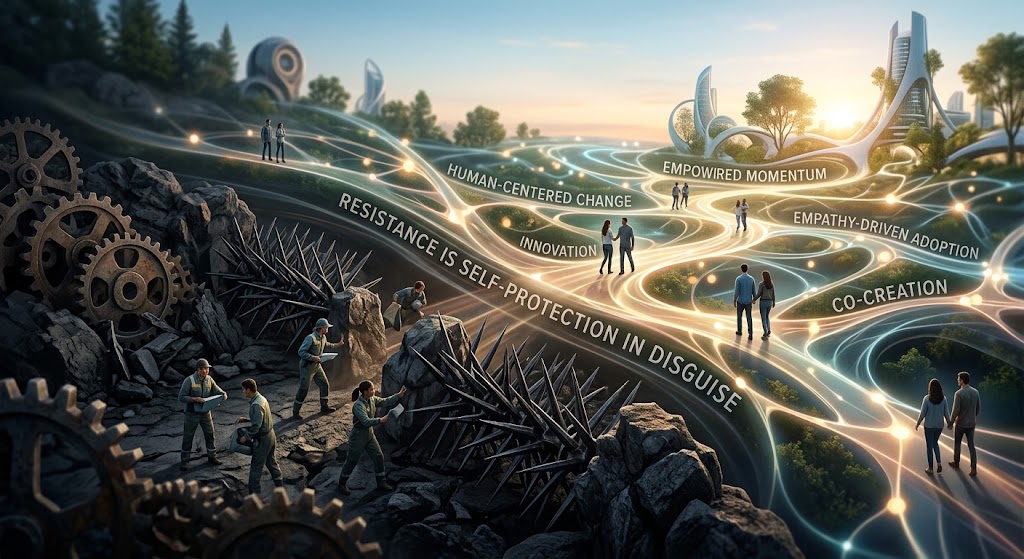
The Flawed Narrative of the “Resistant Employee”
For decades, traditional change management has operated under a confrontational premise: change is introduced from on high, and any hesitation from the organization is labeled as “employee resistance” to be overcome, coerced, or managed away. Leaders build war rooms, craft aggressive communication plans, and deploy top-down mandates aimed at breaking through the wall of pushback. Yet, despite millions spent on change management toolkits and executive roadshows, the industry metric remains stubbornly static—roughly 70 percent of organizational transformations still fail to achieve their intended goals.
The problem isn’t that people inherently hate change; it’s that we are misdiagnosing the response. In a human-centered framework, resistance is rarely malice, cynicism, or laziness. Resistance is valuable biological, emotional, and operational signaling. It is a diagnostic metric highlighting hidden friction, systemic ambiguity, unaddressed risk, and a fundamental breakdown in trust. When an individual or a team pushes back against a new process, software roll-out, or restructuring, they are almost always engaging in a rational act of self-protection.
If we want to build adaptable, resilient organizations that can continuously innovate, we must retire the flawed narrative of the “resistant employee.” To move past forced compliance and achieve true adoption, leaders must stop fighting resistance as an enemy and start uncovering what their people are trying to protect.
The Anatomy of Self-Protection: What Are People Really Defending?
When leadership introduces a major initiative, the natural human reaction is rarely an abstract rejection of progress. Instead, it is a protective response triggered by perceived threats to personal stability, professional standing, and daily mastery. When employees push back, they are usually guarding four core assets:
1. Loss of Mastery and Competence
Your top performers have spent years—sometimes decades—honing their expertise, mastering legacy systems, and establishing efficient workflows. A sudden shift in tools, processes, or business models threatens to instantly downgrade an expert to a novice. The pushback isn’t a refusal to learn; it is a rational defense mechanism against feeling incompetent, making public mistakes, or falling behind on performance metrics during the transition.
2. Loss of Autonomy and Agency
Human beings thrive when they feel a sense of ownership over their work and environment. When changes are dictated from above without meaningful input or involvement from the front lines, it strips away agency. Employees naturally resist top-down control to preserve their autonomy and assert control over their day-to-day work experience.
3. Social Capital and Psychological Safety
Organizational structures run on informal networks, trust, and peer reputation. When a transformation threatens to alter team dynamics, shift reporting structures, or eliminate established roles, it destabilizes social capital. People naturally act to protect their status, their hard-earned credibility, and their sense of psychological safety within the team.
4. Systemic Fatigue and Energy Conservation
Most workers have survived waves of “flavor-of-the-month” strategic shifts, half-baked software rollouts, and executive fads that faded into obscurity after a few quarters. When new initiatives arrive without clear continuity or sunsetting of old priorities, resistance is simply energy conservation. Employees protect their limited focus and well-being from burnout caused by constant, directionless churn.
Identifying the Expectation Gap and Operational Friction
To move past unproductive friction, leaders must recognize that resistance flourishes in the space between executive vision and frontline execution. When leadership views a transformation through a 30,000-foot strategic lens, the change appears logical, necessary, and seamless. However, to the employees responsible for daily delivery, that same change manifests as operational disruption, unaddressed ambiguity, and added complexity.
The Expectation Gap
The expectation gap occurs when decision-makers design solutions in isolation, assuming clean environments, ideal resources, and flawless adoption paths. When the reality of legacy workarounds, competing priorities, and resource constraints collides with this idealized vision, natural friction occurs. Employees who point out these disconnects are often labeled “naysayers,” when in fact they are identifying critical execution risks that leadership failed to anticipate.
Obstacles to Adoption vs. Obstacles to Delight
Human-centered transformation requires distinguishing between two distinct forms of organizational friction:
- Obstacles to Adoption: The fundamental, physical, and technical barriers that prevent people from executing the new way of working—such as inadequate training, broken tooling, contradictory incentives, or insufficient time allocations.
- Obstacles to Delight: The emotional, cultural, and psychological barriers that prevent people from internalizing and embracing the change—such as lack of trust, fear of failure, or a perceived misalignment with core organizational values.
Addressing technical adoption barriers without resolving psychological obstacles to delight results in compliance without commitment—a fragile state where work stalls the moment oversight weakens.
The Hidden Costs of Forced Compliance
When organizations use mandates and authority to bypass genuine engagement, they do not eliminate resistance; they merely drive it underground. Forced compliance yields passive resistance, malicious compliance, and quiet detachment. Employees perform the bare minimum to check the box while withholding the discretionary effort, creativity, and problem-solving required to make innovation successful. True adoption cannot be commanded—it must be designed.
From Resistance to Co-Creation: Human-Centered Design Strategies
Overcoming self-protection requires moving away from pushing change at people and transitioning to designing change with them. When employees are invited to become active architects of the future, resistance naturally transforms into ownership and momentum. Human-centered strategies convert organizational friction into valuable insight.
Getting Everyone on the Same Page
Misalignment thrives in obscurity. Traditional change efforts rely on heavy text documents, endless slide decks, and top-down mandates that leave ample room for misinterpretation. Using visual, collaborative frameworks—such as the Change Planning Canvas™—enables cross-functional teams to map out goals, identify risks, surface assumptions, and clarify expectations in an open, visual environment before execution begins.
Shifting from Telling to Listening
Leaders must treat pushback as critical diagnostic input rather than insubordination. When friction arises, the default response should shift from defensive repetition of corporate messaging to structured inquiry. By asking targeted questions—such as “What operational barrier is this creating for you?” or “What are we asking you to give up?”—leaders uncover hidden risks and gain actionable feedback to refine the solution.
Designing the WIFM (What’s In It For Me?)
For a transformation to stick, the value proposition cannot exist solely at the enterprise level. While executive leadership focuses on market share, efficiency, and revenue growth, individuals evaluate change through personal impact. Human-centered design aligns organizational objectives with frontline needs by explicitly addressing how the new way of working protects psychological safety, reduces daily hassle, builds valuable skills, or enhances long-term career growth.
Empowering Change Champions as Co-Architects
True adoption is built through grassroots participation. Rather than designating “change ambassadors” merely to parrot leadership communications, organizations should empower frontline impacted teams as co-architects. Giving employees genuine agency to test prototypes, refine workflows, and adapt implementation details to their operational reality restores their sense of control and turns potential critics into active drivers of innovation.
Conclusion: Turning Friction into Momentum
The ultimate measure of effective change leadership is not how swiftly an organization suppresses pushback, but how thoughtfully it interprets it. When leaders recognize that resistance is often self-protection in disguise, friction ceases to be a threat—it becomes a strategic roadmap highlighting where clarity, safety, support, and refinement are needed most.
The Mindset Shift for Change Leaders
Transformational success requires abandoning the outdated conquer-and-command playbook. Human-centered leaders do not build battering rams to break down organizational walls; they design bridges grounded in empathy, mutual trust, and shared purpose. By reframing resistance as a rational defense of mastery, autonomy, and psychological safety, leaders replace anxiety with agency and skepticism with co-ownership.
Protecting People to Protect the Enterprise
To navigate continuous disruption, organizations must honor resistance as a vital diagnostic tool rather than an operational defect. When you respect and protect your people’s core human needs during times of transition, you unlock their discretionary effort, ingenuity, and resilience. Protect your people through the process, and they will help you build and protect the future of the enterprise.
Frequently Asked Questions
Why is employee resistance considered self-protection rather than opposition to change?
When employees resist organizational change, they are usually attempting to defend core professional assets such as hard-earned mastery, daily autonomy, psychological safety, or personal energy reserves against burnout. Framing resistance as self-protection shifts the perspective from a human defect to a rational response to perceived threat and uncertainty.
How does a human-centered approach differ from traditional change management?
Traditional change management relies on top-down mandates, coercive communication plans, and forced alignment to overcome pushback. In contrast, human-centered change treats resistance as valuable diagnostic signaling, actively involving impacted employees early through collaborative frameworks to co-create solutions and eliminate operational friction.
What is the most effective way for leaders to convert resistance into adoption?
Leaders can transform resistance into adoption by shifting from telling to structured listening, using visual collaborative tools like the Change Planning Canvas™, and ensuring the transformation addresses frontline value (“What’s In It For Me?”) alongside enterprise goals. Involving impacted teams as co-architects restores agency and turns friction into collective momentum.
EDITOR’S NOTE: Braden Kelley’s Problem Finding Canvas can be a super useful starting point for doing design thinking or human-centered design.
“The Problem Finding Canvas should help you investigate a handful of areas to explore, choose the one most important to you, extract all of the potential challenges and opportunities and choose one to prioritize.”
Image credit: Gemini
 Sign up here to get Human-Centered Change & Innovation Weekly delivered to your inbox every week.