The Experiment Canvas™: Five Gravity-Control Innovation Experiments Visualized

by Braden Kelley and Art Inteligencia
What Is The Experiment Canvas™? (Short Answer)
The Experiment Canvas™ is a one-page innovation tool for structuring experiments that prove or disprove the feasibility, viability, and desirability of a potential innovation — before you burn capital on the wrong bet. It forces a clear hypothesis, helpers, resources, risks, assumptions, barriers, a three-phase experiment plan (setup → execution → wrap-up), and learning metrics that can falsify the idea.
Below: why the canvas accelerates innovation speed and success rates — and five filled examples for a hypothetical gravity control appliance, showing how a radical idea can be broken into sequenced experiments that cull likely failures early.
Why Innovators Need to Instrument for Learning — Not Hope
Most innovation waste is not bad imagination. It is unfalsified imagination: teams fund prototypes, labs, and roadmaps without a written hypothesis, kill criteria, or a learning metric anyone would defend in a budget meeting. Activity photographs well. Learning does not — unless you design for it.
I created The Experiment Canvas™ as part of the Human-Centered Innovation Toolkit™ to help teams instrument for learning fast in iterative new product or service development. The canvas makes the experiment visual and collaborative — so alignment, accountability, and outcomes improve together. Specs can follow. Hope should not lead.
Used well, the canvas helps you:
- Accelerate speed — by sequencing the questions that matter (physics before scale; safety before market theater; cost before Series B fantasy).
- Raise odds of success — by naming helpers, resources, assumptions, and barriers before the first dollar of build.
- Cull likely failures early — with fail-fast gates and learning metrics that can say “no” while the bet is still cheap.
How The Experiment Canvas™ Structures a Bet
Each canvas asks the same disciplined questions, in roughly this flow:
| Zone | What it forces |
|---|---|
| Hypothesis | The question, feasibility/viability/desirability angles, fatal flaws, adoption blockers |
| Who can help / resources / risks | Real people, real tools, real downside — not a slide of optimism |
| Phases 1–3 | Setup, execution, wrap-up with evidence, insight, and next gate |
| Assumptions & barriers | What must be true — and what can stop you |
| Learning metrics | Three measures that can falsify the bet |
To show how this works on something intentionally extreme, I recently built five Experiment Canvas examples (CLICK THEM to get the big version) for a hypothetical gravity control appliance. The point is not sci-fi cosplay. The point is method: even a moonshot becomes manageable when you break it into experiments that can fail honestly.
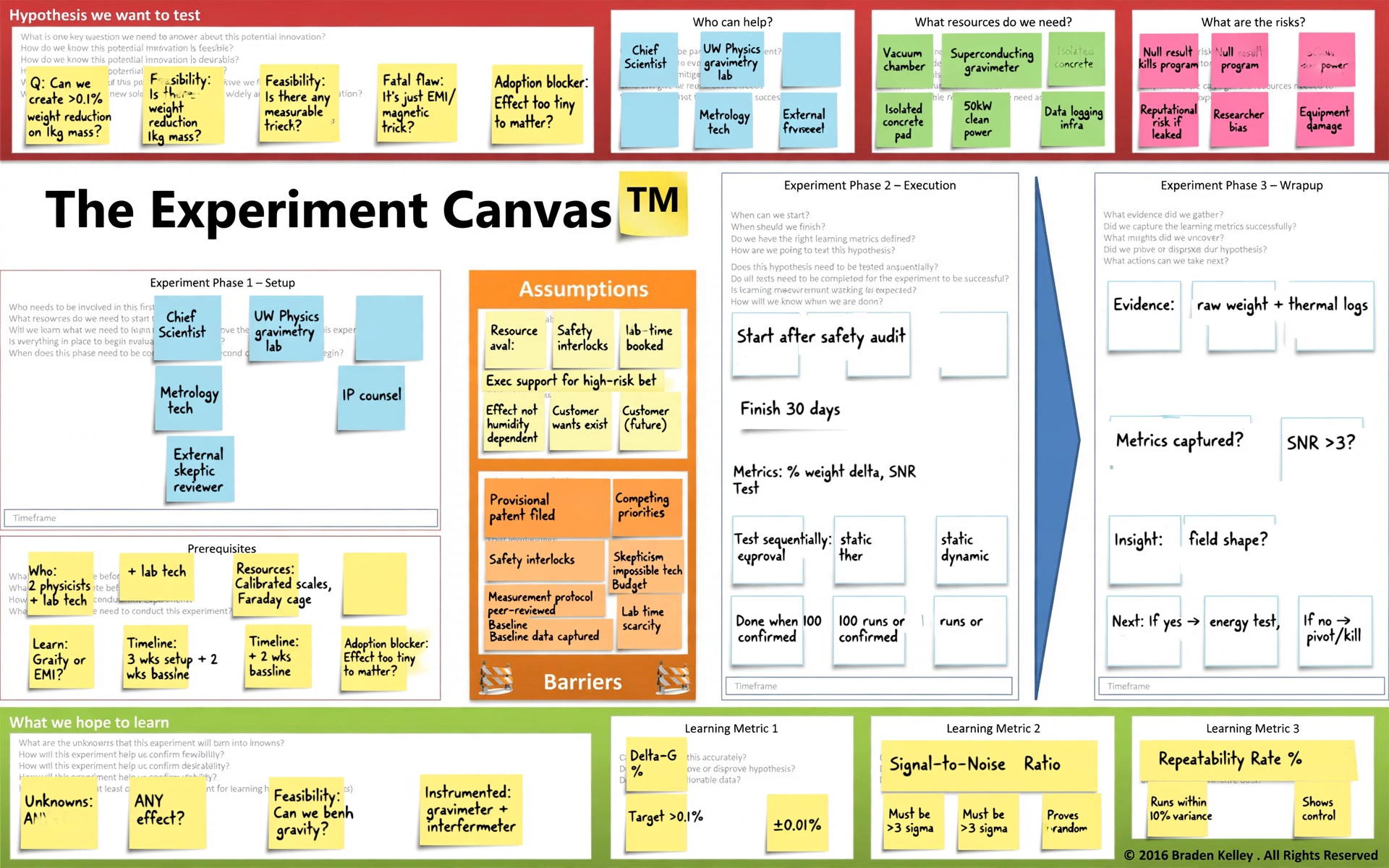
Example 1 — Physics Feasibility: Is There Any Measurable Effect?
Core hypothesis: Can we create >0.1% weight reduction on a 1kg mass — or is there any measurable effect at all?
This first canvas attacks the fatal question: is there a signal, or are we chasing EMI / magnetic tricks and reputational risk? Helpers include a chief scientist, a gravimetry lab, metrology, and an external skeptic reviewer. Learning metrics demand delta-G, signal-to-noise (>3 sigma), and repeatability. Next gate: if yes → energy test; if no → pivot or kill.
Example 2 — Energy Efficiency: Is the Cost Per Newton Survivable?
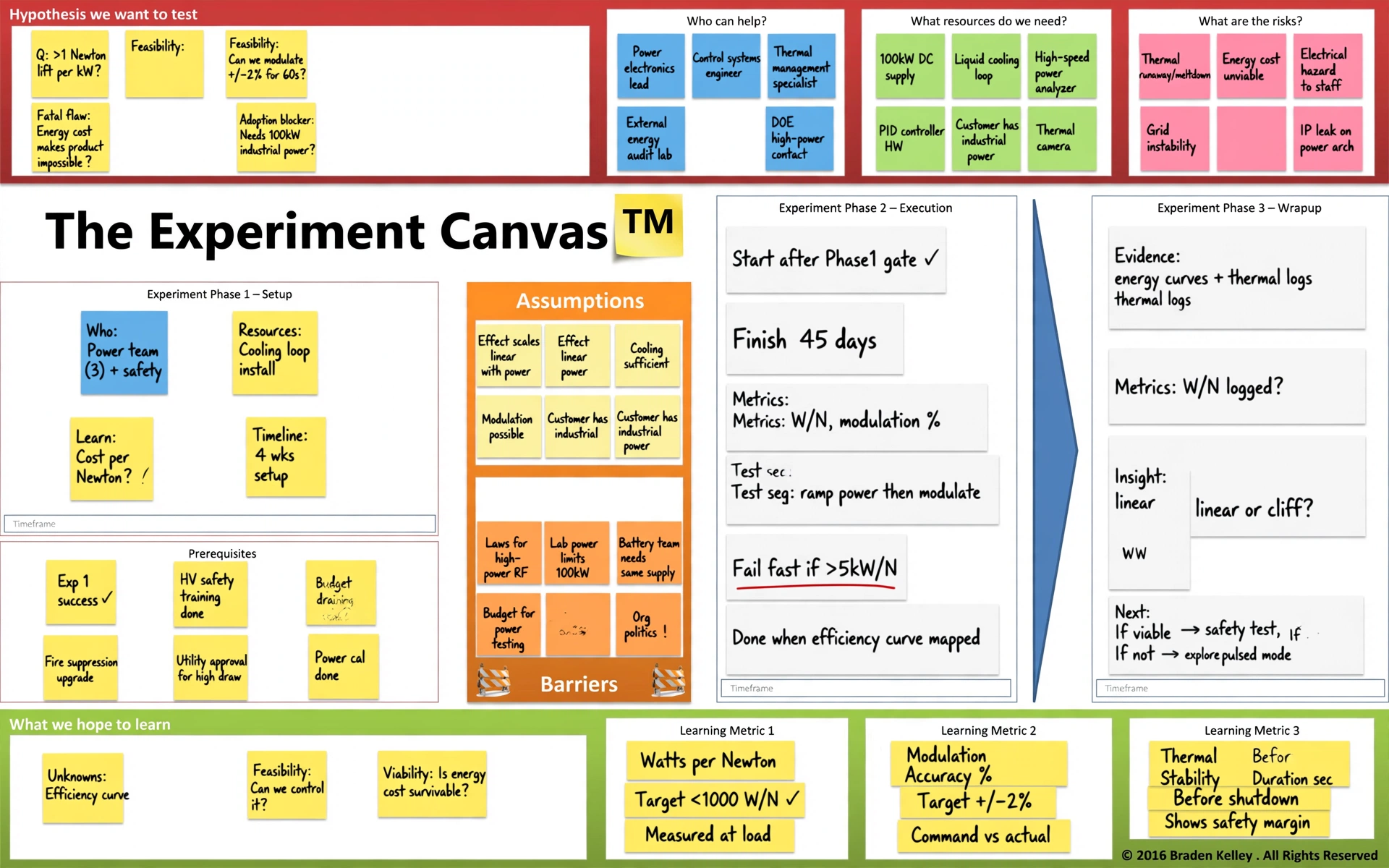
Core hypothesis: Can we achieve >1 Newton of lift per kW — and modulate ±2% for 60 seconds — without an energy cost that makes the product impossible?
Prerequisite: Example 1 success. This canvas puts power electronics, thermal management, and fail-fast gates on the page (>5 kW/N kills the path). Metrics: watts per Newton, modulation accuracy, thermal stability. Insight: is the curve linear — or a cliff? Soft landings for radical tech start with honesty about energy economics.
Example 3 — Safety Envelope: Is Exposure Safe Enough to Sell?
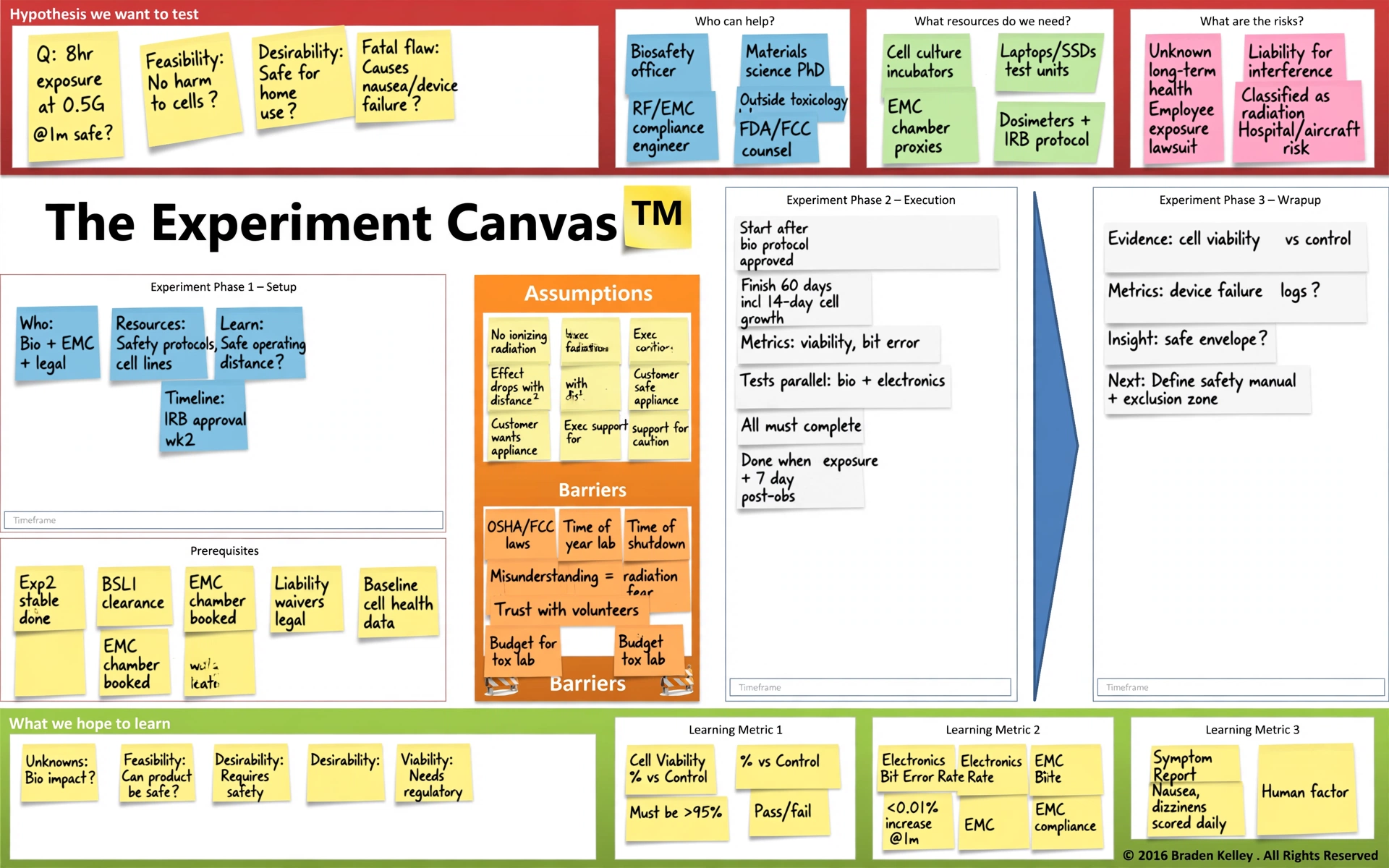
Core hypothesis: Is 8-hour exposure at 0.5G at 1 meter safe — for cells, electronics, and humans?
Prerequisite: a stable Example 2. Here feasibility, desirability, and viability collide: bio impact, EMC, nausea, regulatory classification, liability. Metrics include cell viability (>95% vs control), bit-error rate / EMC compliance, and human symptom reports. Next: define a safety manual and exclusion zone — or stop before market theater begins.
Example 4 — Market Desirability: Who Has Gravity Pain Worth Paying For?
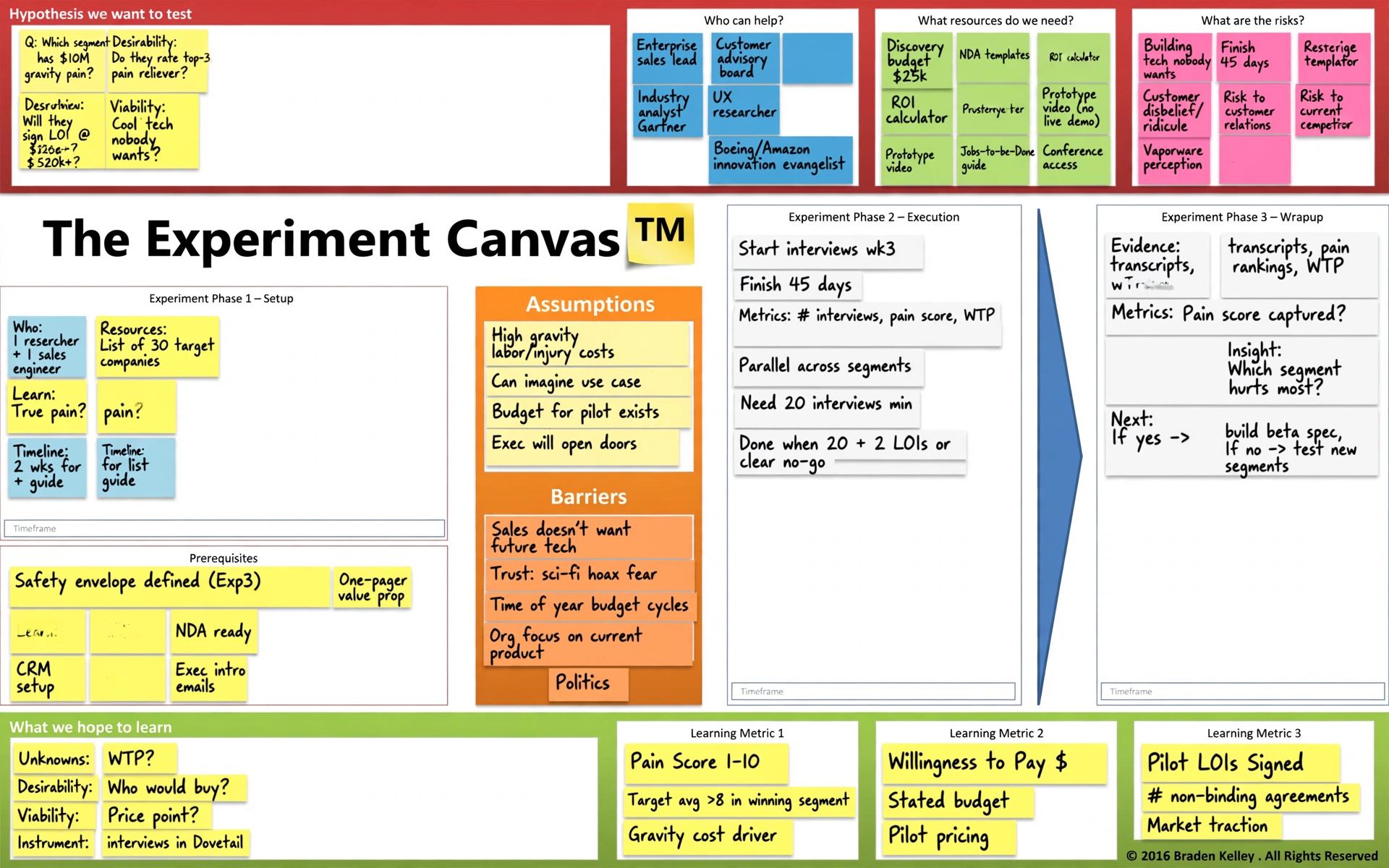
Core hypothesis: Which segment has ~$10M gravity-related pain — and will they sign LOIs at real price points ($120k+ / $520k+), or is this cool tech nobody wants?
Prerequisite: safety envelope from Example 3. This is the desirability canvas — interviews, pain scores, willingness to pay, and traction via pilot LOIs. Done when you have enough contact evidence for a go or a clear no-go. Building without a segment that hurts is innovation theater with better physics.
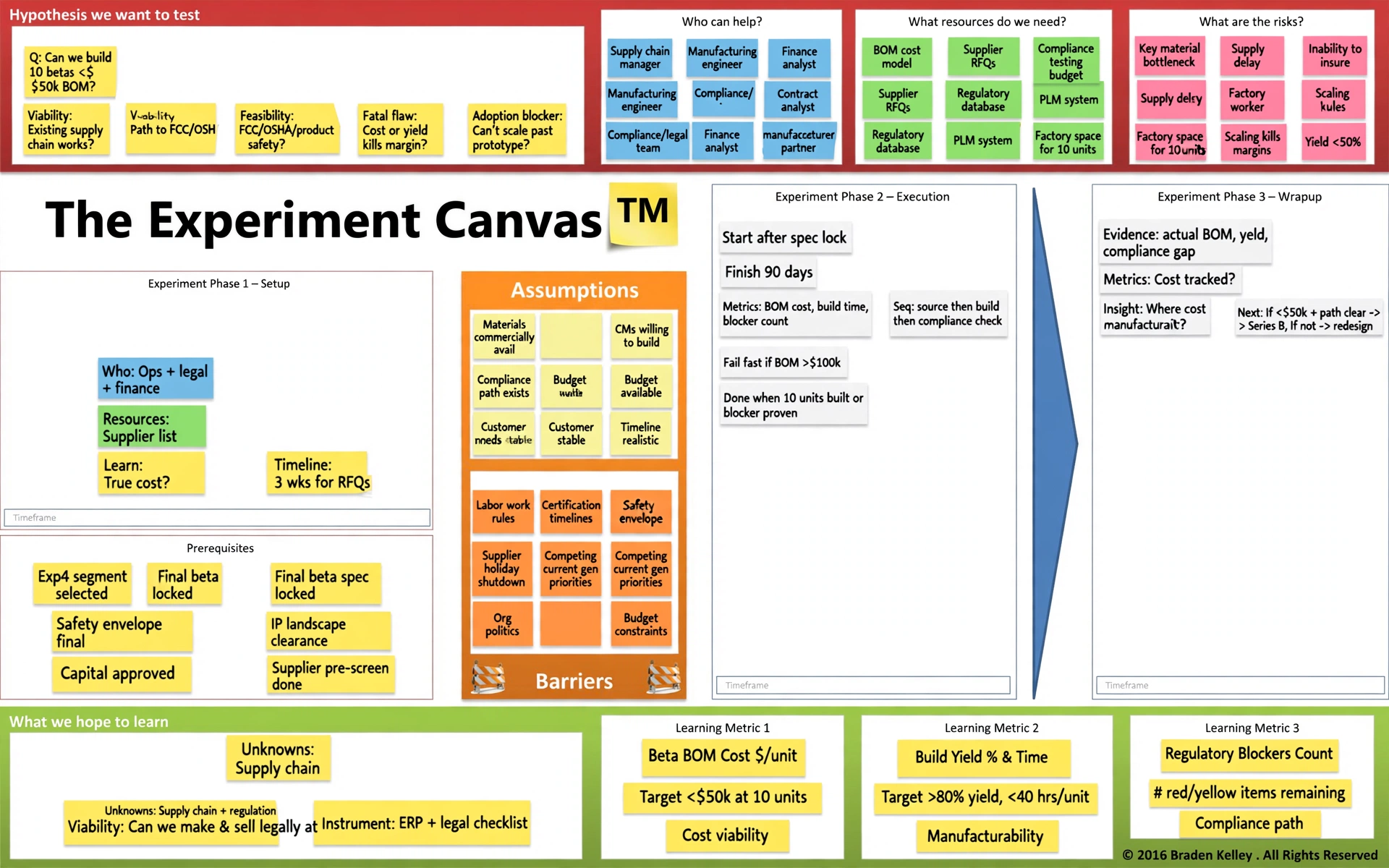
Example 5 — Manufacturing Viability: Can We Build 10 Betas Under $50k BOM?
Core hypothesis: Can we build 10 beta units at under $50k bill of materials — with a real path through supply chain, yield, and compliance?
This viability canvas asks whether the existing supply chain works, whether FCC/OSHA/product safety is a path or a wall, and whether cost or yield kills margin. Fail fast if BOM exceeds $100k. Metrics: unit cost, manufacturability (yield and hours), compliance blockers. Next: if cost and path are clear → fund the next round; if not → redesign before you scale a fantasy.
What These Five Canvases Teach About Speed and Success
Read the five examples in sequence and a pattern appears:
- Sequence the fatal questions. Physics before energy. Energy before safety. Safety before market. Market before manufacturing scale.
- Write the kill criteria in advance. Null result, >5 kW/N, unsafe exposure, no LOIs, BOM blowout — each canvas names how to stop.
- Make learning metrics falsifiable. Three metrics per canvas beat a hundred vanity KPIs.
- Surface helpers, risks, assumptions, and barriers. Innovation fails politically as often as it fails scientifically.
- Treat wrap-up as a decision, not a report. Evidence → insight → next gate. No cemetery of unfinished experiments.
You do not need a gravity appliance to use the method. You need a bet you are tempted to fund on enthusiasm alone — and the discipline to instrument learning before the money gets loud.
Download The Experiment Canvas™ and Run Your Next Bet
The Experiment Canvas™ is available as a free, premium 35″ × 56″ scalable PDF — suitable for wall-sized workshops, 11″ × 17″ (A3) printing, or as a background in Miro, Mural, Lucid, Microsoft Whiteboard, and similar tools. It is one of the optional components of the Human-Centered Innovation Toolkit™.
Go download The Experiment Canvas™ here:
https://bradenkelley.com/product/experiment-canvas-35″-x-56″-poster-size/
Write the hypothesis. Name the metrics that can kill the bet. Run the experiment. Soft landings for innovation are designed — one falsifiable canvas at a time.
Frequently Asked Questions
What is The Experiment Canvas™?
The Experiment Canvas™ is a free innovation tool by Braden Kelley for structuring experiments that test feasibility, viability, and desirability. It covers hypothesis, helpers, resources, risks, setup/execution/wrap-up phases, assumptions, barriers, and learning metrics.
How does The Experiment Canvas™ accelerate innovation?
It forces teams to write a falsifiable hypothesis, sequence fatal questions, name kill criteria and learning metrics, and decide next steps based on evidence — so weak bets die early and strong bets get clearer gates before capital scales.
What are feasibility, viability, and desirability in innovation experiments?
Feasibility asks whether it can work technically. Desirability asks whether humans want it enough to hire it. Viability asks whether it can be made, sold, and sustained economically and legally. The Experiment Canvas™ helps you instrument learning across all three.
Where can I download The Experiment Canvas™?
Download the free 35″ × 56″ poster-size PDF from Braden Kelley’s product page: https://bradenkelley.com/product/experiment-canvas-35″-x-56″-poster-size/
Why use a gravity control appliance as an Experiment Canvas example?
An intentionally extreme hypothetical shows the method under stress: physics, energy, safety, market, and manufacturing each get their own canvas with kill criteria. If the tool works for a moonshot-style idea, it works for the bets already on your roadmap.
Image Credits: Gemini
Content Authenticity Statement: The topic area, key elements to focus on, etc. were decisions made by Braden Kelley, with a little help from Cursor to clean up the article.
 Sign up here to get Human-Centered Change & Innovation Weekly delivered to your inbox every week.