When AI Agents Act on Your Behalf
by Braden Kelley and Art Inteligencia
From Answers to Actions: The Agentic Shift
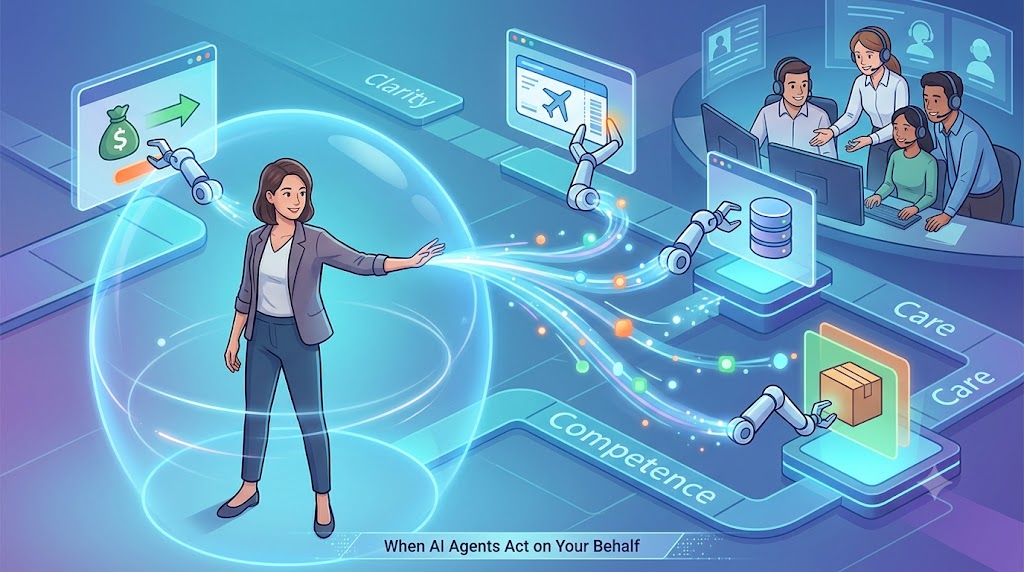
For a decade, “AI in customer experience” mostly meant better answers: chatbots that deflected, assistants that summarized, copilots that drafted. Helpful, imperfect, and still largely conversational. The agentic shift is different. Systems are no longer limited to recommending what a human should do. They are beginning to do — refund, reschedule, rebook, reroute, update records, trigger fulfillment, and coordinate multi-step journeys across channels without waiting for a ticket to crawl through three departments.
That is not a feature upgrade. It is a change in the relationship. The brand now includes a non-human actor with authority. When an agent acts, it acts in the company’s name and, increasingly, on the customer’s behalf. Experience design can no longer stop at tone of voice and containment rates. It must account for delegated power.
Human-centered innovators should hear the signal underneath the hype. Customers are not primarily evaluating whether your AI sounds clever. They are evaluating whether your organization is safe to trust with unfinished business. Answering a question poorly is friction. Acting incorrectly — or acting opaquely — is a breach of the emotional contract.
Welcome to agentic customer experience: where loyalty is shaped less by what the brand says, and more by what its agents are allowed to decide.
Why Customers Will Forgive Slowness — But Not Betrayal
Customers have always traded time for confidence. Many will wait for a competent human. Far fewer will repeatedly educate a system that forgets context, loops through the same failed path, or blocks the exit to a person. Research across the industry keeps pointing to the same pattern: openness to AI rises when it resolves issues completely — and collapses quickly when it wastes attempts, hides escalation, or makes people feel trapped.
This is where leaders misread the risk. They optimize for speed and deflection, then wonder why trust erodes. People will often forgive slowness when they feel progress and respect. They will not forgive what feels like betrayal: decisions that seem optimized for the brand’s cost curve, recommendations that ignore stated preferences, silent policy enforcement with no explanation, or “self-service” that is really forced service.
Betrayal in CX is usually quiet. It looks like a denied refund with no rationale. An agent that “helps” by steering toward what is easiest to contain. A personalization engine that remembers everything except the customer’s dignity. The nervous system keeps score. So does the switching decision.
In the agentic era, the question is not only Did we resolve it? It is Did we resolve it in a way that still makes this relationship feel safe?
The New Experience Design Problem: Delegation
Most AI roadmaps are still framed as automation problems: what can we remove from the human queue? That framing is incomplete. From the customer’s side, agentic CX is a delegation problem. People are deciding how much unfinished business they are willing to hand to a system that can act without them in the room.
Delegation requires a different design brief. Customers need to know what is being done, why it is being done, what happens if it goes wrong, and how to reclaim control. Without those conditions, “autonomy” feels like abandonment dressed up as innovation.
Human-centered experience design therefore asks emotional jobs beneath the functional ones:
- Do I feel represented — or processed?
- Do I feel informed — or surprised after the fact?
- Do I feel able to intervene — or locked out by design?
- Do I feel the brand is on my side — or merely efficient at managing me?
This is why transparency is not a compliance garnish. It is part of the product. So is the handoff. An elegant agent that cannot escalate with context intact is not advanced; it is brittle. Agentic excellence includes knowing when not to act alone.
Four Trust Pillars for Agentic CX
If agentic systems will act in your name, trust needs architecture — not slogans. Four pillars help leaders design for loyalty rather than mere containment.
Clarity
Customers should understand when AI is involved, what it can and cannot do, and what just happened. Clarity reduces suspicion. Mystery breeds it. “Transparency by design” means visible agency, plain-language explanations, and no dark patterns that disguise automation as a person.
Competence
An agent that acts must finish the job. Partial resolution, lost context, and repetitive failure teach customers that delegation is unsafe. Competence is end-to-end: data continuity, accurate policy application, and the ability to complete multi-step work without making the customer re-narrate their life story.
Control
Trust grows when people can undo, override, confirm high-stakes actions, and reach a human without being punished for asking. Control is not the enemy of automation; it is what makes automation acceptable. The best agentic experiences feel powerful and reversible.
Care
The decisive pillar: whose interest is being optimized? If customers believe the agent is steering them toward what is best for the brand — upsell, denial, deflection — loyalty decays even when the interaction is fast. Care means designing decision logic that is fair, explainable, and aligned with the customer’s stated goal.
Clarity, competence, control, and care. Miss one, and agentic CX becomes a trust tax. Honor all four, and autonomy becomes hospitality at scale.
Orchestration Without Losing the Human
The winning model is not AI-only theater. It is orchestration: purposeful sequencing of agentic action, human judgment, and channel continuity so the customer experiences one coherent journey instead of a relay race of disconnected tools.
Agentic AI is uniquely suited to routine multi-step work — the operational choreography that used to create delay and handoff fatigue. Humans remain essential for ambiguity, emotion, ethical judgment, and exceptions that policies cannot pre-chew. CX leaders increasingly expect human interactions to become more complex as AI absorbs the simple. That is not failure of automation. That is the work migrating to where empathy and discernment still matter most.
Orchestration also includes the employee experience. If frontline teams inherit broken context, unexplained agent decisions, and no authority to repair trust, customers will feel that fracture immediately. Human-centered change treats agents and employees as one system: AI handles volume and velocity; people handle meaning and recovery.
Design the sequence, not just the bot. Decide what should happen before, during, and after autonomous action. Make escalation a first-class journey path, not a hidden defeat. In agentic CX, the brand is the conductor. The technology is the orchestra. Customers can tell when nobody is conducting.
A Human-Centered Playbook for the Agentic Era
Urgency without a playbook produces demos. Loyalty requires operating discipline. Start here.
- Define decision rights before you deploy autonomy. Which actions can an agent take alone, which require confirmation, and which are human-only? Write it as policy customers can feel in the experience.
- Design recovery as carefully as resolution. Every autonomous action needs an undo path, an explanation path, and a dignified escalation path with context preserved.
- Measure trust outcomes, not only efficiency. Containment and average handle time matter. So do repeat contact, forced re-explanation, escalation friction, complaint themes, and whether customers say they would delegate again.
- Prototype agent behavior on real journeys. Test the emotional arc of delegation: consent, action, visibility, completion, and repair. Bodies and language reveal failure faster than dashboards.
- Govern for care in public. State how data is used, how models decide, and how you prevent brand-first bias. Trust compounds when principles are operational, not ornamental.
The future of customer experience will not be judged by how many agents you launched. It will be judged by what those agents did in your customers’ names — and whether people still felt human while it happened. Brands that treat agentic AI as a cost play will win quarters. Brands that treat it as a trust system will win relationships.
That is the human-centered mandate of the agentic era: give your systems the power to act, and give your customers every reason to believe that power is being used with them, not on them.
Frequently Asked Questions
What is agentic customer experience?
Agentic customer experience is when AI systems can take multi-step actions on behalf of the customer or company — such as refunds, rescheduling, routing, or journey orchestration — rather than only answering questions. It shifts CX from conversation to delegated action, which raises the bar for trust, transparency, and human handoff.
How can brands build trust in AI agents that act for customers?
Build trust through four pillars: clarity about when AI is acting, competence in completing work with context preserved, control through undo and easy human escalation, and care by optimizing for the customer’s interest rather than containment alone. Recovery design matters as much as automation design.
Will human agents still matter in an agentic CX model?
Yes. Agentic AI is best for routine multi-step work, while humans remain essential for complex, emotional, and exceptional cases. The winning model is orchestration: AI and people working as one system, with seamless escalation and shared context so customers never feel abandoned by automation.
Image credits: Gemini
Content Authenticity Statement: The topic area, key elements to focus on, etc. were decisions made by Braden Kelley, with a little help from Cursor to clean up the article.
 Sign up here to get Human-Centered Change & Innovation Weekly delivered to your inbox every week.