The North Star Shift
LAST UPDATED: January 5, 2026 at 5:29PM

by Braden Kelley
In a world of accelerating change, the rhetoric around Artificial Intelligence often centers on its incredible capacity for optimization. We hear about AI designing new materials, orchestrating complex logistics, and even writing entire software applications. This year, the technology has truly matured into agentic AI, capable of pursuing and achieving defined objectives with unprecedented autonomy. But as a specialist in Human-Centered Innovation™ (which pairs well with Outcome-Driven Innovation), I pose two crucial questions: Who is defining these outcomes, and what impact do they truly have on the human experience?
The real innovation of 2026 will show not just that AI can optimize against defined outcomes, but that we, as leaders, finally have the imperative — and the tools — to master Outcome-Driven Innovation and Outcome-Driven Change. If innovation is change with impact, then our impact is only as profound as the outcomes we choose to pursue. Without thoughtful, human-centered specifications, AI simply becomes the most efficient way to achieve the wrong goals, leading us directly into the Efficiency Trap. This is where organizations must overcome the Corporate Antibody response that resists fundamental shifts in how we measure success.
Revisiting and Applying Outcome-Driven Change in the Age of Agentic AI
As we integrate agentic AI into our organizations, the principles of Outcome-Driven Change (ODC) I first introduced in 2018 are more vital than ever. The core of the ODC framework rests on the alignment of three critical domains: Cognitive (Thinking), Affective (Feeling), and Conative (Doing). Today, AI agents are increasingly assuming the “conative” role, executing tasks and optimizing workflows at superhuman speeds. However, as I have always maintained, true success only arrives when what is being done is in harmony with what the people in the organization and customer base think and feel.
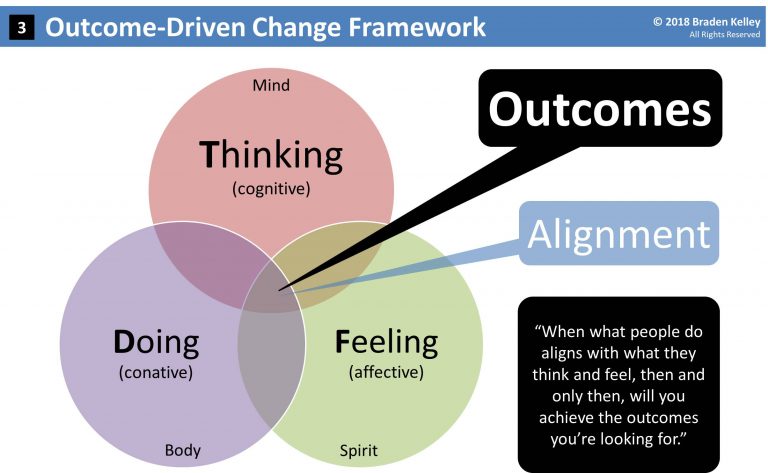
If an AI agent’s autonomous actions are misaligned with human psychological readiness or emotional context, it will trigger a Corporate Antibody response that kills innovation. To practice genuine Human-Centered Change™, we must ensure that AI agents are directed to pursue outcomes that are not just numerically efficient, but humanly resonant. When an AI’s “doing” matches the collective thinking and feeling of the workforce, we move beyond the Efficiency Trap and create lasting change with impact.
“In the age of agentic AI, the true scarcity is not computational power; it is the human wisdom to define the right ‘North Star’ outcomes. An AI optimizing for the wrong goal is a digital express train headed in the wrong direction – efficient, but ultimately destructive.” — Braden Kelley
From Feature-Building to Outcome-Harvesting
For decades, many organizations have been stuck in a cycle of “feature-building.” Product teams were rewarded for shipping more features, marketing for launching more campaigns, and R&D for creating more patents. The focus was on output, not ultimate impact. Outcome-Driven Innovation shifts this paradigm. It forces us to ask: What human or business value are we trying to create? What measurable change in behavior or well-being are we seeking?
Agentic AI, when properly directed, becomes an unparalleled accelerant for this shift. Instead of building a new feature and hoping it works, we can now tell an AI agent, “Achieve Outcome X for Persona Y, within Constraints Z,” and it will explore millions of pathways to get there. This frees human teams from the tactical churn and allows them to focus on the truly strategic work: deeply understanding customer needs, identifying ethical guardrails, and defining aspirational outcomes that genuinely drive Human-Centered Innovation™.
Case Study 1: Sustainable Manufacturing and the “Circular Economy” Outcome
The Challenge: A major electronics manufacturer in early 2025 aimed to reduce its carbon footprint but struggled with the complexity of optimizing its global supply chain, product design, and end-of-life recycling simultaneously. Traditional methods led to incremental, siloed improvements.
The Outcome-Driven Approach: They defined a bold outcome: “Achieve a 50% reduction in virgin material usage across all product lines by 2028, while maintaining profitability and product quality.” They then deployed an agentic AI system to explore new material combinations, reverse logistics networks, and redesign possibilities. This AI was explicitly optimized to achieve the circular economy outcome.
The Impact: The AI identified design changes that led to a 35% reduction in material waste within 18 months, far exceeding human predictions. It also found pathways to integrate recycled content into new products without compromising durability. The organization moved from a reactive “greenwashing” approach to proactive, systemic innovation driven by a clear, human-centric environmental outcome.
Case Study 2: Personalized Education and “Mastery Outcomes”
The Challenge: A national education system faced stagnating literacy rates, despite massive investments in new curricula. The focus was on “covering material” rather than ensuring true student understanding and application.
The Outcome-Driven Approach: They shifted their objective to “Ensure 90% of students achieve demonstrable mastery of core literacy skills by age 10.” An AI tutoring system was developed, designed to optimize for individual student mastery outcomes, rather than just quiz scores. The AI dynamically adapted learning paths, identified specific knowledge gaps, and even generated custom exercises based on each child’s learning style.
The Impact: Within two years, participating schools saw a 25% improvement in mastery rates. The AI became a powerful co-pilot for teachers, freeing them from repetitive grading and allowing them to focus on high-touch mentorship. This demonstrated how AI, directed by human-defined learning outcomes, can empower both educators and students, moving beyond the Efficiency Trap of standardized testing.
Leading Companies and Startups to Watch
As 2026 solidifies Outcome-Driven Innovation, several entities are paving the way. Amplitude and Pendo are evolving their product analytics to connect feature usage directly to customer outcomes. In the AI space, Anthropic‘s work on “Constitutional AI” is fascinating, as it seeks to embed human-defined ethical outcomes directly into the AI’s decision-making. Glean and Perplexity AI are creating agentic knowledge systems that help organizations define and track complex outcomes across their internal data. Startups like Metaculus are even democratizing the prediction of outcomes, allowing collective intelligence to forecast the impact of potential innovations, providing invaluable insights for human decision-makers. These players are all contributing to the core goal: helping humans define the right problems for AI to solve.
Conclusion: The Human Art of Defining the Future
The year 2026 is a pivotal moment. Agentic AI gives us unprecedented power to optimize, but with great power comes great responsibility — the responsibility to define truly meaningful outcomes. This is not a technical challenge; it is a human one. It requires deep empathy, strategic foresight, and the courage to challenge old metrics. It demands leaders who understand that the most impactful Human-Centered Innovation™ starts with a clear, ethically grounded North Star.
If you’re an innovation leader trying to navigate this future, remember: the future is not about what AI can do, but about what outcomes we, as humans, choose to pursue with it. Let’s make sure those outcomes serve humanity first.
Frequently Asked Questions
What is “Outcome-Driven Innovation”?
How does agentic AI change the role of human leaders in ODI?
What is the “Efficiency Trap” in the context of AI and outcomes?
Image credits: Braden Kelley, Google Gemini
Content Authenticity Statement: The topic area, key elements to focus on, etc. were decisions made by Braden Kelley, with a little help from Google Gemini to clean up the article.
 Sign up here to get Human-Centered Change & Innovation Weekly delivered to your inbox every week.
Pingback: Top 10 Human-Centered Change & Innovation Articles of January 2026 | Human-Centered Change and Innovation