A Day in the Life of the Algorithmic Executive
LAST UPDATED: December 28, 2025 at 1:56 PM
GUEST POST from Art Inteligencia
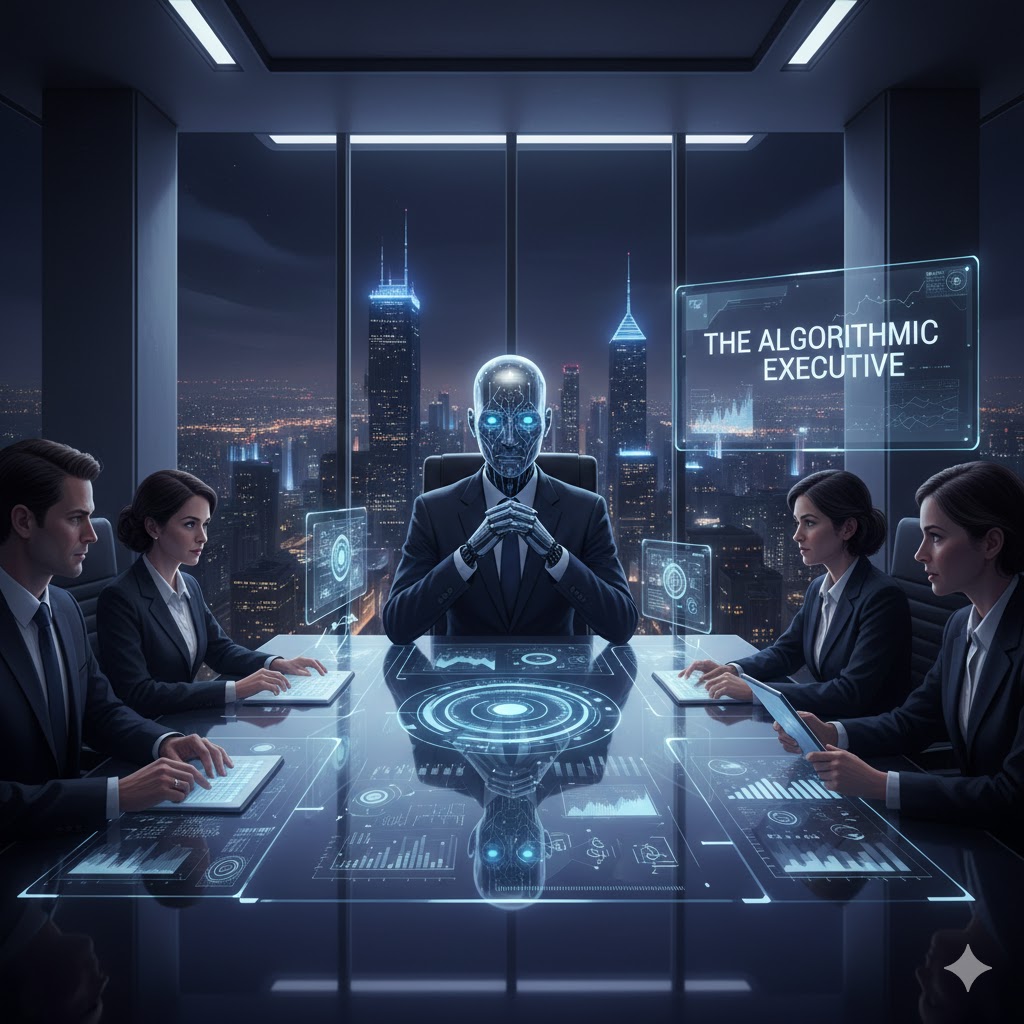
We are entering an era where the corporate antibody – that natural organizational resistance to disruptive change – is meeting its most formidable challenger yet: the AI CEO. For years, we have discussed the automation of the factory floor and the back office. But what happens when the “useful seeds of invention” are planted in the corner office?
The suggestion that an algorithm could lead a company often triggers an immediate emotional response. Critics argue that leadership requires soul, while proponents point to the staggering inefficiencies, biases, and ego-driven errors that plague human executives. As an advocate for Innovation = Change with Impact, I believe we must look beyond the novelty and analyze the strategic logic of algorithmic leadership.
— Braden Kelley
The Efficiency Play: Data Without Drama
The argument for an AI CEO rests on the pursuit of Truly Actionable Data. Humans are limited by cognitive load, sleep requirements, and emotional variance. An AI executive, by contrast, operates in Future Present mode — constantly processing global market shifts, supply chain micro-fluctuations, and internal sentiment analysis in real-time. It doesn’t have a “bad day,” and it doesn’t make decisions based on who it had lunch with.
Case Study 1: NetDragon Websoft and the “Tang Yu” Experiment
The Experiment: A Virtual CEO in a Gaming Giant
In 2022, NetDragon Websoft, a major Chinese gaming and mobile app company, appointed an AI-powered humanoid robot named Tang Yu as the Rotating CEO of its subsidiary. This wasn’t just a marketing stunt; it was a structural integration into the management flow.
The Results
Tang Yu was tasked with streamlining workflows, improving the quality of work tasks, and enhancing the speed of execution. Over the following year, the company reported that Tang Yu helped the subsidiary outperform the broader Hong Kong stock market. By serving as a real-time data hub, the AI signature was required for document approvals and risk assessments. It proved that in data-rich environments where speed of iteration is the primary competitive advantage, an algorithmic leader can significantly reduce operational friction.
Case Study 2: Dictador’s “Mika” and Brand Stewardship
The Challenge: The Face of Innovation
Dictador, a luxury rum producer, took the concept a step further by appointing Mika, a sophisticated female humanoid robot, as their CEO. Unlike Tang Yu, who worked mostly within internal systems, Mika serves as a public-facing brand steward and high-level decision-maker for their DAO (Decentralized Autonomous Organization) projects.
The Insight
Mika’s role highlights a different facet of leadership: Strategic Pattern Recognition. Mika analyzes consumer behavior and market trends to select artists for bottle designs and lead complex blockchain-based initiatives. While Mika lacks human empathy, the company uses her to demonstrate unbiased precision. However, it also exposes the human-AI gap: while Mika can optimize a product launch, she cannot yet navigate the nuanced political and emotional complexities of a global pandemic or a social crisis with the same grace as a seasoned human leader.
Leading Companies and Startups to Watch
The space is rapidly maturing beyond experimental robot figures. Quantive (with StrategyAI) is building the “operating system” for the modern CEO, connecting KPIs to real-work execution. Microsoft is positioning its Copilot ecosystem to act as a “Chief of Staff” to every executive, effectively automating the data-gathering and synthesis parts of the role. Watch startups like Tessl and Vapi, which are focusing on “Agentic AI” — systems that don’t just recommend decisions but have the autonomy to execute them across disparate platforms.
The Verdict: The Hybrid Future
Will AI replace the CEO? My answer is: not the great ones. AI will certainly replace the transactional CEO — the executive whose primary function is to crunch numbers, approve budgets, and monitor performance. These tasks are ripe for automation because they represent 19th-century management techniques.
However, the transformational CEO — the one who builds culture, navigates ethical gray areas, and creates a sense of belonging — will find that AI is their greatest ally. We must move from fearing replacement to mastering Human-AI Teaming. The CEOs of 2030 will be those who use AI to handle the complexity of the business so they can focus on the humanity of the organization.
Frequently Asked Questions
Can an AI legally serve as a CEO?
Currently, most corporate law jurisdictions require a natural person to serve as a director or officer for liability and accountability reasons. AI “CEOs” like Tang Yu or Mika often operate under the legal umbrella of a human board or chairman who retains ultimate responsibility.
What are the biggest risks of an AI CEO?
The primary risks include Algorithmic Bias (reinforcing historical prejudices found in the data), Lack of Crisis Adaptability (AI struggles with “Black Swan” events that have no historical precedent), and the Loss of Employee Trust if leadership feels cold and disconnected.
How should current CEOs prepare for AI leadership?
Leaders must focus on “Up-skilling for Empathy.” They should delegate data-heavy reporting to AI systems and re-invest that time into Culture Architecture and Change Management. The goal is to become an expert at Orchestrating Intelligence — both human and synthetic.
Disclaimer: This article speculates on the potential future applications of cutting-edge scientific research. While based on current scientific understanding, the practical realization of these concepts may vary in timeline and feasibility and are subject to ongoing research and development.
Image credits: Google Gemini
 Sign up here to get Human-Centered Change & Innovation Weekly delivered to your inbox every week.