When Being Human Becomes Economically Valuable
GUEST POST from Art Inteligencia
I. The Commodity Trap of Infinite Efficiency
For decades, the strategic imperative across industries has been singular: drive efficiency, reduce friction, and scale throughput. Organizations invested heavily in digitizing operations, optimizing supply chains, and automating routine tasks. Today, the rapid maturation of generative models, autonomous agents, and synthetic intelligence has pushed that trajectory to its logical conclusion. The marginal cost of execution—whether drafting code, generating content, or processing routine analysis—is rapidly approaching zero.
This drop in friction creates a strategic paradox. When every competitor has access to the same high-speed, low-cost execution engines, speed and efficiency cease to function as meaningful differentiators. They become mere baseline table stakes. When everything can be produced instantaneously, commodity value plummets. We are witnessing the shift from an economy driven purely by information processing to one defined by experience, trust, and shared human meaning.
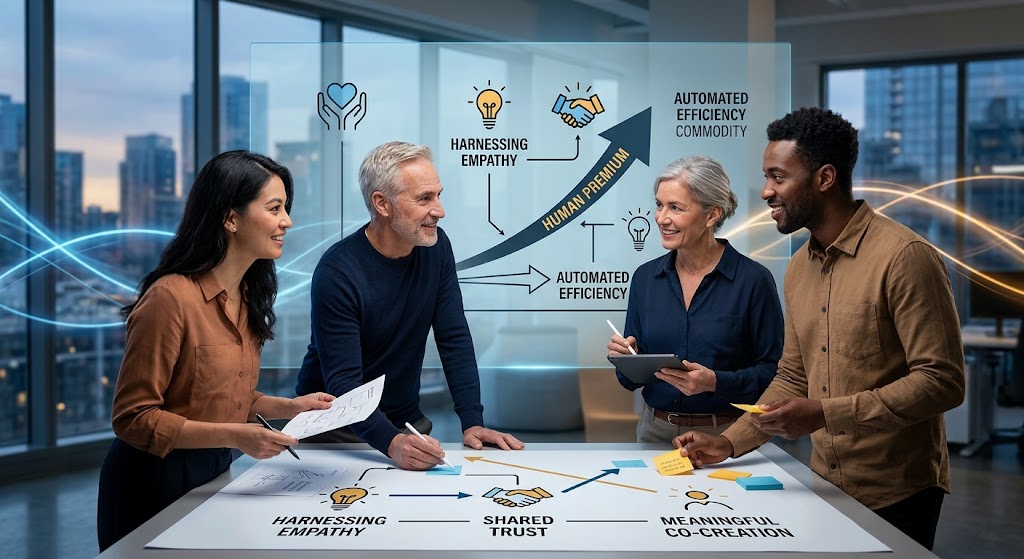
True, sustainable competitive advantage is moving away from raw computational speed and toward intentional human integration. The organizations that thrive in this next era will not be those that simply out-automate their rivals, but those that harness the non-replicable dimensions of humanity—empathy, nuanced judgment, trust, and purpose-driven co-creation—to unlock high-value differentiation. Welcome to the era of the Human Premium.
III. Innovation Strategy in the Post-Commodity Era
When execution becomes instantaneous and low-cost, traditional innovation playbooks focused strictly on incremental speed and feature volume fail to deliver growth. Thriving in a post-commodity economy requires reshaping how leadership structures innovation portfolios, engages stakeholders, and leads people through change.
1. Rethinking Innovation Portfolios
Most corporate portfolios are disproportionately weighted toward defensive innovation—using technology to trim margins, automate processes, and speed up existing pipelines. While defensive efficiency protects baseline operations, it rarely builds a lasting competitive moat. Strategic leadership requires balancing defensive efforts with offensive, human-centered innovation: creating entirely new categories of value, deepening brand affinity, and offering experiences that synthetic alternatives cannot reproduce.
2. The Co-Creation Imperative
The traditional model of designing products or transformation programs behind closed doors and pushing them to passive audiences is obsolete. Modern innovation demands active co-creation. By engaging employees, customers, and ecosystem partners as active co-designers, organizations tap into collective intelligence, unearth hidden latent needs, and build immediate sense of ownership among end users long before a full rollout.
3. Human-Centered Change Leadership
Transformation initiatives do not fail because of flawed software or inadequate tools; they fail because of human friction, fear, and change fatigue. Successful change management puts people at the center of the transition. Establishing psychological safety, communicating a clear purpose, and treating organizational change as an ongoing collaborative journey ensures that teams embrace new technologies rather than resist them.
IV. Redesigning the Value Chain: From Efficiency to Resonance
Capturing the Human Premium requires operationalizing it across the enterprise. Leaders must audit their end-to-end value chains to strike the right balance between synthetic speed and human resonance, updating legacy metrics and organizational models to support continuous adaptation.
1. Operationalizing the Human Premium
The goal is not to reject automation, but to strategically deploy it where it delivers maximum speed and lower operational costs, freeing up talent to focus where human connection drives margin and loyalty. Purely transactional, repetitive processes should be streamlined through automation, while high-value touchpoints—such as strategic advisory, complex problem-solving, and critical customer relationships—are intentionally designed for human interaction.
2. Metrics That Matter
Traditional metrics focused solely on cost reduction, transaction volume, and speed can blind organizations to erosion in trust and customer loyalty. To measure the economic impact of human-centered initiatives, leadership must adopt modern indicators of enterprise value:
- Lifetime Value (LTV): Tracking the long-term compound value of trusted customer relationships over short-term transactional gains.
- Emotional Resonance Score: Measuring depth of brand affinity and emotional connection across customer touchpoints.
- Trust Equity: Evaluating organizational credibility, resilience, and stakeholder confidence during moments of change or crisis.
3. Organizational Design for Adaptability
Siloed structures built for rigid efficiency cannot adapt fast enough to shifting market expectations. Redesigning the organization for the Human Premium requires flexible, cross-functional teams empowered with psychological safety and experimental capability. By prioritizing curiosity, rapid learning loops, and multidisciplinary collaboration, enterprises build the agility required to continually innovate ahead of commodity curves.
V. Conclusion: The Call to Action for Leaders
We are arriving at a decisive fork in corporate strategy. As automation commoditizes raw execution, business leaders face a clear choice: participate in a margin-eroding race to the bottom on pure algorithmic efficiency, or build a resilient, high-margin enterprise anchored in the Human Premium.
Automation and synthetic tools are essential for operational scale, but they represent only half of the equation. Sustainable growth, customer advocacy, and organizational agility require the intentional cultivation of non-replicable human strengths—empathy, creative ingenuity, authentic trust, and collaborative experience design. Technology scales products and processes, but humanity scales value.
The imperative for leaders today is clear: audit your value chain, liberate your workforce from routine tasks, and invest boldly in the human relationships that drive lasting differentiation. The future belongs to organizations that harness technology to amplify human capability rather than replace it.
Frequently Asked Questions
- What is the “Human Premium” in an automated economy?
- The Human Premium is the economic markup and competitive advantage organizations earn by strategically embedding human capabilities—such as empathy, relational trust, contextual judgment, and authentic craftsmanship—into products and services where algorithmic efficiency alone creates commodity status.
- How should organizations balance AI automation with human-centered design?
- Deploy synthetic intelligence and automation for high-speed, low-cost transactional operations, while elevating human talent at high-value touchpoints like complex decision-making, strategic advisory, co-creation, and relational experience design (VX & EX).
- Why does efficiency cease to be a sustainable competitive advantage?
- As generative models and autonomous agents lower the marginal cost of execution toward zero, rapid execution becomes table stakes available to all competitors. When speed and output volume are commoditized, true differentiation shifts toward trust, emotional resonance, and meaning.
EDITOR’S NOTE: Braden Kelley’s Problem Finding Canvas can be a super useful starting point for doing design thinking or human-centered design.
“The Problem Finding Canvas should help you investigate a handful of areas to explore, choose the one most important to you, extract all of the potential challenges and opportunities and choose one to prioritize.”
Image credit: Gemini
 Sign up here to get Human-Centered Change & Innovation Weekly delivered to your inbox every week.