Transforming Beyond Technology
GUEST POST from Chateau G Pato
I. Introduction: The AI Shift – Moving from Augmentation to Native Architecture
For decades, organizations have responded to technological shifts by executing a familiar playbook: layer new digital tools on top of legacy processes, run isolated pilot projects, and measure success through short-term productivity gains. As generative and agentic artificial intelligence sweep through the business landscape, many leaders are making the mistake of applying this same incremental approach—viewing AI as merely a faster engine to bolt onto an aging vehicle.
True transformation, however, requires a fundamental shift in perspective. Bolting AI onto siloed departments and outdated workflows creates friction rather than agility. It speeds up bad processes, amplifies existing organizational noise, and fails to unlock structural value. To capture the full potential of this shift, leaders must move past the fallacy of simple automation and embrace complete organizational reinvention.
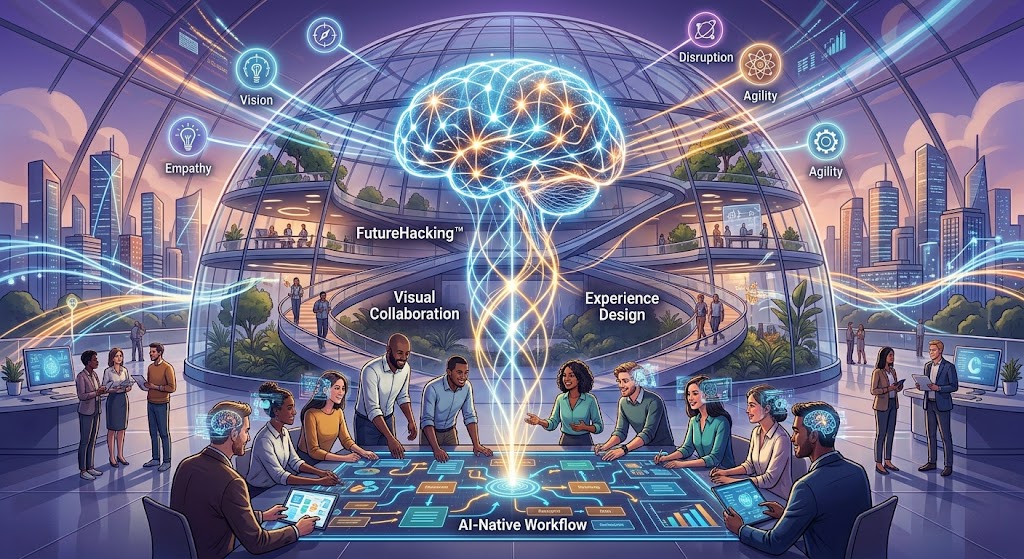
An AI-Native Organization does not simply use artificial intelligence; it is architected ground-up around seamless human-machine collaboration. It reimagines the core operating system of the business—how insights are gathered, how strategy is formed, how teams collaborate, and how value is delivered to customers. In an AI-native architecture, intelligence flows fluidly across functions, breaking down traditional silos and turning real-time data into immediate organizational action.
Yet, no matter how advanced the technology becomes, technology transformation always succeeds or fails based on human adoption, alignment, and experience design. AI-native reinvention is not a technology project; it is a human-centered change initiative. Without intentional focus on psychological safety, clarity of vision, and empowering people to co-create their new working reality, even the most sophisticated AI capability will stall at the point of human friction.
II. FutureHacking™ the AI Landscape: Strategic Foresight and Weak Signals
Navigating the rapid evolution of artificial intelligence requires moving beyond traditional, rear-view planning methods. Linear forecasting fails when technology advances exponentially and consumer expectations shift overnight. To build an AI-native organization, leadership teams must develop strategic foresight—cultivating the capacity to track emerging shifts before they become mainstream disruptions.
Through the lens of FutureHacking™, organizations learn to systematically scan the horizon for weak signals. These quiet indicators—found at the intersections of technology, human behavior, regulatory shifts, and cross-industry experimentation—reveal where value is moving. Rather than treating AI as a static set of tools to implement today, leaders use signal tracking to anticipate how human-machine orchestration will redefine their industry tomorrow.
Foresight, however, is not about predicting a single, perfect future; it is about preparing for multiple plausible ones. Effective strategic planning involves scenario building—stress-testing organizational models, governance structures, and customer value propositions against various AI-driven futures. By mapping both preferred and non-preferred scenarios, leaders can make proactive, resilient bets today while remaining flexible enough to pivot as weak signals mature into macro trends.
Finally, exploring future states inevitably exposes present-day friction. To make space for genuine transformation, organizations must identify and systematically dismantle structural and cultural “innovation blockages”—the risk-averse mindsets, rigid approval chains, and outdated incentives that stifle adaptability. Clearing this organizational debt fuels the momentum needed to continuously reinvent the enterprise in an AI-first world.
III. Redesigning Experience: The Intersection of EX, CX, and AI
The true power of AI-native transformation is unlocked at the intersection of human experience and intelligent capabilities. Rather than viewing technology as a mechanism for head-count reduction, progressive organizations leverage AI to elevate the human experience across both internal operations and external customer touchpoints.
Augmenting the Employee Experience (EX) begins by shifting the organizational mindset from workforce displacement to workforce empowerment. Intelligent co-pilots and agentic assistants eliminate administrative friction, automate tedious data gathering, and liberate employees to focus on high-value, strategic, and creative problem-solving. By reducing cognitive overload, organizations create space for continuous learning, empathy, and genuine innovation.
Equally critical is the evolution of the Customer Experience (CX). AI enables enterprises to move beyond reactive service to proactive, hyper-personalized engagement. By synthesizing customer data and sentiment in real time, organizations can anticipate needs, streamline complex journeys, and design seamless interactions that build long-term trust and loyalty. When AI handles routine complexity in the background, front-line teams are empowered to deliver human warmth and meaningful connection where it matters most.
Sustaining this synergy requires intentional team alignment. Utilizing frameworks like the Nine Innovation Roles™, organizations can structure cross-functional teams that pair distinct human talents—from Revolutionaries and Magic Makers to Connectors—with AI capabilities. This balanced approach ensures that human-machine collaboration is actively designed, governed, and optimized to drive strategic growth rather than disjointed experimentation.
IV. Visual Collaboration & Planning: Orchestrating Human-Centered Change™
The pace and non-linear nature of AI-driven transformation render traditional, text-heavy change management playbooks obsolete. Lengthy strategy decks and static documentation fail to build genuine alignment; instead, they create communication gaps, slow execution, and obscure critical project dependencies. To succeed, organizations must shift to visual planning methodologies that make strategy transparent and actionable.
Shared visual frameworks provide a common language that brings cross-functional teams together—bridging the gap between business leaders, technical architects, and front-line employees. By mapping out the change ecosystem visually, teams can clearly define goals, identify operational friction, and trace how AI capabilities integrate into day-to-day workflows. This visual clarity aligns diverse perspectives and accelerates decision-making across the entire enterprise.
To overcome the notorious 70% failure rate common to large-scale transformations, change cannot be imposed top-down; it must be co-created. Utilizing structured visual canvases allows stakeholders to collectively map out potential risks, surface hidden anxieties, and define adoption drivers in real time. Engaging employees as active co-designers of their new working reality builds psychological safety, addresses change fatigue directly, and turns passive compliance into active ownership.
Ultimately, visual collaboration transforms change management from a periodic disruption into a continuous, participatory discipline. When teams visually co-create the roadmap for human-AI integration, they build the organizational confidence, clarity, and agility necessary to navigate ongoing reinvention.
V. Building a Capability for Continuous Reinvention
Transformation in an AI-first world is not a one-time project with a fixed endpoint; it is an ongoing organizational muscle. The rapid pace of technological change means that today’s cutting-edge AI architecture will become tomorrow’s legacy tech. To thrive long-term, organizations must move away from sporadic, reactive change initiatives and build an enduring capability for perpetual reinvention.
Embedding systematic frameworks like the Eight I’s of Infinite Innovation™ allows enterprises to continuously discover, evaluate, and scale emergent AI capabilities. By formalizing every stage—from continuous Inspiration and Insight gathering to intentional Implementation and Impact assessment—organizations build a repeatable engine that continuously refreshes their value proposition and operational models.
Sustaining this momentum demands flexible governance and fluid organizational structures. Hierarchical, rigid silos slow down decision-making and stifle the rapid experimentation required for AI integration. AI-native organizations replace static organizational charts with dynamic, cross-functional networks—cross-disciplinary teams empowered to test hypotheses, iterate on processes, and redeploy resources as technological capabilities evolve.
Finally, continuous reinvention requires evolving how success is measured. Legacy vanity metrics—such as head-count reductions or simple task-automation counts—fail to capture true organizational transformation. Modern scorecards prioritize systemic agility, change capability, human-AI collaboration efficiency, and the speed at which market feedback is converted into improved employee and customer experiences.
VI. Conclusion: The Leadership Call to Action
The journey toward becoming an AI-native organization is fundamentally a test of leadership. While the rapid development of artificial intelligence offers unprecedented speed, analytical power, and automation, technology alone cannot set a vision, build trust, or inspire a culture of continuous adaptation. The defining factor of successful transformation will not be the algorithms an enterprise deploys, but the clarity and empathy of the leaders guiding the change.
In an increasingly automated business landscape, leadership must evolve beyond command-and-control management toward intentional orchestration. Leaders must cultivate deep curiosity, champion psychological safety, and lead with transparent purpose. Their role is to clear organizational blockages, foster cross-functional collaboration, and ensure that technology serves to amplify human potential rather than diminish it.
Artificial intelligence may supply the speed, computational intelligence, and predictive insights, but human-centered design, values, and vision provide the necessary direction. By grounding technological advance in visual collaboration, experience design, and continuous reinvention, organizations can build a resilient, future-ready enterprise where humans and intelligent systems thrive together.
Frequently Asked Questions
What is an AI-Native Organization?
An AI-native organization is designed from the ground up around seamless human-machine collaboration. Rather than simply adding AI tools onto legacy processes, it reimagines its entire operating system—strategy, workflows, culture, and customer touchpoints—to leverage real-time intelligence and continuous innovation.
Why does human-centered change matter in AI adoption?
Technology transformations succeed or fail based on human adoption, trust, and alignment. A human-centered approach ensures that AI implementation focuses on empowering employees, elevating customer experiences, and building psychological safety—preventing human friction from stalling technical progress.
How do visual planning frameworks accelerate AI-driven transformation?
Visual planning frameworks replace lengthy, text-heavy strategy documents with transparent, collaborative canvases. They create a shared language across technical and non-technical teams, surface hidden risks early, and engage stakeholders as active co-creators of organizational change.
Bottom line: Futurology is not fortune telling. Futurists use a scientific approach to create their deliverables, but a methodology and tools like those in FutureHacking™ can empower anyone to engage in futurology themselves.
Image credit: Gemini
 Sign up here to get Human-Centered Change & Innovation Weekly delivered to your inbox every week.