From Reactive to Proactive
GUEST POST from Art Inteligencia
The Failure of the Crystal Ball
Traditional forecasting is broken. For decades, the C-suite has relied on linear projections and lagging market data to predict what comes next. But in an era defined by rapid macroeconomic shifts and accelerating technological integration, treating the future as a straight-line extension of the past is a dangerous trap. It creates an illusion of certainty, locking organizations into rigid plans that fall apart the moment reality deviates from the spreadsheet.
When we treat forecasting as a crystal ball, we naturally adopt a reactive posture. We wait for the predicted future to arrive, only to find ourselves scrambling when a blind spot disrupts our assumptions. More importantly, this mechanical approach completely misses the human element. It ignores the shifting employee dynamics, evolving customer expectations, and cultural friction that ultimately dictate whether an organization thrives or stumbles.
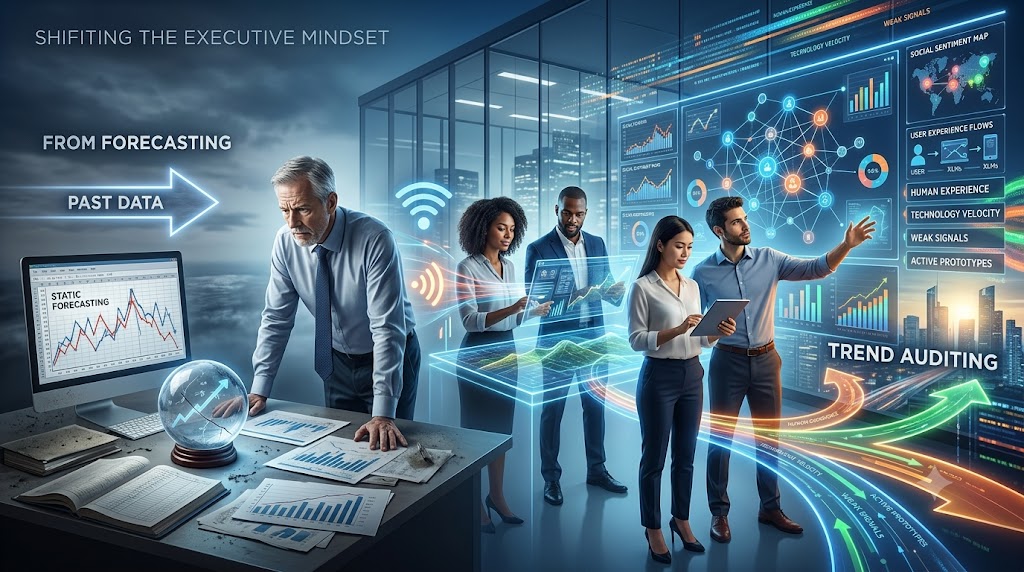
The Paradigm Shift: We must move from predicting the future to preparing the organization to actively shape it. This requires shifting our executive mindset from traditional forecasting to continuous Trend Auditing.
Trend Auditing is a human-centered, dynamic approach to evaluating, mapping, and testing the real-world signals occurring right now. Instead of guessing where the dart will land years from today, a Trend Audit inventories the velocity and relevance of emerging shifts, filtering them through the lens of human experience. It is the ultimate tool for moving leadership from passive observation to proactive ecosystem design — turning systemic disruption into a distinct strategic advantage.
The Pitfalls of Linear Forecasting
The traditional corporate planning cycle is built on a fundamental flaw: the belief that the future can be accurately mapped using a rearview mirror. When executives sit down to plan for the coming years, they typically reach for historical data, linear growth curves, and static market reports. While these tools provide a comforting sense of structure, they ultimately create an illusion of certainty that leaves organizations highly vulnerable to sudden shifts.
Linear forecasting treats the business ecosystem as a controlled environment where variables behave predictably. In reality, modern markets are complex, non-linear systems. When an organization locks itself into a single, rigid forecast, it builds institutional blindness. Leadership becomes so focused on hitting the milestones of a predetermined plan that they completely miss the weak signals of disruption bubbling up at the periphery. By the time those signals become large enough to impact the balance sheet, the window for a proactive response has already closed.
Furthermore, standard forecasting models suffer from a critical blind spot: they are fundamentally detached from the human experience. They prioritize cold financial metrics and surface-level technology trends while ignoring the underlying human dynamics that actually drive adoption, resistance, and market transformation. Technology doesn’t change markets on its own; human behavior in response to technology does.
The Agility Trap: When organizations optimize for efficiency against a static forecast, they inadvertently strip out the agility required to pivot. True resilience isn’t about being right about a single future; it’s about being prepared for multiple potential realities.
When we evaluate organizational readiness solely through traditional metrics, we miss the growing friction within our workforce and customer base. To build a strategy capable of navigating an uncertain landscape, executives must move away from defensive, spreadsheet-driven predictions and begin assessing the real-world velocity of change through a human-centered lens.
Defining the Trend Audit Framework
To break free from the constraints of traditional forecasting, leadership teams must adopt a rigorous methodology for evaluating the present landscape. This is where Trend Auditing diverges sharply from casual trend scanning. While scanning is a passive exercise—essentially making a list of interesting things happening in the world—a Trend Audit is an active, human-centered inventory designed to measure the velocity, relevance, and structural impact of emerging shifts on the organization.
Instead of treating every new headline or technological buzzword as an equal priority, a Trend Audit filters external signals through a systematic framework. It forces leadership to ask: How fast is this signal moving, how deeply does it intersect with our core business, and what is the friction of adoption? This process transforms a chaotic sea of information into a prioritized matrix of strategic realities, allowing executives to identify which shifts require immediate experimentation and which simply demand close observation.
Crucially, this framework introduces a vital “Human-Centered” Filter to the strategic process. True trend auditing does not evaluate an emerging technology or macroeconomic shift in isolation; it measures how that shift alters human behavior and expectations. By focusing on Experience Level Measures (XLMs), executives can gauge the real-world impact a trend has on customers and employees alike. After all, a trend only gains commercial and operational velocity when humans choose to embrace it, reject it, or adapt to it.
The Core Difference: Linear forecasting asks, “What will the market look like in five years?” Trend Auditing asks, “What signals are actively reshaping human experience today, and how agile must our architecture be to capitalize on them?”
By shifting the focus from abstract future points to the tangible trajectory of current human experiences, Trend Auditing provides the baseline data needed to re-engineer corporate strategy. It moves the organization away from speculative bets and grounds executive decision-making in a clear, actionable understanding of the shifting ecosystem.
Shifting Executive Leadership Mechanics
Moving from forecasting to trend auditing isn’t just a change in strategy; it requires a fundamental restructuring of how leadership teams operate. In a volatile landscape, executives can no longer afford to be passive observers of quarterly reports. Instead, they must become active curators of emerging signals. This means moving away from closed-door, top-down predictions and intentionally distributing the responsibility for foresight across the entire organizational ecosystem.
To operationalize this mindset, leadership must align accountability with clear visual frameworks. By leveraging the Nine Innovation Roles, executives can move past ambiguous ownership and assign specific individuals to act as the organization’s Anthropologists (to study human behavior shifts), Experimenters (to test the impacts of those shifts), and Cross-Pollinators (to connect disparate trends across business units). This ensures that audited trends are not just logged into a database, but are actively championed and explored by the right people.
Furthermore, organizations require a dedicated operational anchor to manage the human impact of these external shifts. This drives the necessity of the Experience Management Office (XMO). While a traditional PMO focuses on project timelines and budgets, the XMO acts as the central engine monitoring how external macro trends collide with internal culture, employee friction, and customer reality. It ensures that the organization’s response to a trend remains deeply rooted in human-centered design rather than mere technological implementation.
The Power of Participatory Foresight: The most critical weak signals rarely show up first in the boardroom; they are caught on the front lines by employees interacting daily with customers and technology. Replacing top-down mandates with participatory, inclusive contribution reduces organizational resistance and drastically accelerates response times.
By democratizing the foresight process and embedding human experience metrics directly into leadership mechanics, executives can build a highly responsive ecosystem. This structural alignment turns trend auditing from an abstract exercise into a dynamic corporate capability, setting the stage for targeted, intentional innovation.
Activating the Strategy: From Audit to Innovation
An audit is only as valuable as the action it provokes. To truly capitalize on the insights generated from a Trend Audit, leadership must embed this practice directly into the organization’s operational DNA. Rather than treating it as an annual static exercise to populate a strategy deck, Trend Auditing must function as a continuous feedback loop that feeds, shapes, and challenges the strategic planning cycle on an ongoing basis.
When properly integrated, a clear trend audit serves as the precise fuel needed to spark targeted, intentional innovation. It puts an end to “random acts of digital transformation” — those reactionary, expensive tech implementations driven by FOMO (fear of missing out) rather than strategic alignment. By understanding the velocity and human friction associated with audited trends, executives can ignite their internal innovation engines with absolute intentionality, ensuring every initiative solves a real human or operational need.
Activating this strategy is also the ultimate method for de-risking the future. In a complex business ecosystem, top-down mandates are obsolete and high-risk. Instead, the insights from the Trend Audit allow leadership to design low-stakes experiments and prototype solutions in real time. This approach allows the organization to test assumptions against emerging macro shifts safely, paving the way for a smooth, calculated soft landing during major operational and workforce transitions.
The Operational Reality: Innovation without continuous auditing is just guesswork. By coupling a rigorous understanding of current trends with agile experimentation, organizations stop guessing where the market is going and start actively building the capabilities required to lead it.
By moving fluidly from auditing to experimentation, leadership transforms the organization from a rigid structure vulnerable to disruption into a fluid, adaptive organism. This seamless connection between insight and execution ensures that the business is always positioned ahead of the curve, ready to convert macro shifts into sustainable growth.
The Proactive Premium
The future cannot be predicted, but it can be anticipated, designed, and co-created. As the complexity of our macroeconomic and technological landscape intensifies, the premium on proactive leadership has never been higher. Executives who cling to traditional, linear forecasting will find themselves perpetually on the defensive, reacting to disruptions they failed to see coming because they were looking at the wrong metrics.
By shifting the corporate mindset to continuous Trend Auditing, leadership teams reclaim control of their trajectory. This human-centered approach strips away the dangerous illusion of certainty and replaces it with a dynamic, resilient capability. It allows organizations to ground their strategies in the velocity of real-world human behavior, leveraging frameworks like the Nine Innovation Roles and the XMO to translate emerging signals into immediate, low-stakes experiments.
The Ultimate Takeaway: Master the trend audit, and you stop reacting to the ecosystem that others create. You start designing the ecosystem yourself.
The choice facing today’s executive is simple: continue chasing the mirage of a perfect forecast, or build an organization agile enough to thrive in any version of tomorrow. It is time to challenge your leadership team to cancel their next static forecasting session, step away from the spreadsheets, and initiate a rigorous, human-centered Trend Audit. The future isn’t waiting—and neither should your strategy.
Frequently Asked Questions
What is the core difference between trend forecasting and trend auditing?
Traditional trend forecasting tries to predict a specific outcome at a future point in time using linear projections and historical data. Trend auditing, by contrast, is a human-centered inventory of existing macro shifts and micro signals. It measures their current velocity, organizational relevance, and impact on human behavior so leadership can adapt to multiple potential realities in real time.
How do human-centered metrics like XLMs fit into a Trend Audit?
A trend only gains commercial or operational momentum when humans choose to adopt or resist it. By applying Experience Level Measures (XLMs) rather than just technical or financial data, a Trend Audit evaluates how a shift alters customer and employee experiences. This ensures strategy is grounded in real-world human behavior rather than technology buzzwords.
What organizational structures are needed to support continuous trend auditing?
Successful trend auditing requires shifting from a top-down mandate to participatory foresight. Structurally, this is driven by an Experience Management Office (XMO) to monitor human impact and friction, alongside the deliberate assignment of clear innovation responsibilities — such as those defined in the Nine Innovation Roles — to ensure emerging signals are continuously captured, tested, and cross-pollinated.
SPECIAL BONUS: Braden Kelley’s Problem Finding Canvas can be a super useful starting point for doing design thinking or human-centered design.
“The Problem Finding Canvas should help you investigate a handful of areas to explore, choose the one most important to you, extract all of the potential challenges and opportunities and choose one to prioritize.”
Image credit: Gemini
 Sign up here to get Human-Centered Change & Innovation Weekly delivered to your inbox every week.