Utilizing Collaborative Frameworks to Foster Safe Experimentation
GUEST POST from Art Inteligencia
The Innovation Paradox
Every modern leadership team shares a common refrain: “We need bigger, bolder ideas to disrupt the market before someone else disrupts us.” Yet, underneath this call for revolutionary thinking lies an uncomfortable, unspoken reality. Most organizations possess a structurally low tolerance for the ambiguity, missteps, and flat-out failures that inherently accompany groundbreaking work. This is the Innovation Paradox—demanding radical leaps forward while operating in cultures optimized entirely for incremental steps and predictable, quarterly outcomes.
For the average employee, this paradox creates a psychological barrier that kills creativity at the source. When the professional cost of a failed “big bet” is perceived as career-limiting, people naturally default to the safest possible options. They polish existing processes, launch slight line extensions, and repackage old ideas as new initiatives. The risk of swinging for the fences simply feels too high when there is no net to catch them if they fall.
But true transformation shouldn’t feel like a high-wire act without a net. To unlock genuine creativity across an enterprise, we must systematically lower the stakes of trying. By introducing structured, collaborative frameworks, leadership can shift the burden of risk away from individual brave souls and onto a disciplined process. When we design environments where big ideas are deliberately broken down into small, safe, and highly collaborative experiments, we don’t just protect the organization’s resources—we liberate its collective imagination.
Reframing “Failure” as “Validated Learning”
To successfully de-risk ambitious concepts, organizations must undergo a fundamental linguistic and cultural shift: we have to eliminate the punitive, traditional definition of “failure.” In a human-centered innovation ecosystem, a test that disproves a hypothesis is not a defeat; it is validated learning. When an experiment reveals that a feature doesn’t resonate with users or a business model falls short, it delivers exact data that prevents a multi-million dollar misstep down the road. That isn’t a loss—it is a strategic win.
The greatest enemy of big ideas isn’t a lack of commercial potential; it is the cost of waiting to find out. When teams incubate a concept in isolation for months—or worse, years—without real-world interaction, the financial and emotional stakes skyrocket. Every week spent planning without testing increases the organization’s sunk-cost fallacy, making it harder to pivot when flaws finally surface. By the time the idea meets the market, the cost of failure is exponential.
The antidote is a micro-experimentation mindset. Instead of treating a massive vision as a single, high-stakes gamble, collaborative frameworks allow us to deconstruct that vision into a portfolio of small, testable, and completely disposable hypotheses. We ask ourselves, “What is the smallest, fastest thing we can build or simulate today to prove our assumptions wrong?” By shrinking the scope of our trials, we make trying ideas so cheap and safe that the fear of failure evaporates, replaced by a shared curiosity to discover what actually works.
Structural Foundations for Safe Experimentation
Culture doesn’t change just because leadership tells people it’s okay to experiment. To truly unleash a human-centered innovation practice, organizations must build the actual structural scaffolding that protects people and ideas alike. It starts with establishing deep psychological safety. If an employee believes that a miscalculated assumption or an unsuccessful pilot will negatively impact their performance review, their promotion path, or their standing in the company, they will never share their best ideas. Leadership must explicitly give permission—not just to succeed, but to explore, stumble, and learn openly.
Beyond the cultural shift, we need to design physical and digital “sandboxed” environments. A sandbox is an isolated, controlled ecosystem where teams can run live experiments without the risk of affecting core business operations, disrupting the primary codebase, or damaging the overarching brand reputation. Whether it is a dedicated beta-testing group of customers who love co-creation, or a localized regional market used as a proving ground, the goal is simple: ensure that if an experiment fails, it has an absolute zero blast radius on daily enterprise operations.
Finally, safe experimentation requires resource ring-fencing. Too often, innovation teams are forced to “steal” time from their day-to-day delivery responsibilities or beg for budget from rigid operational funds. This tension instantly creates friction and heightens the perceived risk of the project. By dedicating micro-budgets and fixed, protected time blocks exclusively for discovery and validation, organizations remove the operational guilt. Teams are empowered to move fast and focus entirely on learning, confident that their core business metrics are structurally protected.
Collaborative Frameworks that De-Risk the Journey
True innovation is never a solitary sport; top-down design and isolated ivory towers are entirely obsolete in complex modern business ecosystems. To systematically de-risk our most ambitious concepts, we must replace insular thinking with participatory innovation. By engaging cross-functional teams, end-users, and broader ecosystem partners early in the design process, we leverage diverse perspectives to expose critical blind spots before a single dollar of capital expenditure is committed. Co-creation reduces organizational resistance downstream because stakeholders are co-authoring the solution rather than having a mandate pushed onto them.
The foundational mechanism for this collaborative de-risking is a structured Assumptions Mapping exercise. When a team brings forward a big idea, we don’t debate whether it is “good” or “bad.” Instead, we work out everything that must be true for the concept to succeed, systematically filtering these unvetted leaps of faith across three vital human-centered lenses:
- Desirability: Do our users or customers actually want this? Does it solve a real, deeply felt human pain point?
- Feasibility: Do we possess—or can we acquire—the technological capability and operational expertise to actually build and execute this?
- Viability: Should we do this? Does the underlying business model hold up, and will it generate sustainable value for the enterprise?
Once these assumptions are mapped out based on their level of uncertainty and potential impact, the team aligns them against a Lean Experimentation Matrix. This framework prevents teams from over-engineering solutions by matching high-uncertainty assumptions with low-fidelity validation tools. If a desirability assumption is highly volatile, we don’t build a software architecture—we deploy a targeted landing page test, a paper prototype, or a Wizard of Oz simulation (where the front-end looks real, but the back-end is manually driven by humans). This collaborative mapping ensures we are always investing the absolute minimum amount of effort required to harvest the maximum amount of validated truth.
Operationalizing the Framework: A Step-by-Step Guide
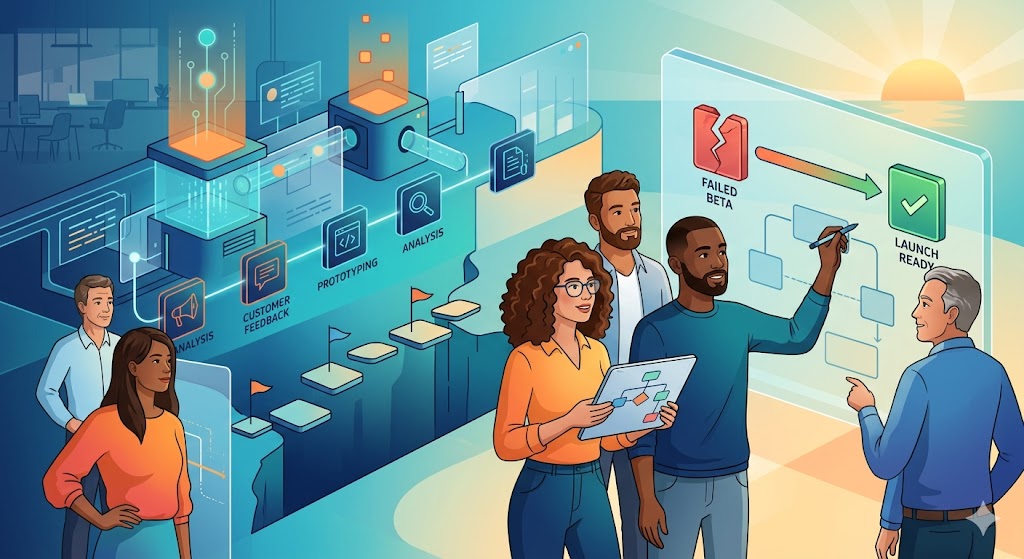
Moving from the theory of safe experimentation to daily execution requires a clear, repeatable operational workflow. When a team uncovers a compelling, high-potential concept, they can systematically move it through a structured five-step collaborative pipeline designed to maximize discovery while minimizing financial exposure.
- Isolate the Core Value Proposition:
Strip away the bells, whistles, and secondary features of the big idea. Focus entirely on the foundational promise: what is the primary value this concept intends to deliver, and exactly whose problem does it solve? - Identify Critical Assumptions:
Convene a cross-functional squad to unearth the hidden leaps of faith underlying the idea. Identify the most volatile, unverified assumptions across desirability, feasibility, and viability—the specific assumptions that, if proven false, would completely derail the project. - Design the Smallest Viable Test (SVT):
Move past the traditional Minimum Viable Product (MVP), which often takes too long and costs too much to build. Instead, architect an SVT—the fastest, lowest-fidelity, and cheapest possible mechanism to validate or invalidate your most critical assumption. - Execute, Measure, and Document:
Run the experiment within your ring-fenced sandbox. Gather clean data by looking at both quantitative behavioral metrics (what people actually do, rather than what they say they would do) and deep, qualitative human feedback. Capture these findings transparently so the broader organization can see the results. - Pivot, Persevere, or Pause:
Bring the team together to review the experimental data against your initial hypotheses. Establish clear governance to remove raw emotion from the decision-making process, allowing the data to cleanly dictate whether you pivot the strategy, persevere and fund the next micro-experiment, or pause the project entirely to reallocate resources.
The Change Management Pivot: Scaling a Culture of Experimentation
Building the structural sandboxes and defining the operational steps means very little if the broader organization’s cultural immune system rejects the behavior. To scale safe experimentation across an enterprise, leadership must intentionally execute a deliberate change management pivot. This begins with leaders modeling vulnerability. If executives only celebrate unblemished victories, teams will continue to hide their mistakes and take fewer risks. True human-centered leadership requires managers to stand up and openly share their own experimental learning moments—destigmatizing the pivot and demonstrating that validated learning is highly valued by the organization.
To deeply root this mindset, organizations must overhaul how they evaluate and reward talent. We have to start incentivizing the behavior, not just the final outcome. If performance metrics and bonuses are tied exclusively to immediate, predictable key performance indicators (KPIs), people will naturally avoid anything unproven. A progressive innovation framework updates these structures to reward rigorous hypothesis testing, intellectual curiosity, and fast-pivoting. By celebrating a team that elegantly invalidated a bad concept before it wasted capital, you send a clear signal that smart experimentation is an accelerated path to professional growth.
Finally, to ensure these insights transcend individual teams, organizations must build a decentralized, enterprise-wide learning repository. When an experiment concludes—whether the hypothesis was proven or disproven—the core metrics, qualitative human feedback, and subsequent pivot decisions must be documented transparently in a shared knowledge base. This institutional memory acts as a vital asset for the company. It ensures that cross-functional teams aren’t working in silos, prevents the organization from paying for the same strategic mistake twice, and allows everyone to build continuously upon a growing foundation of shared enterprise wisdom.
Conclusion: Making Innovation Sustainable
Ultimately, de-risking big ideas isn’t about playing it safe or watering down bold visions; it is about building the necessary structural and cultural scaffolding to make ambitious leaps possible. When we implement collaborative, human-centered frameworks, we create a sustainable innovation engine that can run continuously without burning out our people or bankrupting our resources. The true return on investment here stretches far beyond a single successful launch—it fundamentally transforms the capability, confidence, and agility of the entire workforce.
If we want our organizations to thrive in an era of relentless disruption, we must stop asking our teams to be brave without equipping them for the journey. It is time for leadership to step up and replace the anxiety of the unknown with the structure of disciplined exploration. By committing to shared frameworks, psychological safety, and micro-experimentation, we transform innovation from a terrifying, high-stakes gamble into a predictable, rewarding, and deeply human practice. Let’s build the collaborative net that gives our people the confidence to leap higher, test faster, and build the future together.
Frequently Asked Questions
What is the difference between an SVT (Smallest Viable Test) and a traditional MVP?
A traditional Minimum Viable Product (MVP) is often a functional product that requires significant engineering, design, and time to build before it can be tested in the market. In contrast, a Smallest Viable Test (SVT) focuses entirely on speed and learning; it is the lowest-fidelity, lowest-cost mechanism designed to validate or invalidate a single, critical assumption—such as using a landing page or paper prototype—before any real product infrastructure is built.
How can a company introduce psychological safety without lowering performance standards?
Psychological safety is not about lowering standards or accepting sloppy execution; it is about decoupling personal professional risk from experimental uncertainty. By holding teams accountable to a high standard of rigorous hypothesis testing, clear metric tracking, and fast documentation, leadership rewards high-quality execution and curiosity while safely embracing the fact that some hypotheses will naturally be proven incorrect.
What are the primary indicators that a big idea should pivot rather than persevere?
A project should pivot when the data from your Smallest Viable Tests consistently invalidates core assumptions around desirability, feasibility, or viability—meaning customers aren’t engaging, the tech is excessively prohibitive, or the business model is unsustainable. If behavioral metrics and human feedback show no path to value despite multiple micro-experiments, it is a clear signal to shift strategy or pause the project to redirect resources.
FutureHacking™ Is Coming
FutureHacking™ is Braden Kelley’s strategic foresight methodology — and a paid download and training program is launching soon. Register your interest now to be the first to know when it’s available, and get early access pricing.
Image credit: Gemini
 Sign up here to get Human-Centered Change & Innovation Weekly delivered to your inbox every week.