LAST UPDATED: April 1, 2026 at 11:23 AM
GUEST POST from Chateau G Pato
The Visibility Gap in Hybrid Innovation
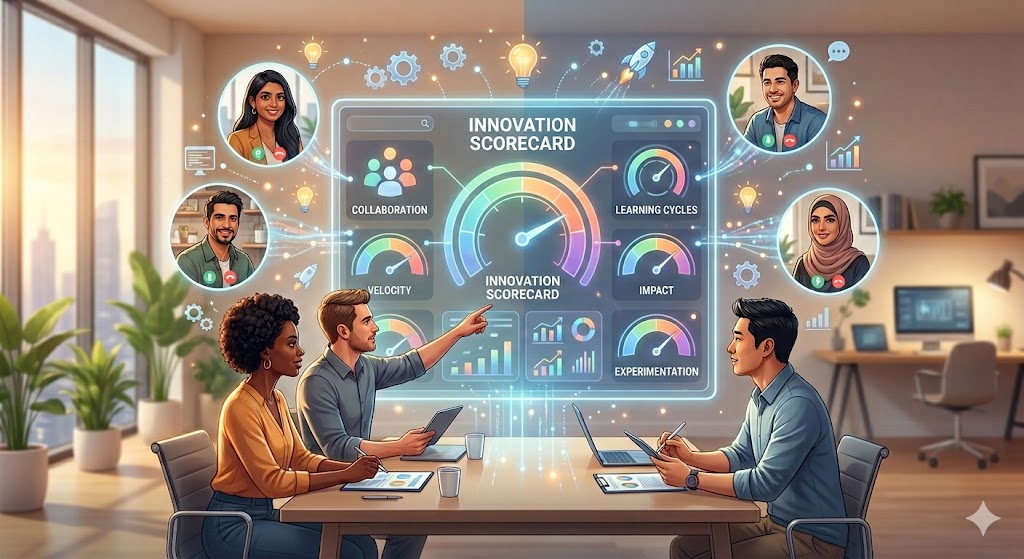
In the transition to distributed work, many organizations have fallen into a dangerous trap: equating presence with productivity. When team members are no longer occupying the same physical space, a visibility gap emerges. Traditional innovation KPIs, which often relied on the serendipity of “water-cooler moments” and the energy of a shared war room, fail to capture the nuanced, asynchronous contributions that drive progress in a hybrid environment.
To bridge this gap, leaders must move away from Management by Walking Around—a model that inherently biases toward those in the office—and toward Management by Design. This requires a scorecard that intentionally tracks the health of the innovation ecosystem across both physical and digital divides.
Our objective is to build a measurement framework that balances individual autonomy with collective organizational agility, ensuring that “out of sight” never translates to “out of the loop” when it comes to high-value creative work.
Pillar 1: Input & Engagement Metrics (The Energy)
In a hybrid model, innovation begins with the “energy” injected into the system. It is no longer enough to track the number of ideas submitted; we must measure the quality and inclusivity of the collaborative process itself. This ensures that the digital divide doesn’t silence valuable voices.
Collaborative Diversity
One of the greatest risks in hybrid work is the emergence of digital echo chambers. We must measure the cross-functional nature of our sessions. Are we seeing a broad distribution of participation across time zones and departments, or is the conversation being dominated by a few individuals in the physical office? Tracking “Share of Voice” in digital meetings helps identify if we are truly leveraging our collective intelligence.
Asynchronous Contribution
Innovation doesn’t always happen in real-time. A robust scorecard tracks the “shelf life” and evolution of ideas within shared digital workspaces. By measuring how ideas are built upon, challenged, and refined asynchronously—outside of scheduled meetings—we validate the work that happens during deep-focus hours, regardless of a team member’s physical location.
Psychological Safety Scores
High-performing hybrid teams rely on psychological safety. Without the benefit of physical proximity to read non-verbal cues, remote members may feel a higher barrier to proposing “wild” or disruptive ideas. Utilizing frequent, anonymous pulse surveys allows us to quantify the level of safety felt across the team, ensuring the cultural foundation is strong enough to support radical experimentation.
Pillar 2: Velocity & Friction Metrics (The Flow)
In a hybrid environment, the speed of innovation is often dictated by the “friction” within our digital and physical handoffs. To maintain a competitive edge, we must measure the flow of ideas and identify where the transition between remote and in-office work creates drag on the creative process.
The Digital Prototype Cycle
We measure velocity by tracking the time elapsed from the initial “back-of-the-napkin” digital sketch to the first low-fidelity experiment. In a distributed team, the ability to rapidly transition from a conceptual discussion to a tangible (even if digital) prototype is the primary indicator of a team’s momentum. Long delays here often signal a lack of clarity in digital toolsets or a breakdown in collaborative handoffs.
Decision Latency
One of the silent killers of hybrid innovation is “decision lag.” This metric identifies bottlenecks in the approval process. We track whether the move to hybrid work has slowed down critical “Yes/No” cycles. If a project stalls because we are waiting for a specific in-person meeting to occur, we have a design flaw in our governance. High-velocity teams empower decentralized decision-making to keep the engine running.
Experimentation Frequency
We must shift our focus from “Successful Projects” to Active Learning Cycles per quarter. In innovation, the goal isn’t just to be right; it’s to learn as quickly as possible. By measuring how many experiments—failed or successful—a hybrid team conducts, we prioritize the process of discovery over the safety of the status quo. This encourages teams to take smaller, more frequent risks that lead to larger breakthroughs.
Pillar 3: Output & Impact Metrics (The Value)
Ultimately, the effectiveness of a hybrid innovation team is measured by the value it delivers to the organization and the customer. In a distributed setting, we must look beyond the final product to measure the durability and relevance of the outcomes produced.
Knowledge Artifacts
In a hybrid world, the “documentation” is as important as the “destination.” We track the creation of knowledge artifacts—reusable frameworks, digital templates, and “learning logs” that capture the why behind our decisions. These artifacts ensure that the insights gained by one sub-team are accessible to the entire organization, preventing the loss of institutional memory that often occurs in siloed, remote environments.
Customer Experience (CX) Alignment
Innovation is only successful if it solves a real human problem. We utilize Experience Level Measures (XLMs) to ensure that every project is tethered to a specific friction point in the customer journey. By measuring how hybrid-led innovations impact these specific experience metrics, we ensure the team remains laser-focused on external value rather than getting lost in internal digital processes.
Incremental vs. Radical Balance
Distributed teams can easily fall into a “maintenance” mindset, focusing on small, tactical fixes that are easier to coordinate over chat. Our scorecard monitors the balance between incremental improvements and radical, disruptive bets. We must ensure that our hybrid workflows still provide the “cognitive space” required for long-term thinking, preventing the team from becoming a high-speed feature factory that loses sight of the big picture.
Pillar 4: Network & Connection Metrics (The Community)
Innovation is a team sport that thrives on the strength of our connections. In a hybrid environment, social capital can erode if not intentionally maintained. We must measure the connectedness of our ecosystem to ensure that geographical distance does not lead to intellectual isolation.
Connectivity Heatmaps
We monitor the strength and frequency of ties between office-based and remote employees. Innovation dies in silos, and hybrid work can inadvertently create “in-groups” and “out-groups.” By analyzing digital interaction patterns—such as cross-functional Slack participation or collaborative document editing—we can identify emerging silos and intervene before they stifle the flow of diverse perspectives.
Mentorship & Shadowing
The informal “apprenticeship” that happens in a physical office is often lost in a digital-first world. We track how often junior or remote staff are integrated into high-level innovation “war rooms” and strategic planning sessions. Measuring the frequency of these mentorship touchpoints ensures that we are intentionally building the next generation of innovators, regardless of where their desk is located.
The Serendipity Quotient
While we can no longer rely solely on chance encounters, we can measure the success of “engineered serendipity.” This metric tracks the outcomes of structured networking events, random coffee chats, or virtual “brown bag” lunches. We look for instances where a connection made in a non-project setting leads to a tangible innovation insight or a new collaborative effort.
Implementation: Making the Scorecard Stick
A scorecard is only as effective as the culture that supports it. To prevent these metrics from becoming “shelfware,” they must be integrated into the daily rhythm of the hybrid team, moving from a static reporting tool to a dynamic driver of behavior.
Transparency by Default
In a distributed environment, information symmetry is vital. The innovation scorecard should not be hidden in a monthly slide deck; it should be a live, shared dashboard accessible to every team member. When everyone can see the same “North Star” metrics in real-time, it fosters a sense of collective ownership and reduces the anxiety often associated with remote performance monitoring.
The “Human-in-the-Loop” Review
Data tells you what is happening, but people tell you why. While we use digital tools to automate the collection of these metrics, we must maintain a regular, human-led “Innovation Retrospective.” These sessions allow teams to interpret the data, discuss the friction points identified in the scorecard, and pivot their approach based on qualitative insights that a dashboard might miss.
Rewarding the Process
To truly drive innovation, we must reward the behaviors we want to see repeated. This means publicly celebrating “intelligent failures”—experiments that were well-designed but didn’t yield the expected result—just as loudly as we celebrate successful launches. By aligning recognition with the metrics in our scorecard, we reinforce a culture of continuous learning and psychological safety across the entire hybrid workforce.
Conclusion: The Modular Future
Innovation in a hybrid world mirrors the very frameworks we use to describe organizational agility: it requires a Stable Spine of clear strategy and consistent measurement, supported by Modular Wings of flexible execution and diverse locations. The scorecard is not a tool for surveillance; it is the wind beneath those wings, providing the data necessary to ensure every team member—regardless of their coordinates—is seen, heard, and valued for their creative contributions.
As we move forward, we must remember that the goal of measurement isn’t just to track output, but to foster a healthy, sustainable innovation ecosystem. By focusing on human-centered metrics, we bridge the gap between the digital screen and the physical office, creating a unified culture that thrives on discovery.
Key Takeaway: We do not need more metrics; we need meaningful metrics that bridge the gap between the screen and the cubicle, ensuring that the future of work is as innovative as the products we create.
Frequently Asked Questions
How do these scorecards prevent bias against remote workers?
By shifting focus from “activity-based” metrics (like being seen in the office) to “contribution-based” metrics (like asynchronous knowledge artifacts and digital prototyping cycles), the scorecard ensures that value is measured by impact rather than physical presence.
Is this scorecard too complex for small teams?
The framework is modular. Small teams should start with one metric per pillar—such as Decision Latency and Collaborative Diversity—to gain immediate visibility into their innovation flow without administrative overhaul.
How often should the metrics be reviewed?
While data should be collected continuously in a live dashboard, a formal human-led review should occur monthly to interpret the qualitative “why” behind the quantitative “what.”
Image credits: Gemini
 Sign up here to join 17,000+ leaders getting Human-Centered Change & Innovation Weekly delivered to their inbox every week.