LAST UPDATED: March 28, 2026 at 11:30AM
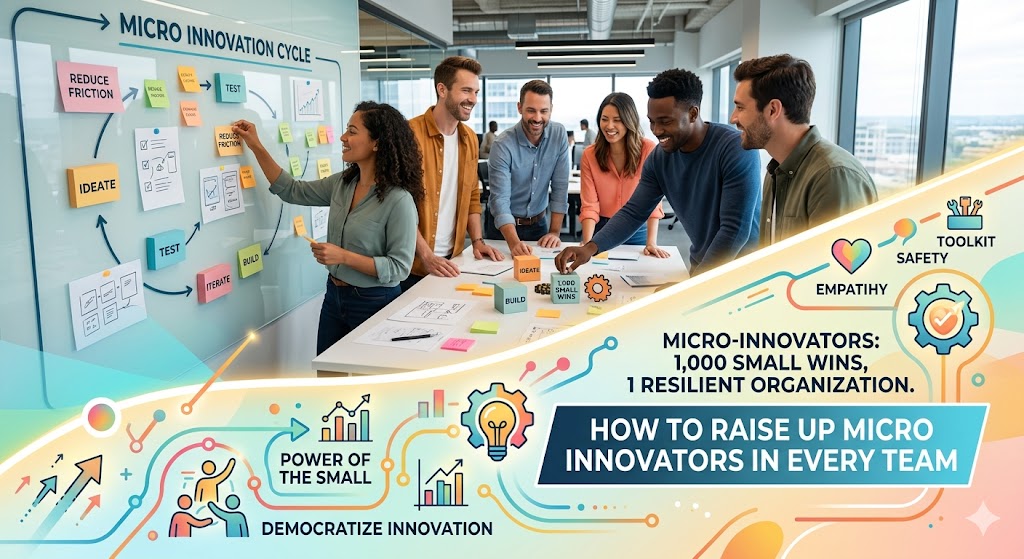
GUEST POST from Art Inteligencia
The Power of the Small: Redefining Innovation
In many organizations, innovation is often mistakenly viewed as a monolithic event — a “Big Bang” disruption or a revolutionary product launch orchestrated by a specialized R&D department. This perspective creates a “Lone Genius” myth that inadvertently sidelines the vast majority of the workforce. To build a truly resilient, human-centered organization, we must shift our focus toward Micro-Innovation.
The Innovation Fallacy
Relying solely on top-down, high-stakes initiatives leaves an organization vulnerable to market shifts and internal stagnation. When innovation is cordoned off, the “frozen middle” and frontline staff become passive executioners of tasks rather than active problem solvers. This creates a gap between corporate strategy and the daily reality of customer friction.
Defining the Micro-Innovator
A Micro-Innovator is an individual — regardless of their job title — who applies a continuous improvement lens to their immediate sphere of influence. They are the team members who:
- Identify “paper cuts” (small, recurring frustrations) in daily workflows.
- Develop “workarounds” that eventually become more efficient than the standard process.
- Utilize existing tools in novel ways to save time or enhance Experience Level Measures (XLMs).
The Cumulative Effect: 1,000 Small Wins
While a single disruptive pivot is rare and risky, the cumulative impact of 1,000 small improvements is profound. Micro-innovation acts as the “compound interest” of organizational change. By empowering every team member to fix what is broken in their own world, we move from a culture of “that’s not my job” to a culture of Infinite Innovation.
“Innovation is not a department; it is a fundamental human capability that thrives when we give people the agency to improve their own day-to-day reality.”
Phase 1: Creating Psychological Safety (The Foundation)
Before a single idea can be voiced, a team must feel that the environment is “innovation-ready.” Without psychological safety, the risk of looking foolish or being penalized for a failed experiment will always outweigh the potential benefit of a new idea. Raising up micro-innovators requires a foundational shift in how leadership perceives and reacts to the unknown.
Eliminating the “Cost of Failure”
In many corporate cultures, failure is a line item to be avoided at all costs. To foster micro-innovation, we must rebrand “failure” as Learning Cycles. When a team member attempts a small process improvement that doesn’t work, the post-mortem should not be a search for blame, but a quest for data. By lowering the stakes of these small-scale tests, we encourage more frequent “at-bats,” which statistically leads to more “home runs.”
The Permission to Question: Standard Operating Curiosity
Micro-innovation begins when a team member asks, “Why do we do it this way?” Leaders must move from being “The Answer Person” to “The Chief Questioner.” If a process exists simply because “that’s how we’ve always done it,” it is ripe for a human-centered redesign. Encouraging this curiosity — and rewarding it even when it challenges existing norms — is the spark that ignites the innovation bonfire.
The Human-Centered Lens: Empathy as an Engine
True innovation isn’t just about technology; it’s about people. We empower micro-innovators when we teach them to look at their workflows through a lens of empathy. This means asking:
- “How does this step make my colleague’s job harder?”
- “Where is the customer feeling friction that we’ve become blind to?”
- “What small change would make our internal experience more fluid?”
When the goal is to reduce frustration for another human being, the motivation for innovation becomes intrinsic rather than mandated. This empathy-led approach ensures that micro-innovations are meaningful, not just “change for the sake of change.”
Phase 3: Building the “Innovation Toolkit”
Empowerment without tools is merely a suggestion. To move from “permission to innovate” to “capability to innovate,” we must provide teams with a structured yet lightweight framework. The goal isn’t to turn every employee into a full-time designer, but to give them the mental models needed to navigate the journey from a problem to a solution.
Simplified Frameworks: The Eight I’s of Infinite Innovation
Micro-innovation thrives when there is a shared language. While high-level strategy might require deep dives, team-level innovation can be driven by a simplified version of the Eight I’s of Infinite Innovation. By focusing on the first few stages — Inspiration, Ideation, and Investigation — teams can quickly vet their own ideas before they ever reach a manager’s desk. This “Self-Vetting” reduces administrative drag and keeps the momentum high.
The 15-Minute Friction Audit
Innovation often fails because people feel they “don’t have time” for it. We must integrate discovery into the flow of work. A 15-Minute Friction Audit is a simple weekly practice where teams identify:
- Redundancies: Where are we entering the same data twice?
- Bottlenecks: Where is a process waiting for a “rubber stamp” that adds no value?
- Shadow Work: What “workarounds” have we created that should actually be the standard process?
Resource Micro-Dosing: The 10% Rule
You cannot mandate innovation while simultaneously demanding 100% utilization of every minute of the workday. Resource Micro-Dosing involves carving out small, protected windows of time — such as “10% time” or “Innovation Fridays”—where the focus shifts from execution to evolution. This isn’t “free time”; it is “focused time” dedicated specifically to testing the hypotheses generated during the friction audits.
The Micro-Innovation Loop
Teach your teams this three-step mental model for any new idea:
- Empathize: Who is hurting because of this current process?
- Experiment: What is the smallest, cheapest way we can test an alternative?
- Evaluate: Did the change improve our Experience Level Measures (XLMs) or just move the problem elsewhere?
By providing these tools, you transform innovation from a mysterious “spark” into a repeatable, democratic process that belongs to everyone.
Phase 4: From Ideation to Implementation
The graveyard of corporate culture is filled with “great ideas” that never transitioned into action. To raise up micro-innovators, we must bridge the gap between thinking and doing. This phase is about velocity — moving an idea from a team member’s head into a tangible test as quickly and cheaply as possible.
Low-Fidelity Prototyping: The “Paper and Tape” Solution
One of the biggest barriers to micro-innovation is the belief that every solution requires a software update or a budget line item. We must encourage Low-Fidelity Prototyping. If a team thinks a new form layout will work better, they should mock it up in a document or on a whiteboard first. By using “paper and tape” solutions, teams can iterate five times in a afternoon rather than waiting five months for a technical requirement document to be approved.
The Peer Review Loop: Socializing the Spark
Micro-innovation should not happen in a vacuum. Establishing a Peer Review Loop — such as a bi-weekly “Show and Tell” or a digital “Win Wall” — creates a culture of shared learning. When Team A shows how they automated a manual spreadsheet task, Team B often realizes they can apply a similar logic to their own workflow. This social proof validates the innovator and spreads the innovation naturally through the organization.
Scaling the Micro: Identifying Global Potential
Not every micro-innovation stays “micro.” A core responsibility of leadership is to act as a talent and idea scout. When a small-scale fix shows significant improvement in Experience Level Measures (XLMs), it should be evaluated for wider adoption. We must ask:
- “Is this a localized fix, or does it solve a systemic pain point?”
- “What happens to the workflow if we export this to three other departments?”
- “Does this micro-innovation align with our broader Digital Transformation roadmap?”
The “Micro-to-Macro” Checklist
Before scaling a team-level innovation, ensure it meets these three criteria:
- Portability: Can the solution function without the specific “hero” who created it?
- Simplicity: Does it reduce complexity for the end-user, or just shift the burden?
- Measurability: Can we prove it saved time, reduced errors, or improved the human experience?
By focusing on rapid implementation and deliberate scaling, you transform your teams from passive observers into an active, distributed R&D engine.
Phase 5: Recognition and Rewards (Beyond the Financial)
To sustain a culture of micro-innovation, we must move beyond the transactional. Traditional “suggestion box” bonuses often fail because they treat innovation as a one-off lottery win. Instead, we must focus on Human-Centered Recognition — acknowledging the intrinsic value of an individual’s contribution to the team’s collective success.
Visibility Over Incentives: The Power of Social Proof
While a small bonus is appreciated, visibility is often a more potent driver of long-term behavior. When a micro-innovator’s “workaround” or process improvement is highlighted in a company-wide meeting or a digital “Win Wall,” it signals to the entire organization that curiosity is a valued currency. This public validation transforms the innovator from a “rule-breaker” into a “pathfinder.”
Career Pathing: Innovation as a Core Competency
We must stop viewing innovation as an “extra-curricular” activity. True micro-innovation thrives when it is baked into the Performance Review process for every role — from administrative assistants to senior engineers. By measuring and rewarding the ability to identify and solve friction, we ensure that our best problem solvers are the ones who ascend the leadership ladder. We should ask during reviews:
- “What processes did you challenge and improve this quarter?”
- “How did you use your 10% time to enhance the team’s efficiency?”
- “Who did you mentor or help to implement a micro-innovation?”
The “Innovation Bonfire” Effect: Creating Heat and Light
In the Eight I’s of Infinite Innovation, the final stages involve scaling and sustaining. Celebrating small wins creates “heat” (momentum) and “light” (clarity of purpose). This environment naturally attracts top talent — people want to work where they have the agency to make an impact. This cultural shift creates a self-sustaining loop where the organization no longer needs to “force” change; change becomes the natural byproduct of the environment.
The Micro-Innovation Reward Matrix
| Reward Type | Example Action | Impact on Culture |
|---|---|---|
| Autonomy | Granting more time to work on a pet project. | Increases trust and ownership. |
| Access | Invitation to present the idea to senior leadership. | Builds confidence and breaks silos. |
| Advocacy | Using the micro-innovation as a case study for the department. | Validates the effort and encourages peers. |
When you reward the behavior of innovation rather than just the outcome, you build a resilient team capable of navigating any disruption. You aren’t just rewarding a fix; you are rewarding the mindset of a micro-innovator.
VI. Conclusion: The Infinite Innovation Organization
To raise up micro-innovators is to perform the ultimate act of Human-Centered Leadership. It requires moving away from the “Command and Control” structures of the past — where a few people think and everyone else executes — toward a “Curate and Coach” model. In this new reality, the leader’s job is to clear the path, provide the tools, and then get out of the way.
The Shift in Leadership: From Gatekeeper to Facilitator
In a traditional hierarchy, a leader is a gatekeeper who protects the status quo. In an Infinite Innovation organization, the leader is a facilitator who protects the experiment. This shift requires humility; it means acknowledging that the person closest to the friction — the frontline worker, the junior analyst, the customer service rep — is often the one best equipped to solve it.
Final Call to Action: The Power of One
Building a culture of micro-innovation does not require a massive budget or a three-year roadmap. It starts with The Power of One:
- One Team: Choose a single group to pilot these concepts.
- One Friction Point: Ask them to identify one small thing that makes their job harder than it needs to be.
- One Week: Give them the permission and the 15 minutes of “air cover” to test a solution.
Closing Thought: Resilience Through Participation
When everyone in your organization is empowered as a micro-innovator, change is no longer a threat to be managed; it is an opportunity to be seized. You stop being a company that reacts to disruption and start being a company that drives it from the bottom up. By raising up micro-innovators, you aren’t just improving your workflows — you are honoring the creative potential of every human being on your team.
The Micro-Innovator’s Manifesto: I see the friction. I have the tools. I have the safety. I will make it better.
Frequently Asked Questions
What is the difference between Micro-Innovation and Continuous Improvement?
While both aim for better efficiency, Micro-Innovation focuses specifically on the human-centered agency of the individual. It empowers employees to challenge the “why” behind their tasks and use creative problem-solving to reduce friction, rather than just following a top-down efficiency mandate.
How do I measure the success of micro-innovation?
Success is best measured through Experience Level Measures (XLMs) rather than just traditional KPIs. Look for a reduction in “shadow work,” an increase in employee engagement scores, and a decrease in recurring friction points reported by frontline teams.
Does micro-innovation require a dedicated budget?
No. The hallmark of a micro-innovation is that it is low-fidelity and low-cost. Most improvements come from repurposing existing tools, shifting meeting structures, or clarifying communication — requiring “resource micro-dosing” of time rather than a capital expenditure.
Image credit: Google Gemini
 Sign up here to get Human-Centered Change & Innovation Weekly delivered to your inbox every week.