LAST UPDATED: March 17, 2026 at 11:21 PM

GUEST POST from Art Inteligencia
I. Anticipation: Developing “Future Sight”
In an era of exponential change, the traditional “wait and see” approach to technology is a recipe for irrelevance. Change leaders must shift from reactive observation to active Anticipation. This isn’t about predicting the future with 100% accuracy; it’s about building the organizational muscles to recognize patterns before they become disruptions.
Signal vs. Noise: Filtering the Hype
Every emerging tech wave arrives with a deafening roar of marketing hype. To lead effectively, you must distinguish between transient trends and foundational shifts.
- The Duration Test: Does this technology solve a perennial human problem, or is it a novel solution looking for a problem?
- The Ecosystem Check: Is there a supporting infrastructure (talent, regulation, hardware) maturing alongside the software?
- The “Shiny Object” Filter: Are we interested because it’s cool, or because it moves the needle on our core purpose?
The Opportunity Matrix: Strategic Categorization
Once a signal is identified, it must be mapped. We evaluate tech waves across two critical dimensions to determine our level of investment:
| Axis | Focus Area | Key Question |
|---|---|---|
| Operational Efficiency | Internal Optimization | Does this automate the mundane to liberate human creativity? |
| Customer Value | External Transformation | Does this fundamentally improve the lives of those we serve? |
The Pre-Mortem: Identifying Cultural Antibodies
Innovation often fails not because of the tech, but because the organization’s “immune system” attacks it. Change leaders perform a Pre-Mortem to visualize failure before it happens.
“Assume it is two years from today and the implementation has been a total disaster. What went wrong?”
By identifying potential cultural antibodies — such as fear of job loss, data silos, or rigid hierarchy — we can design the change strategy to address these anxieties head-on, turning potential detractors into co-architects of the future.
II. The Human-Centered Foundation
Technology is merely a catalyst; the reaction — success or failure — is entirely human. As change leaders, we must move beyond “user adoption” and toward Human-Centered Transformation. If the technology doesn’t amplify human potential or solve a core human friction point, it is destined to become expensive “shelfware.”
The Innovation Excellence Framework: Alignment with Purpose
Innovation does not happen in a vacuum. To build a foundation that survives the turbulence of emerging tech waves, every digital shift must be anchored to the organizational purpose.
- Strategic Intent: Does this tech wave enable us to deliver on our “North Star” more effectively?
- Capability Mapping: Do we have the human skills to match the technical requirements, or are we creating a “capability gap” that breeds resentment?
- Values Integration: Ensuring that AI or automation doesn’t inadvertently erode the ethical standards or culture we’ve spent years building.
Psychological Safety in the Midst of Chaos
Emerging tech often brings the “Fear of the Unknown” — specifically the fear of obsolescence. A robust foundation requires Psychological Safety, where employees feel safe to experiment, ask “dumb” questions, and even fail during the learning curve.
- The Permission to Learn: Leaders must explicitly allocate time for play and exploration without the immediate pressure of KPIs.
- Vulnerability as a Leadership Tool: When leaders admit they are also learning the new tech, it flattens the hierarchy and invites collective problem-solving.
- Redefining Failure: Shifting the narrative from “we failed to implement” to “we successfully gathered data on what doesn’t work.”
The “What’s In It For We” (WIIFW): Shifting the Narrative
Standard change management focuses on the WIIFM (What’s In It For Me). However, for tech waves that reshape entire departments, we must elevate the conversation to the WIIFW.
This involves transparently communicating how the tech wave:
- Eliminates Drudgery: Moving people from “data entry” to “insight generation.”
- Enhances Collaboration: Using tech to bridge silos that have existed for decades.
- Ensures Longevity: Positioning the organization — and its people — to thrive in a digital-first economy rather than just surviving it.
By building this foundation, we ensure that the organization isn’t just “using” new tools, but is evolving alongside them.
III. Strategic Execution: The Agile Change Sprint
In the context of emerging tech waves, the “Waterfall” approach to change management — where every detail is mapped out months in advance — is a recipe for obsolescence. By the time the plan is executed, the technology has already evolved. To lead effectively, we must adopt an Agile Change Sprint methodology.
Iterative Rollouts: The End of the “Big Bang”
The “Big Bang” implementation — flipping a switch for the entire enterprise at once — creates massive risk and cultural shock. Instead, we execute in micro-waves.
- The Minimum Viable Change (MVC): What is the smallest version of this tech adoption that provides immediate value?
- De-Risking through Isolation: Roll out to a single department or “lighthouse team” to identify technical bugs and cultural friction in a controlled environment.
- Momentum over Perfection: Frequent, small wins build the organizational confidence necessary to tackle larger, more complex integrations.
Co-Creation Labs: Turning Users into Architects
Resistance to change is often a reaction to a lack of agency. Co-Creation Labs bring the end-users into the “engine room” of the transformation.
- Joint Design Sessions: Instead of IT pushing a solution, employees help define the workflows the new tech will support.
- The Empathy Loop: Developers and change leaders must shadow the people doing the work to understand where the “friction points” actually live.
- User-Led Documentation: Let the early adopters write the “cheat sheets” and FAQs; they speak the language of the business, not the language of the vendor.
Real-Time Feedback Loops: Steering the Ship
Static project reports are lagging indicators. An Agile Change Sprint relies on real-time sentiment and performance data to pivot strategy mid-stream.
| Feedback Channel | What It Measures | The “Pivot” Action |
|---|---|---|
| Sentiment Pulses | Employee anxiety or excitement levels. | Increase communication or slow the rollout pace. |
| Usage Heatmaps | Which features are being ignored or adopted. | Redesign the UI or provide targeted micro-training. |
| Friction Logs | Where users are getting “stuck” in the process. | Refine the technical integration or simplify the policy. |
By treating execution as a series of learning loops rather than a linear checklist, we ensure the organization remains flexible enough to absorb the next ripple in the tech wave without breaking.
Bonus: The Architecture of Organizational Agility
To truly master the “Change Leader’s Playbook,” we must look beyond individual tech waves and examine the structural integrity of the organization itself. As detailed in my recent exploration of Organizational Agility, the secret to sustained transformation lies in navigating the strategic tension between Fixedness and Flexibility.
The Stable Spine vs. Flexible Wings
True agility is not about being formless. It requires a Stable Spine — the non-negotiable elements of your organization that provide the support necessary for rapid movement. When the spine is stable, the Flexible Wings can flap as fast as needed to catch the next tech wave.
| The Stable Spine (Fixed) | The Flexible Wings (Fluid) |
|---|---|
| Core Values & Purpose | Quarterly Tactics & Experiments |
| Governance & Ethical Guardrails | Cross-functional Squads & Roles |
| Essential Compliance Standards | Daily Workflows & Modular Tools |
The Permission Bottleneck
One of the primary inhibitors of innovation is the “permission bottleneck.” By conducting a Stable Spine Audit, leaders provide the clarity employees need to move fast. When people know exactly what is fixed (the spine), they realize that everything else is a variable they are empowered to experiment with.
Key Insight: Agility is the architectural capability to change direction at speed without destroying the engine. It moves the organization from reactive maneuvering to proactive orchestration.
Deep Dive: Architecting Your Enterprise
For a complete diagnostic questionnaire and a guide on conducting your own Stable Spine Audit, read the full article:
The Architecture of Organizational Agility: Beyond the Pivot
IV. Scaling the Transformation
Moving from a successful pilot to an enterprise-wide shift is where most tech waves lose their crest. Scaling requires more than just a larger server capacity; it requires a social architecture that allows the change to go viral within the organization.
The Influence Map: Activating Your Change Champions
Change doesn’t move through the org chart; it moves through networks of trust. To scale effectively, we must identify and empower the “Hidden Influencers” — those individuals who may not have a “Director” title but whom others look to for guidance.
- Peer-to-Peer Advocacy: When a colleague shows a teammate how a new AI tool saved them two hours of reporting, the “sales pitch” is far more authentic than a corporate memo.
- The Champion Toolkit: We provide these influencers with early access, specialized training, and a direct line to the project team to resolve roadblocks.
- Rewarding the “Helping” Behavior: Recognition shouldn’t just go to those who use the tech, but to those who teach it.
Training for Adaptability: Beyond Tool Proficiency
Most corporate training focuses on “Button Clicking” — which icons to press to get a result. In an era of emerging tech waves, that knowledge has a short shelf-life. Scaling requires a shift toward Adaptive Literacy.
- Metacognitive Skills: Teaching employees how to learn new interfaces and logic patterns, rather than memorizing a specific software version.
- The “Sandbox” Environment: Providing a low-stakes space where the entire organization can play with the tech waves before they are integrated into mandatory workflows.
- Micro-Learning Bursts: Replacing the eight-hour seminar with five-minute, just-in-time video modules that solve specific, real-world problems.
Metrics that Matter: Measuring Value over Volume
To prove that the tech wave is truly scaling, we must move past vanity metrics like “Number of Logins.” Instead, we focus on Value Realization and Cultural Sentiment.
| Metric Category | What to Measure | The Scaling Goal |
|---|---|---|
| Proficiency Speed | Time from first login to “Expert” output levels. | Decreasing the “Learning Curve” gap for each new wave. |
| Cross-Functional Use | Number of departments collaborating via the new tech. | Breaking down silos and increasing data liquidity. |
| Sentiment Health | Employee surveys on “Confidence in the Future.” | Shifting from tech-anxiety to tech-optimism. |
Scaling is not a mechanical process; it is a cultural one. By focusing on influence, adaptability, and the right metrics, we ensure the tech wave doesn’t just crash against the shore of the organization, but lifts the entire ship.
V. Sustainability: Preventing Innovation Fatigue
The greatest threat to a digital transformation strategy isn’t a lack of budget or technical glitches; it is Innovation Fatigue. When emerging tech waves hit an organization in rapid succession without a recovery period, the workforce becomes cynical, exhausted, and resistant. Sustainability requires managing the human energy as carefully as the technical roadmap.
The Pacing Principle: Managing the “Change Load”
Change leaders must act as the organization’s “air traffic controller.” Not every technology needs to be adopted the moment it hits the market. Sustainability is found in the strategic pause.
- The Absorption Rate: Measure how much change a specific department can actually process before performance degrades. If the sales team is adopting a new CRM, do not launch a new AI forecasting tool in the same quarter.
- Sequencing vs. Simultaneity: Prioritize tech waves based on their “Impact-to-Effort” ratio. Focus on high-impact, low-friction changes first to build a reservoir of goodwill.
- Recovery Sprints: Designate “Steady State” periods where no new tools are introduced, allowing employees to achieve mastery and find their flow with the existing stack.
Institutionalizing Agility: Hardcoding Change DNA
Sustainability is achieved when “change” is no longer viewed as a disruptive event, but as a core competency. We move from doing change to being agile.
- The Stable Spine: Maintain a “Stable Spine” of core values, purpose, and clear communication channels. This provides the psychological anchor that allows the rest of the organization to remain flexible and “fluid.”
- Adaptive Governance: Replace rigid, annual planning with rolling quarterly reviews. This allows the organization to “kill” tech projects that aren’t delivering value and reallocate resources to those that are.
- The Innovation Bonfire: Continuously “stoke the bonfire” by celebrating the small, everyday innovations that come from the bottom up, not just the massive corporate mandates.
Continuous Evolution: The “New Next”
The goal of the Change Leader’s Playbook isn’t to reach a final destination or a “New Normal.” In a world of infinite innovation, the only constant is the New Next.
To sustain this momentum, we must shift the mindset:
- From Destination to Journey: Helping the workforce find pride in their ability to adapt rather than their mastery of a specific, static tool.
- Ecosystem Thinking: Recognizing that our tech stack is a living, breathing ecosystem that requires regular pruning and nourishment.
- Human-First Metrics: Continuously checking the “Human Pulse” to ensure that as our technology becomes more sophisticated, our workplace remains more human.
By respecting the limits of human bandwidth and building agility into the very structure of the company, we ensure that the organization doesn’t just survive the current wave, but is ready to surf the next one.
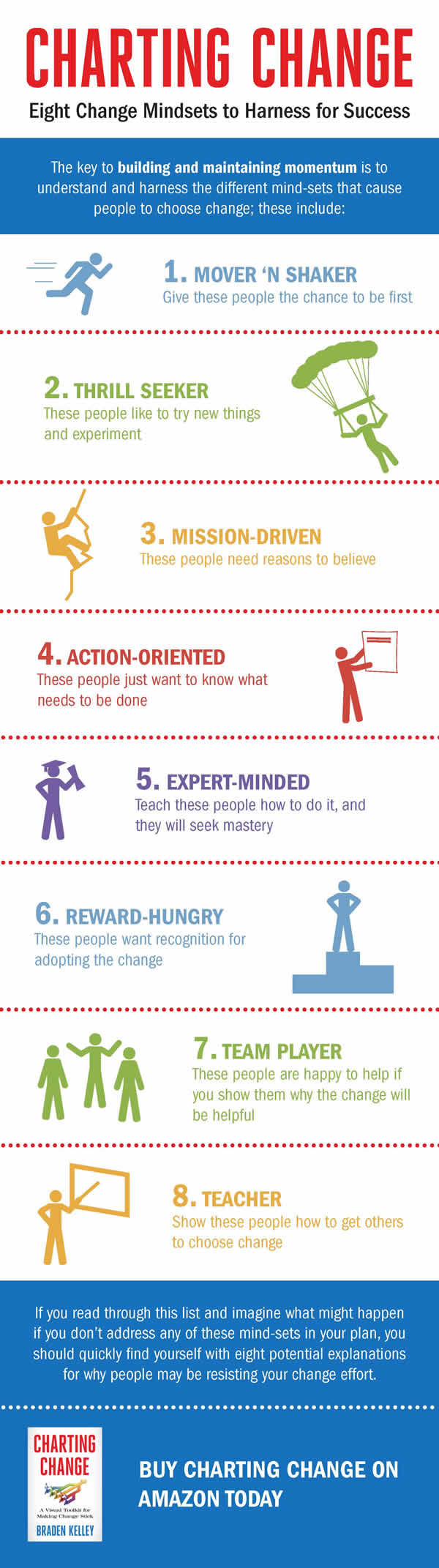
Bonus: The Eight Change Mindsets
Successful change isn’t just about process — it’s about mindset. In The Eight Change Mindsets, Braden Kelley outlines a practical philosophy for making change more adaptive, human-centered, and sustainable. At its core, the article emphasizes that poorly designed change creates resistance and fatigue, while well-designed change builds momentum and engagement.
Key Insights
- Start Small (Minimum Viable Progress): Break change into manageable pieces to reduce overwhelm and increase adoption.
- Pace Matters: Moving too fast creates resistance, while moving too slow erodes relevance — find a sustainable cadence.
- Design for People: Change must be human-centered, accounting for emotions, habits, and psychological safety.
- Anticipate Resistance: Resistance is natural — plan for it rather than reacting to it.
- Engage, Don’t Mandate: Change succeeds when people feel involved, not imposed upon.
- Iterate and Learn: Treat change as a continuous learning process, not a one-time event.
- Focus on Outcomes: Keep attention on the value being created, not just the activities being performed.
- Build Momentum: Small wins create energy and help overcome change fatigue.
Conclusion: The Human Edge in a Technical World
As we navigate the accelerating cycles of emerging tech waves, it is easy to become obsessed with the specifications, the speeds, and the sheer novelty of the tools at our disposal. But as change leaders, our focus must remain steadfastly on the Human Architecture of our organizations. Technology changes the what of our work, but people — their creativity, their empathy, and their ability to collaborate — remain the how.
The “Playbook for Emerging Tech Waves” is not a static set of rules; it is a living framework for Human-Centered Innovation. By prioritizing anticipation over reaction, building a foundation of psychological safety, executing with agile sprints, scaling through social influence, and guarding against innovation fatigue, we transform change from a disruptive event into a sustainable competitive advantage.
A Call to Action for Change Leaders
The era of “implementation” is over; the era of Continuous Evolution has begun. To lead your organization through the next wave and beyond, I challenge you to take the following three steps immediately:
- Audit the “Change Load”: Look at your current roadmap. Are you hitting your teams with too many “simultaneous” shifts? Identify one project to pause or sequence differently to protect your team’s cognitive bandwidth.
- Identify Your Hidden Influencers: Stop looking at the org chart and start looking at the “trust network.” Find the three people in your organization who others naturally go to for tech advice and invite them into your next co-creation session.
- Shift the Language: Move the conversation from “User Adoption” to “Value Realization.” Stop asking “Are they using the tool?” and start asking “Is the tool amplifying their unique human potential?”
The future belongs to those who can harmonize the cold efficiency of emerging technology with the warm, unpredictable brilliance of human ingenuity. Let us stop managing change and start leading transformation.
Are you ready to stoke the innovation bonfire? The next wave is already here.
Frequently Asked Questions: Emerging Tech & Change Leadership
What is the biggest mistake leaders make during emerging tech waves?
The most common error is “Shiny Object Syndrome,” where organizations prioritize the technical capabilities of a tool over the human architecture required to support it. Successful transformation requires shifting focus from software “implementation” to human “adoption and value realization.”
How do you prevent innovation fatigue in a rapidly shifting landscape?
Preventing fatigue requires Strategic Pacing. Leaders must act as “air traffic controllers,” sequencing technology rollouts to match the organization’s collective “absorption rate.” This includes building in “recovery sprints” where no new tools are introduced, allowing employees to achieve mastery.
What is the difference between WIIFM and WIIFW in change management?
While WIIFM (What’s In It For Me) focuses on individual benefit, WIIFW (What’s In It For We) emphasizes collective evolution. It highlights how tech waves eliminate departmental drudgery, bridge silos, and ensure the long-term viability of the entire workforce in a digital-first economy.
Image credit: Google Gemini
 Sign up here to get Human-Centered Change & Innovation Weekly delivered to your inbox every week.