Resilience as Innovation
LAST UPDATED: February 5, 2026 at 3:13PM
GUEST POST from Chateau G Pato
Moving Beyond Robustness to Anti-fragility
A bridge is robust when it resists a load. An organization is resilient when it learns from the load. When we focus purely on robustness, we build rigid structures that eventually shatter under unprecedented stress. When we focus on human-centered resilience, we empower our people to iterate in real-time.
This shift requires us to address Subjective Time Pressure. When employees feel “bullied by time,” their cognitive bandwidth shrinks, and they default to survival instincts. Innovation requires the opposite: the mental “white space” to see a crisis as a collection of data points rather than a series of threats. By designing conditions that provide temporal agency, leaders allow their teams to process change with curiosity rather than fear.
“The most valuable innovation isn’t a new product; it’s a resilient culture. Products can be copied, and technologies will be disrupted, but a team that has mastered the art of continuous adaptation is an insurmountable competitive advantage.”
— Braden Kelley
Case Studies: Resilience in Action
Case Study 1: The Supply Chain Transformation
A global electronics manufacturer faced a catastrophic disruption when a primary regional hub was taken offline by an environmental crisis. Traditional disaster recovery focused on restoring the status quo. However, the leadership team utilized my Change Planning Toolkit™ to reframe the crisis. Instead of just rebuilding, they empowered cross-functional “Agility Cells” to design a decentralized, AI-driven sourcing model. This wasn’t just recovery; it was a structural innovation. The new system was 15% more cost-effective and reduced lead times by 30%, proving that resilience is the catalyst for the next leap in operational excellence.
Case Study 2: Retail Pivot through Psychological Safety
A national retail chain saw a dramatic shift in consumer behavior that rendered their flagship store model obsolete almost overnight. Rather than implementing top-down layoffs, the CEO fostered psychological safety by launching an internal “Phoenix Initiative.” Store managers—the people closest to the customer—were given the agency to experiment with hyper-local micro-fulfillment and “service-as-an-experience” concepts. By treating their frontline staff as distributed innovators rather than mere executors, the company successfully pivoted 80% of its footprint to a high-growth hybrid model within 12 months.
Tools for Cultivating Adaptive Resilience
To turn resilience into an innovation engine, leaders need a structured approach. It isn’t enough to tell people to “be resilient.” You must provide the scaffolding for it. This involves:
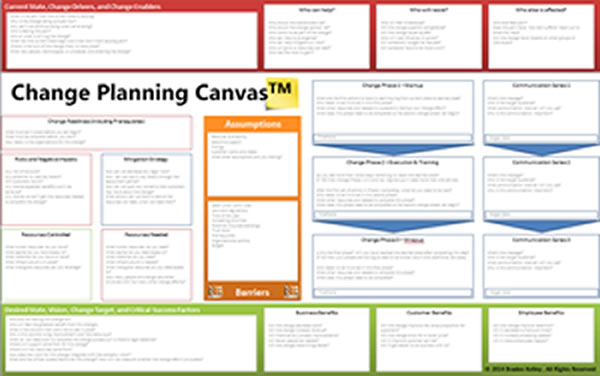
- The Change Planning Canvas™: Visualizing the transition to ensure everyone understands the why behind the what.
- Metabolic Alignment: Ensuring the organization’s pace of decision-making matches the pace of market change.
- Cognitive Slack: Intentionally protecting time for reflection and synthesis during high-stress periods.
When these tools are in place, resilience stops being an exhausting effort and starts being a natural state of flow. We stop fighting the waves and start learning how to surf them.
Resilience is the ultimate form of innovation because it is the only one that is self-sustaining. As we look toward the future of work, the winners will be those who recognize that their greatest asset isn’t their intellectual property, but the adaptive capacity of their people. By leading with empathy, providing the right visual tools, and reclaiming our agency over time, we can build organizations that are not just built to last, but built to evolve.
For years, innovation has been framed as a forward-looking activity: new ideas, new technologies, new business models. But the most overlooked truth about innovation is that it is not powered by novelty. It is powered by people who can absorb disruption, learn quickly, and adapt continuously.
Resilience is not a soft skill. It is the human engine that makes innovation sustainable over time. Without resilience, innovation becomes episodic—bursts of creativity followed by exhaustion, resistance, or collapse. With it, organizations evolve steadily, even under pressure.
As I often say, “Innovation isn’t about how fast you move when conditions are perfect; it’s about how well you adapt when they aren’t.”
Why Resilience Is the Missing Link in Innovation
Many organizations invest heavily in innovation labs, design thinking workshops, and emerging technologies, yet struggle to translate these efforts into lasting change. The issue is rarely a lack of ideas. It is a lack of human capacity to sustain change.
Resilience enables individuals and teams to stay curious under stress, to reframe setbacks as learning, and to recover quickly when experiments fail. Innovation demands repeated exposure to uncertainty. Resilience determines whether that uncertainty becomes energizing or debilitating.
When resilience is absent, organizations default to risk avoidance, short-term thinking, and defensive behavior. When resilience is present, they experiment, learn, and adapt faster than their competitors.
Case Study 3: Microsoft’s Cultural Reset
When Satya Nadella became CEO of Microsoft, the company faced a familiar innovation challenge: strong legacy products, slowing growth, and an internal culture resistant to change.
Rather than focusing first on new technologies, Nadella emphasized a shift from a “know-it-all” culture to a “learn-it-all” culture. This cultural reframing prioritized psychological safety, growth mindset, and continuous learning.
The result was a more resilient organization. Teams became more open to experimentation and failure. Collaboration improved across silos. Innovation accelerated not because people were pushed harder, but because they felt safer adapting.
Resilience turned cultural humility into a competitive advantage.
Resilience Is Built, Not Declared
Organizations often mistake resilience for grit or endurance. In reality, resilience is about recovery and renewal. It requires intentional design.
Resilient systems balance challenge with support. They create clear priorities, reduce unnecessary friction, and provide space for reflection. Leaders play a critical role by modeling learning, acknowledging uncertainty, and reinforcing progress rather than perfection.
Without these conditions, resilience degrades. Burnout replaces creativity. Innovation becomes performative instead of practical.
Case Study 4: Toyota and Continuous Improvement
Toyota’s long-standing commitment to continuous improvement offers another powerful example of resilience as innovation.
The Toyota Production System encourages employees at all levels to identify problems, stop the line if needed, and propose improvements. Mistakes are treated as signals, not failures.
This approach builds organizational resilience by embedding adaptation into daily work. Small improvements accumulate. Learning compounds. The system remains flexible even as complexity increases.
Toyota’s resilience is not reactive; it is designed into the way work gets done.
The Human Experience of Adaptation
Innovation ultimately happens inside people. Resilience is shaped by how individuals experience change: whether they feel informed or surprised, supported or isolated, empowered or constrained.
Human-centered innovation recognizes that adaptation is emotional as well as cognitive. Anxiety, fatigue, and identity threats can stall even the best ideas.
“You don’t scale innovation by demanding more from people. You scale it by removing what drains them and reinforcing what helps them adapt.”
— Braden Kelley
Resilience as a Strategic Capability
Organizations that treat resilience as a strategic capability outperform those that treat it as a personal responsibility. They invest in leadership development, clarity of purpose, and systems that reinforce learning.
They understand that the pace of change will not slow, and that resilience is the only sustainable response.
Innovation, in this light, becomes less about disruption and more about evolution. Less about heroic breakthroughs and more about consistent progress.
Innovation is often portrayed as a moment—a breakthrough idea, a disruptive product, a bold strategic move. But in reality, innovation is a long game played under conditions of uncertainty, pressure, and constant change. The organizations that win are not simply the most creative. They are the most resilient.
Resilience is the hidden infrastructure of innovation. It is the capacity that allows people, teams, and systems to absorb disruption, learn quickly, and keep moving forward without losing coherence or energy.
As I often say, “Innovation doesn’t start with ideas. It starts with the human capacity to adapt when the old answers stop working.”
Why Innovation Breaks Without Resilience
Most innovation efforts fail not because the idea was wrong, but because the organization could not sustain the journey. Uncertainty creates stress. Stress narrows thinking. Narrow thinking kills experimentation.
Resilience interrupts this cycle. It allows people to stay open when outcomes are unclear and to reframe setbacks as feedback rather than failure.
Without resilience, organizations retreat to what feels safe. With it, they move toward what is necessary.
Case Study 3: Microsoft and the Power of Learning
Microsoft’s resurgence under Satya Nadella is a powerful example of resilience driving innovation.
Nadella recognized that technical excellence alone was not enough. The organization needed to become more adaptable. By emphasizing growth mindset, collaboration, and empathy, Microsoft rebuilt its cultural foundation.
Teams became more willing to experiment, more open to feedback, and less defensive about legacy success. This cultural resilience enabled innovation across cloud computing, AI, and enterprise services.
Innovation followed resilience, not the other way around.
Designing for Human Recovery
Resilience is often misunderstood as toughness. In practice, it is about recovery. Resilient organizations create space to pause, reflect, and learn.
They limit initiative overload. They clarify priorities. They normalize saying “we don’t know yet.” These behaviors reduce cognitive strain and preserve creative energy.
“People don’t resist change because they hate progress. They resist it because they’re exhausted.”
— Braden Kelley
Case Study 4: Toyota and Embedded Adaptation
Toyota’s approach to continuous improvement demonstrates how resilience can be embedded into daily work.
Employees are encouraged to surface problems early, test small improvements, and share learning openly. This creates a system that adapts constantly rather than episodically.
Resilience becomes routine. Innovation becomes cumulative.
The organization does not rely on heroic change initiatives. It evolves continuously.
Resilience as a Leadership Responsibility
Resilience is not an individual burden. It is a leadership responsibility.
Leaders shape resilience through clarity, consistency, and compassion. They influence whether people feel safe experimenting or afraid of being wrong.
When leaders reward learning instead of just outcomes, resilience grows. When they model adaptability, others follow.
The Strategic Payoff
Organizations that invest in resilience outperform those that chase innovation theater. They adapt faster, recover quicker, and sustain momentum longer.
Resilience transforms innovation from a risky bet into a repeatable capability.
In an era defined by volatility, resilience is not optional. It is the price of admission.
Frequently Asked Questions
How does Braden Kelley define resilience in an innovation context?
Braden Kelley defines resilience not as bouncing back to the status quo, but as a generative capability where the organization uses change and disruption as a stimulus for continuous adaptation and new value creation.
Why is psychological safety important for organizational resilience?
Psychological safety allows employees to take the risks necessary for adaptation. Without it, fear of failure leads to rigid thinking and resistance to change, which are the opposites of a resilient, innovative culture.
What role do visual tools play in resilience?
Visual tools like the Change Planning Canvas™ provide clarity and alignment during periods of chaos. They help teams externalize complex problems, reducing cognitive load and allowing for faster, more collaborative decision-making.
Image credits: ChatGPT
 Sign up here to get Human-Centered Change & Innovation Weekly delivered to your inbox every week.