A Human-Centered Approach to Responsible Design
LAST UPDATED: December 20, 2025 at 12:39PM

GUEST POST from Chateau G Pato
AI systems increasingly mediate how people access healthcare, credit, employment, and information. These systems do not simply reflect reality; they shape it. As a human-centered change and innovation practitioner, I believe the central challenge of AI is not intelligence, but responsibility. This is why ethics must move from abstract principles to practical design tools.
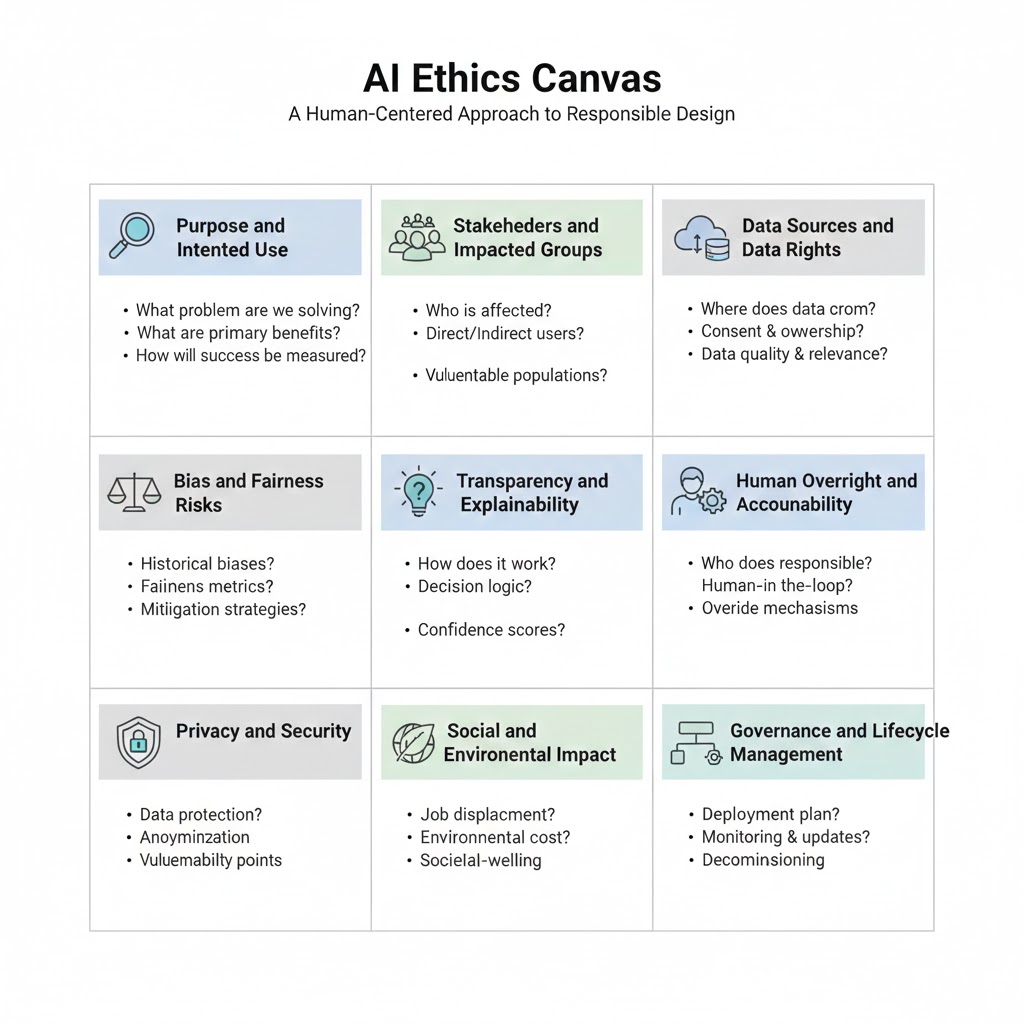
The AI Ethics Canvas provides that bridge. It translates values into design considerations, helping teams anticipate consequences and make informed trade-offs before harm occurs.
From Principles to Practice
Most organizations already have AI ethics principles. Fairness, transparency, accountability, and privacy are widely cited. The problem is not knowing what matters, but knowing how to act on it.
The AI Ethics Canvas operationalizes these principles by embedding them into everyday innovation workflows. Ethics becomes part of discovery, not an afterthought.
Designing for Power and Impact
AI systems redistribute power. They decide who is seen, who is prioritized, and who is excluded. The canvas explicitly asks teams to examine power asymmetries and unintended consequences.
This perspective shifts conversations from compliance to stewardship. Teams begin to ask not only what they can build, but what they should build.
Case Study One: Recalibrating Healthcare Diagnostics
In one healthcare organization, an AI diagnostic tool showed promising accuracy but failed to perform consistently across populations. Rather than pushing forward, the team used the AI Ethics Canvas to examine data bias, user trust, and accountability.
The outcome was a redesigned deployment strategy that included broader datasets, human oversight, and transparent communication with clinicians. Performance improved, but more importantly, trust was preserved.
Ethics as a Learning System
Ethical AI is not static. Contexts change, data evolves, and societal expectations shift. The AI Ethics Canvas supports continuous learning by encouraging teams to revisit assumptions and update safeguards.
This makes ethics adaptive rather than brittle.
Case Study Two: Building Trust in Financial AI
A financial institution faced backlash when customers could not understand automated credit decisions. Using the AI Ethics Canvas, the team re-framed explainability as a customer experience requirement.
By introducing clear explanations and appeal pathways, the organization strengthened trust while maintaining operational efficiency. Ethics became a differentiator rather than a constraint.
Leadership Accountability
Tools alone do not ensure ethical outcomes. Leaders must create incentives that reward responsible behavior and allocate time for ethical reflection.
The AI Ethics Canvas gives leaders visibility into ethical risk without requiring technical expertise, enabling informed governance.
Conclusion
The future of AI will be shaped by the choices we make today. Responsible design does not emerge from good intentions alone. It requires structure, dialogue, and accountability.
The AI Ethics Canvas is not a checklist. It is a mindset made visible. Used well, it helps organizations innovate with integrity and earn lasting trust.
Frequently Asked Questions
What problem does the AI Ethics Canvas solve?
It helps teams move from abstract ethical principles to concrete design decisions in AI systems.
Who should participate in an AI Ethics Canvas session?
Cross-functional teams including designers, engineers, legal experts, business leaders, and affected stakeholders.
Is the AI Ethics Canvas only for regulated industries?
No. Any organization building AI systems that affect people can benefit from ethical design.
Extra Extra: Because innovation is all about change, Braden Kelley’s human-centered change methodology and tools are the best way to plan and execute the changes necessary to support your innovation and transformation efforts — all while literally getting everyone all on the same page for change. Find out more about the methodology and tools, including the book Charting Change by following the link. Be sure and download the TEN FREE TOOLS while you’re here.
Image credit: Google Gemini
 Sign up here to get Human-Centered Change & Innovation Weekly delivered to your inbox every week.