LAST UPDATED: April 10, 2026 at 2:41 PM
GUEST POST from Chateau G Pato
Breaking the “Right Brain” Myth
For decades, we’ve been told a seductive but oversimplified story: that the left brain is a cold, calculating machine while the right brain is the wild, colorful source of creativity. As a thought leader in human-centered design, I’ve seen how this myth limits organizational potential by pigeonholing employees into “creative” or “analytical” roles.
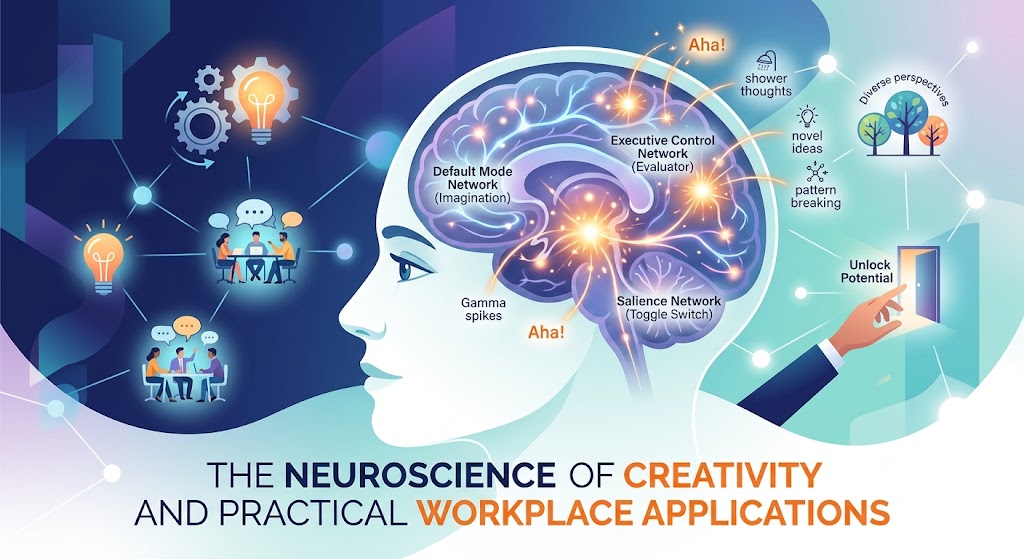
Neuroscience now tells us a far more integrated story. Creativity is not a localized spark; it is a whole-brain symphony. It involves the dynamic interaction of multiple large-scale networks that span across both hemispheres. When we innovate, we aren’t just “switching on” our right brain; we are orchestrating a complex collaboration between imagination, focus, and evaluation.
The Economic Imperative of Neural Insight
In the realm of experience design and change management, understanding the “why” behind human behavior is our greatest lever. When we recognize that creativity is a biological process — subject to chemistry, environment, and stress — we move from accidental innovation to intentional design. By aligning our workplace cultures with the way the brain actually functions, we unlock a sustainable competitive advantage that goes beyond mere brainstorming sessions.
The Neural Trio: The Engines of Idea Generation
To master the art of innovation, we must look under the hood at the three primary neural networks that drive the creative process. These aren’t isolated islands; they are a high-speed transit system for information.
The Default Mode Network (DMN): The “Imagination Network”
The DMN is active when we aren’t focused on the outside world — during daydreaming, reflecting on the past, or envisioning the future. In the context of experience design, this is where incubation happens. It is the network responsible for connecting disparate dots and generating those “out of left field” ideas. If your team is constantly “on task,” they are likely starving their DMN of the oxygen it needs to produce breakthroughs.
The Executive Control Network (ECN): The “Evaluator”
Once the DMN generates a flurry of possibilities, the ECN takes over. This network handles complex cognitive tasks and focused attention. It acts as the editor, filtering out the noise and selecting the ideas that are actually viable. Effective change management requires a strong ECN to bridge the gap between a wild “what if” and a practical “how to.”
The Salience Network: The “Switch”
The Salience Network is the conductor of the orchestra. Its job is to constantly monitor external stimuli and internal consciousness to decide what deserves our attention. It functions as a neural toggle, switching us between the expansive thinking of the DMN and the laser focus of the ECN. A well-designed workplace experience minimizes “cognitive friction,” allowing the Salience Network to switch gears smoothly without burning out the employee.
The Chemistry of “Aha!” Moments
Innovation isn’t just about the architecture of the brain; it is driven by a precise chemical cocktail. When we design experiences or lead change, we are essentially managing the neurochemistry of our teams.
Dopamine and the Reward Loop
Dopamine is often misunderstood as the “pleasure chemical,” but in the world of creativity, it is the chemical of anticipation. It fuels the “drive” to solve a problem. When we encounter a novel challenge or a potential breakthrough, dopamine levels spike, providing the cognitive energy and persistence required to push through the “messy middle” of the creative process.
The Alpha State and the Gamma Spike
Have you ever wondered why your best ideas come in the shower? It’s because your brain has entered an Alpha state — a frequency of 8 to 12 Hz associated with relaxed wakefulness. This relaxation lowers the “noise” of the Executive Control Network, allowing the brain to detect faint signals from the Default Mode Network.
Moments before a breakthrough, there is a literal “Aha!” spike — a burst of Gamma waves (high-frequency neural activity) that signifies the binding of neurons across different regions to form a brand-new connection.
The Role of Neuroplasticity
Perhaps the most empowering discovery in modern neuroscience is neuroplasticity: the brain’s ability to reorganize itself by forming new neural connections throughout life. By intentionally exposing ourselves to diverse perspectives and “human-centered” design challenges, we physically strengthen the pathways required for a Change Mindset. We aren’t just thinking differently; we are literally building a more innovative brain.
Practical Workplace Applications: Designing for the Brain
As a strategist, I believe that knowing how the brain works is useless unless we apply it to how we work. To move from theory to impact, we must design “brain-friendly” environments that respect our biological constraints while amplifying our creative potential.
Cognitive Diversity as a Design Tool
Innovation is a team sport, but it requires more than just different job titles. It requires cognitive diversity — a mix of thinking styles that engage different neural networks. By intentionally pairing those who naturally lean toward the “Imagination Network” (DMN) with those who excel in “Executive Control” (ECN), we create a collective brain that is capable of both radical ideation and disciplined execution.
Psychological Safety and the Amygdala
This is the “Change Management” golden rule: Fear kills innovation. When an employee feels judged or threatened, the amygdala triggers a “fight or flight” response. This diverts blood flow away from the prefrontal cortex — the seat of higher-order thinking — effectively locking the door to the “Imagination Network.” Designing for psychological safety isn’t just about culture; it’s about keeping the brain’s “innovation centers” online.
Environment Design: The Architecture of Insight
Our physical and digital surroundings act as a remote control for our neural states. To optimize for the “Aha!” moment, we must build spaces that support two distinct modes:
- The Case for “Slow Time”: We must move away from the “cult of busy.” Designing deliberate gaps in the day allows for neural incubation. Without downtime, the brain never has the opportunity to enter the Alpha state necessary for breakthrough insights.
- Sensory Stimulation: The brain thrives on novelty. By varying light levels, incorporating movement, and using biophilic design (natural elements), we can nudge the Salience Network to stay alert and open to new patterns.
Overcoming Cognitive Biases in Innovation
Our brains are evolved for efficiency, not necessarily for innovation. This efficiency comes in the form of “neural shortcuts” or biases that help us navigate the world quickly but often act as roadblocks to original thinking. To lead human-centered innovation, we must learn to recognize and bypass these biological hurdles.
The Functional Fixedness Trap
The brain is a pattern-matching machine. Functional fixedness is a cognitive bias that limits us to seeing objects or processes only in the way they are traditionally used. In experience design, this often manifests as “we’ve always done it this way.” To break this neural loop, we must use techniques like deconstruction to force the brain to see the raw components of a problem rather than the established pattern.
Confirmation Bias in Change Management
The brain experiences a small hit of dopamine when we find information that confirms our existing beliefs, and a stress response when we encounter information that challenges them. This is why organizational change is so difficult — the status quo literally feels “safer” to our neurons. Overcoming this requires creating a culture of curiosity over certainty, where we reward the seeking of “disconfirming” evidence.
The “Ego-Depletion” Factor
High-order creative thinking and self-regulation are energy-intensive processes that draw from a finite pool of cognitive resources. This is often referred to as ego-depletion. If a team is bogged down by “digital friction” — clunky tools, excessive meetings, or administrative “sludge” — they will lack the neural stamina required for the deep work of innovation. As leaders, our job is to clear the path so their mental energy can be spent on solving the right problems.
Conclusion: From Neural Insight to Organizational Impact
We must stop viewing creativity as an elusive “soft skill” and start treating it as a biological capacity that can be nurtured or stifled. The neuroscience is clear: our brains are not hardwired to be static; they are designed for adaptation. However, that adaptation requires the right conditions — chemistry, culture, and environmental design must align to turn potential into performance.
Designing the “Box”
For years, leaders have told their teams to “think outside the box.” But as human-centered designers, we realize that the “box” is actually the environment we build for our people. If we build a box defined by fear, cognitive overload, and rigid silos, no amount of exhortation will spark innovation. When we design the box to support neural incubation and psychological safety, creativity becomes the natural byproduct of the system rather than an accidental miracle.
The Human-Centered Future
The most successful organizations of the future won’t just be those with the best technology; they will be the ones that best understand the human operating system. By bridging the gap between neuroscience and the workplace, we move closer to a world where “change” isn’t a source of anxiety, but a source of energy.
Innovation is, at its heart, the ultimate expression of human potential. Let’s start designing our organizations to honor the incredible hardware we all carry between our ears.
Frequently Asked Questions
Does “brainstorming” actually work according to neuroscience?
Traditional brainstorming often triggers “evaluation apprehension,” which causes the amygdala to stifle the Default Mode Network. To make it work, you must first allow for individual “neural incubation” (quiet time) followed by a psychologically safe group session to connect the dots.
Can you actually “train” your brain to be more creative?
Yes. Through neuroplasticity, you can strengthen the Salience Network — the brain’s “toggle switch.” By practicing divergent thinking and exposing yourself to diverse sensory experiences, you physically build more efficient pathways for insight.
Why do my best ideas happen when I’m not working?
When you stop focusing on a specific task, your brain enters an “Alpha state.” This relaxation lowers the barriers of the Executive Control Network, allowing the Default Mode Network to link disparate ideas into a “Gamma spike” — the literal neural signature of an “Aha!” moment.
Image credits: Gemini
 Sign up here to join 17,000+ leaders getting Human-Centered Change & Innovation Weekly delivered to their inbox every week.