The Temperament Audit
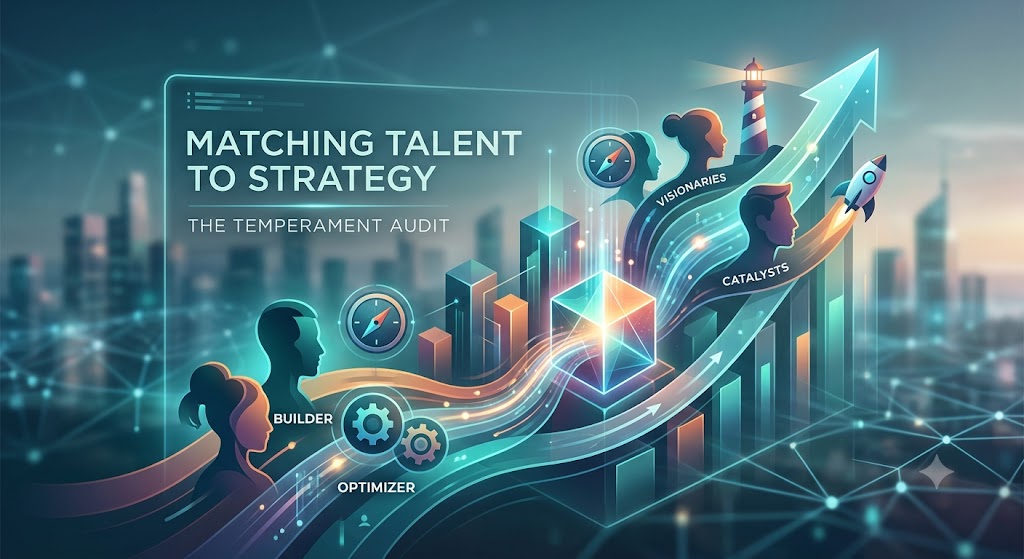
GUEST POST from Chateau G Pato
The Strategy-Talent Mismatch
Too often, organizations treat strategy as a purely analytical exercise — a roadmap drawn in a boardroom that assumes the current workforce can simply execute the plan through sheer will. However, strategic failure is rarely a result of poor planning. Instead, it stems from a fundamental mismatch between an organization’s “innovation temperament” and its stated objectives.
The “Vision vs. Reality” Gap
The gap between “Strategic Intent” and “Tactical Reality” is the graveyard where most ambitious initiatives go to die. Leaders often articulate a bold future-state, but they lack a method to evaluate whether their existing team’s psychological and behavioral makeup is actually wired to get them there. When the strategy demands agility but the organization is temperamentally built for risk-aversion, the resulting friction creates a culture of stagnation.
Defining the Temperament Audit
It is time to move beyond the limiting scope of skills-based hiring and performance reviews. A Temperament Audit goes deeper. It identifies the cognitive and creative predispositions — the intrinsic ways individuals process change, view risk, and approach problem-solving. By auditing the temperaments currently present within your organization, you gain visibility into what your team is naturally capable of achieving and where you are culturally inhibited.
The Cost of Misalignment
Misalignment is expensive. When you force a team dominated by “Optimizers” to execute a “Disruption” strategy, you aren’t just slowing down innovation — you are inducing organizational trauma. You end up with a team that feels like they are failing because they are being asked to solve problems for which their temperament is ill-suited, leading to rapid burnout and the quiet abandonment of the strategic vision. Recognizing this mismatch is the first step toward building a truly resilient organization.
The Four Archetypes of Innovation Temperament
To audit your organization effectively, you must first understand the primary temperaments that drive behavior. While individuals possess a complex blend of traits, most team members will exhibit a dominant mode of engagement that defines how they contribute to innovation.
The Visionary (The Architect)
Visionaries are the architects of the future. They possess the cognitive ability to scan the horizon, connecting disparate dots to foresee 10-year shifts in markets and technology. They are essential for setting the “North Star,” but they can often feel detached from the ground-level work required to execute their own grand designs.
The Builder (The Engineer)
Builders are the bridge between abstraction and reality. They thrive when tasked with taking a rough concept and defining the tactical steps necessary to make it functional. While Visionaries dream the “What,” the Builders engineer the “How,” providing the structural integrity that prevents good ideas from collapsing under their own weight.
The Optimizer (The Refiner)
Optimizers are the masters of efficiency, scale, and consistency. They are critical for the long-term survival of an organization because they ensure that processes are lean and profitable. However, in an innovation context, they can become the “silent killers” of radical ideas, inadvertently applying rigid efficiency metrics to experiments that require breathing room to survive.
The Catalyst (The Disruptor)
Catalysts are the high-energy agents of change who challenge the status quo. They are inherently uncomfortable with “the way we’ve always done it” and are the most likely to push for radical, human-centered shifts. They are the friction that creates the spark of innovation, but they require a steady hand to channel their energy toward constructive organizational outcomes.
Assessing Your Current Portfolio
Knowing the archetypes is only the first step; the true challenge lies in mapping the distribution of these temperaments within your current workforce. An organization that is “temperamentally heavy” in one area will face predictable blind spots.
Diagnostic Tools
Moving toward a data-informed approach, we must implement diagnostic frameworks that go beyond static job descriptions. These tools should assess where your team members naturally gravitate when faced with ambiguity, conflict, or the need for creative problem-solving, creating a heatmap of your organizational cognitive diversity.
The “Innovation Roles” Perspective
To ensure alignment with your broader strategy, we must map these temperaments against the Nine Innovation Roles. By evaluating whether your current talent pool can effectively fill roles like the Trend Spotter, the Experimenter, or the Connector, you can pinpoint the specific functional gaps preventing your strategy from gaining traction.
Identifying the “Silent Voids”
The most dangerous gaps are often the ones you cannot see. It is easy to recognize when you lack a Visionary, but it is much harder to realize that you have an abundance of Builders and an total absence of Catalysts. This “Silent Void” creates an organization that is excellent at executing yesterday’s strategy, but completely unable to pivot toward tomorrow’s opportunities. Auditing your portfolio forces you to confront these voids and determine whether you need to recruit new talent, or provide the psychological safety necessary for your existing team to flex into underrepresented roles.
Matching Talent to Strategic Phases
Strategy is not a static destination; it is a series of shifting cycles. As your organization moves through different stages of the innovation lifecycle, the temperament required to succeed changes. Failing to adjust your talent focus accordingly is a primary driver of strategic drift.
Phase 1: Exploration (The Need for Catalysts)
In the early-stage exploration of new opportunities, the organization must prioritize risk-tolerance and high-velocity learning. This phase requires a high density of Catalysts who are willing to break existing models and challenge ingrained assumptions. Attempting to manage this phase with a heavy hand of Optimizers will stifle the creative volatility necessary to uncover disruptive potential.
Phase 2: Execution & Scaling (The Need for Builders/Optimizers)
Once a viable innovation is identified, the focus must shift. The chaotic energy of the exploration phase becomes a liability if not tempered. You must transition your organizational focus to Builders and Optimizers who can refine the concept, establish repeatable processes, and drive market scalability. Success here is defined by consistency, not disruption.
Phase 3: Transformation (The Need for Visionaries)
Even the most successful organizations eventually face the “plateau of maturity,” where established efficiency begins to impede long-term relevance. During this phase, you must re-infuse the organization with Visionaries capable of identifying the next “Great American Contraction” or technological shift. Transformation is not about doing the same thing better; it is about having the foresight to pivot before the market renders your current model obsolete.
Strategic Recommendations
Once you have diagnosed your organization’s temperament gaps, the final step is moving from insight to action. Creating a temperamentally aligned organization is not about firing and hiring, but about creating the conditions for fluid, intentional contribution.
Dynamic Talent Mobility
Static job descriptions are the enemy of innovation. Instead of keeping individuals tethered to a fixed set of duties, implement dynamic talent mobility. This allows you to shift individuals into roles that match the organization’s current strategic cycle — moving a team member from a Builder role during execution to a Catalyst role during a new exploration phase — based on their temperament strengths rather than their historical title.
Managing the Friction
Productive tension is not just inevitable; it is desirable. The goal is not to eliminate friction between your Optimizers and your Catalysts, but to manage it. Foster environments where these temperaments are encouraged to challenge one another — the Optimizers ensuring feasibility and the Catalysts pushing for possibility. Without this friction, you either end up with unscalable fantasies or stagnant, risk-averse execution.
The Human-Centered Approach
Above all, remember that a Temperament Audit is a tool for empowerment, not exploitation. It should focus on placing individuals in roles where they are most likely to thrive, reducing the cognitive dissonance that comes from forcing “round-peg” people into “square-peg” roles. When you treat talent as human beings with specific creative predispositions rather than resources to be moved across a spreadsheet, you create a culture of belonging that naturally fosters higher performance and innovation resilience.
Conclusion: The Future of Organizational Resilience
The landscape of work is undergoing a seismic shift. As we navigate the “AI Soft Landing” and the increasing automation of routine, task-based labor, the true competitive advantage for any organization will no longer be technical proficiency alone. Instead, it will be the temperamental alignment of your workforce with your strategic vision.
The “AI Soft Landing” Context
In an era where AI can handle the heavy lifting of data analysis and tactical execution, the value of human labor shifts toward synthesis, empathy, and strategic foresight. Understanding your organization’s collective temperament is the key to ensuring that your human talent is focused on the high-value, creative work that machines cannot replicate, effectively future-proofing your human capital.
Final Thought
The winning organizations of the future will not necessarily be those with the largest budgets or the most advanced technology; they will be the ones that can successfully navigate the transition between distinct modes of work. By auditing your temperament mix and intentionally matching your people to the strategic phase at hand, you build a foundation of true resilience. It is time to stop managing people as static resources and start leading them as a dynamic, temperamentally aligned force capable of shaping the future.
Frequently Asked Questions
What is an Innovation Temperament Audit?
An Innovation Temperament Audit is a strategic diagnostic process that evaluates the cognitive and creative predispositions of your workforce. Rather than focusing solely on technical skills, it maps how individuals naturally process change, approach risk, and handle problem-solving to ensure your team is aligned with your organization’s specific strategic goals.
Why is matching talent to strategic phases important?
Different phases of innovation — such as exploration, scaling, and transformation — require different behavioral strengths. If your team’s collective temperament does not match the current phase (for example, relying on risk-averse optimizers during an exploration phase), your strategy will likely fail due to lack of cultural agility.
How does a Temperament Audit differ from traditional performance management?
While traditional performance management focuses on past output and competency against static job descriptions, a Temperament Audit is forward-looking. It prioritizes human-centered design by identifying the environment where an individual will naturally thrive, facilitating better talent mobility and reducing burnout by aligning work roles with inherent creative predispositions.
Bottom line: Futurology is not fortune telling. Futurists use a scientific approach to create their deliverables, but a methodology and tools like those in FutureHacking™ can empower anyone to engage in futurology themselves.
Image credit: Gemini
 Sign up here to get Human-Centered Change & Innovation Weekly delivered to your inbox every week.