GUEST POST from Art Inteligencia
Section I: The Shifting Baseline — From Innovation to Infrastructure
1. The Utility Pattern: Lessons from Historical Infrastructure
Throughout history, fundamental advances follow a predictable evolutionary arc. Technologies that begin as specialized, high-cost innovations—whether clean running water, electrical power, telecommunications, or the internet—gradually transition into quiet, essential infrastructure. In their early stages, competitive advantage stems from simply possessing or accessing the technology. Over time, however, as adoption broadens and delivery mechanisms standardize, the baseline shifts. The core technology becomes a utility: ubiquitous, reliable, and expected.
Artificial intelligence is undergoing this exact transition, but at an unprecedented velocity. We are moving rapidly past the phase where merely having an AI capability offers a distinct edge. Instead, we are entering an era where basic machine intelligence is assumed to be running invisibly in the background of every tool, workflow, and human experience.
2. Intelligence as Flow, Not Stock
To understand intelligence as a utility, we must rethink how we conceptualize cognitive compute. Historically, organizations treated intelligence as a “stock”—a resource to be accumulated, hoarded, and stored in proprietary databases, specialized teams, or custom algorithms.
As foundational models mature and compute capacity scales globally, intelligence shifts from a stock to a “flow.” Like electricity running through a grid or water through a municipal pipe, machine intelligence becomes an atmospheric, ambient resource. It flows into interfaces, automated systems, and decision-making environments in real time. Value no longer resides in owning the reservoir of intelligence, but in how intentionally and humanely we direct its flow to solve meaningful human problems.
3. The Abundance Paradox
As the raw marginal cost of processing power drops, we encounter the Abundance Paradox: the exponential increase in raw cognitive compute does not automatically translate into democratized human benefit or equitable value creation.
Without deliberate architectural and policy choices, abundant intelligence risks being concentrated within a handful of private silos. When access to high-tier cognitive capabilities, low-latency infrastructure, or specialized domain models is gated behind high economic barriers, technological abundance can actually widen the gap between those who leverage intelligent systems and those who are displaced or underserved by them.
4. The Human-Centered Imperative
Reframing artificial intelligence as public infrastructure elevates the stakes of experience design and change management. Infrastructure is not passive; its design actively shapes human behavior, agency, and societal health.
If intelligence is to become a true utility, human flourishing, psychological safety, and individual agency must be treated as foundational design requirements rather than secondary considerations. Building an AI utility requires designing systems that amplify human potential, preserve dignity, and remain intuitive and trustworthy for every individual who relies upon them.
Section II: Architecture of the AI Commons
1. Defining the Public AI Utility
If machine intelligence is to serve as a foundational utility, its underlying infrastructure must be reimagined as a public common. Just as a municipal water system relies on reservoirs, filtration plants, and piping networks, a functional AI Commons requires three core layers:
- Open-Weight Base Models as Digital Public Goods: High-capacity, foundational models maintained transparently and made universally accessible to prevent monopoly control over baseline reasoning.
- Sovereign Compute Grids & Energy Alignment: Distributed, clean-energy-backed computational infrastructure managed with public oversight to ensure reliability, security, and environmental sustainability.
- Standardized Interoperability Layers: Universal protocol standards that allow diverse devices, applications, and human-facing interfaces to connect seamlessly to core intelligence channels.
2. The Human Experience Design (HXD) Layer
An infrastructure is only as effective as its point of interaction with human lives. In an AI Commons, experience design becomes the primary vehicle for equity and trust.
We must design interfaces that uphold human dignity and autonomy—ensuring people retain clear choice and agency rather than becoming passive consumers of automated outputs. This demands intuitive cognitive ergonomics, universal accessibility across physical and economic capabilities, and cultural adaptability that respects local contexts. Without deliberate design at this layer, we risk creating a severe “cognitive divide” where advanced capabilities remain usable only by the tech-literate elite.
3. Governance & Ethics in the Open
Managing shared resources historically carries the risk of the “Tragedy of the Commons”—where individual overconsumption or misuse depletes the shared resource for all. In the context of intelligence, this manifests as algorithmic bias, deliberate disinformation, or resource monopolization.
| Governance Pillar | Traditional Proprietary Model | Public AI Commons Model |
|---|---|---|
| Model Auditing | Closed-door internal reviews behind corporate secrecy | Participatory, continuous public auditing and open lineage tracking |
| Access Rights | Tiered monetization based on capital and market power | Guaranteed baseline access as a civic right, paired with tiered usage limits |
| Alignment & Values | Optimized for shareholder engagement and profit retention | Co-designed with multi-stakeholder governance representing broad societal values |
By embedding democratic oversight, clear lineage, and ethical stewardship directly into the architectural blueprints, the AI Commons can maintain its integrity as a sustainable resource for universal human empowerment.
Section III: Orchestrating Human-Centered Change
1. Organizational Transformation: The Shift to Application Density
When baseline intelligence becomes a universally accessible public commodity, the traditional sources of competitive advantage evaporate overnight. Organizations can no longer rely on hoarding proprietary algorithms or controlling isolated pockets of technical expertise.
Instead, value creation shifts dramatically from intelligence scarcity to application density. Victory belongs to organizations that excel at weaving raw cognitive flow into deeply empathetic, frictionless, and impactful human experiences. Success is no longer measured by how much intelligence an organization owns, but by how effectively it applies that intelligence to solve real-world human problems.
2. Reimagining Change Management for Collaborative Intelligence
Legacy change management frameworks were designed for linear transitions and discrete tool adoption. In an era of atmospheric AI infrastructure, change management must evolve from an exercise in structural disruption to an ongoing discipline of human empowerment.
Leaders must active-steer their cultures away from anxiety over job displacement toward a mindset of collaborative intelligence. This requires redesigning workflows so that human curiosity, creative synthesis, strategic judgment, and empathy are amplified—not replaced—by underlying AI utilities.
3. Co-Creating the Future Through Multi-Stakeholder Ecosystems
Building an equitable AI Commons cannot be left to technologists or policymakers alone. Sustainable infrastructure requires continuous co-creation across diverse ecosystems:
- Citizens & Communities: Defining local needs, cultural guardrails, and real-world priorities.
- Experience Designers & Human-Centered Innovators: Ensuring interfaces promote human agency, clarity, and trust.
- Technologists & Engineers: Delivering resilient, scalable, and environmentally aligned technical architectures.
- Policymakers & Ethicists: Establishing transparent oversight, fair access protocols, and public accountability.
4. Unlocking Continuous Innovation on Stable Foundations
A common misconception is that public utilities stifle innovation through standardization. History proves the exact opposite: standardizing foundational layers unleashes unprecedented waves of higher-order creativity.
When the power grid became a reliable utility, it didn’t eliminate innovation—it enabled the creation of modern computing, global manufacturing, and home appliances. By turning baseline intelligence into a stable, trusted, public foundation, society frees innovators to focus their energies on solving higher-order challenges in healthcare, education, climate resilience, and human flourishing.
Section IV: Futurology — Scenarios for 2035 and Beyond
As we project a decade into the future, the structural choices we make today regarding cognitive infrastructure will branch into radically different societal landscapes. By exploring plausible future scenarios, leaders can better navigate today’s decisions to steer humanity toward shared prosperity and resilient design.
1. Scenario A: The Enclosed Gardens (Status Quo Extended)
In this scenario, intelligence remains trapped behind proprietary walls controlled by a small oligopoly of technology behemoths. Advanced reasoning capabilities are heavily monetized, resulting in extreme digital and socio-economic stratification.
- Siloed Ecosystems: Proprietary “cognitive ecosystems” dictate user experiences with high lock-in costs and minimal interoperability.
- The Expanding Cognitive Divide: Wealthy institutions and individuals access hyper-optimized cognitive amplifiers, while public services, non-profits, and developing regions rely on legacy, second-tier models.
- Erosion of Public Trust: Black-box algorithms and profit-driven optimization lead to widespread algorithmic bias, deepfakes, and societal polarization.
2. Scenario B: The AI Commons (Public Utility Realized)
Here, global standards establish foundational intelligence as a public utility—accessible to all as a basic civic right, backed by transparent governance and green compute infrastructure.
- Universal Baseline Intelligence: High-quality reasoning, translation, and problem-solving models are freely accessible to every school, clinic, small business, and community globally.
- Explosion of Hyper-Local Innovation: Unburdened by model licensing fees, grassroots innovators design tailored solutions addressing specific cultural, environmental, and regional needs.
- Human-Centric Flourishing: Interfaces prioritize user agency, mental well-being, and cognitive extension, turning technology into a seamless partner in human potential.
3. Scenario C: The Hybrid Infrastructure Network
Borrowing from modern transportation and logistics, this scenario pairs a publicly funded base layer with specialized commercial layers running on top.
| Infrastructure Layer | Primary Function | Governance & Access |
|---|---|---|
| Public Foundation Layer | Provides baseline reasoning, general knowledge, standard ethics, and civic services (e.g., public transit / public roads). | Publicly funded, open source/open weights, universal free access up to standard quota limits. |
| Commercial Specialty Layer | Delivers ultra-high-precision, specialized domain expertise for medicine, advanced engineering, and high-frequency finance. | Market-driven, subscription/metered pricing, enterprise SLA guarantees and specialized security. |
The Hybrid Model offers a pragmatic bridge—protecting public interests and equitable baseline access while preserving powerful economic incentives for high-stakes, specialized technological breakthroughs.
Section V: Call to Action — Designing for Shared Flourishing
The trajectory of artificial intelligence is not preordained by technology itself; it is determined by the choices we make today as leaders, creators, policy makers, and human-centered innovators. Moving from proprietary enclosure to an intentional AI Commons requires a fundamental pivot in mindset: shifting our focus from building higher competitive walls to designing broader, more inclusive tables.
1. Core Design Principles for the AI Commons
To ensure that public intelligence infrastructure truly serves humanity, every system, policy, and user interface should adhere to three non-negotiable principles:
- Human Agency First: Intelligent infrastructure must elevate human decision-making and intentionality, serving as a cognitive lever that expands capability rather than an opaque engine that quietly replaces human choice.
- Radical Transparency & Lineage: Every public baseline model must offer verifiable data provenance, open auditability, and clear explainability, building lasting societal trust through radical open-source visibility.
- Equitable Frictionlessness: Quality of access and baseline cognitive capability must be uniformly excellent across zip codes, socioeconomic strata, and physical capabilities, eliminating artificial digital barriers.
2. A Strategic Directive for Leaders
For business executives, public officials, and innovation leaders, preparing for the utility era requires immediate action across three fronts:
| Stakeholder Group | Immediate Strategic Shift | Core Focus |
|---|---|---|
| Business Leaders | Pivot from hoarding algorithms to maximizing application density. | Differentiate through superior experience design, trust, and solving real human problems. |
| Policymakers | Invest in public compute infrastructure and open data standards. | Ensure baseline intelligence is treated as a core civic right with multi-stakeholder oversight. |
| Designers & Innovators | Champion cognitive ergonomics and human dignity. | Build intuitive interface layers that bridge the cognitive divide and empower every individual. |
3. Conclusion: The Ultimate Benchmark of Innovation
Intelligence is rapidly becoming the core substrate of modern human existence—as fundamental as light, power, or communication. As we stand at this crossroad, we must remember that true progress has never been measured by the raw power of our tools, but by how broadly and equitably those tools expand human potential.
By designing an AI Commons anchored in human-centered change, shared stewardship, and intentional experience design, we can weave machine intelligence into the common fabric of society—unlocking an unprecedented era of shared prosperity, continuous innovation, and collective human flourishing.
Frequently Asked Questions: The AI Commons
1. What is the AI Commons, and why is it necessary?
The AI Commons is a proposed model where foundational artificial intelligence—such as open-weight base models, sovereign compute grids, and interoperability layers—is treated as a shared public utility rather than a closed private asset. It is necessary to prevent severe socio-economic stratification, bridge the cognitive divide, and ensure universal baseline access to essential intelligence.
2. Won’t making intelligence a public utility stifle commercial innovation?
No. History shows that standardizing foundational infrastructure—like electricity and the internet—actually accelerates innovation. By providing a stable, reliable, and universally accessible base layer of intelligence, organizations and entrepreneurs are freed to focus on higher-order value creation, specialized commercial applications, and solving complex human problems (“application density”).
3. What role does Human Experience Design (HXD) play in the AI Commons?
Human Experience Design (HXD) serves as the critical bridge between raw computational power and human flourishing. In an AI Commons, HXD ensures that interfaces prioritize human agency, dignity, cognitive ergonomics, and universal accessibility, preventing technology from overwhelming or displacing human intentionality.
SPECIAL BONUS: Braden Kelley’s Problem Finding Canvas can be a super useful starting point for doing design thinking or human-centered design.
“The Problem Finding Canvas should help you investigate a handful of areas to explore, choose the one most important to you, extract all of the potential challenges and opportunities and choose one to prioritize.”
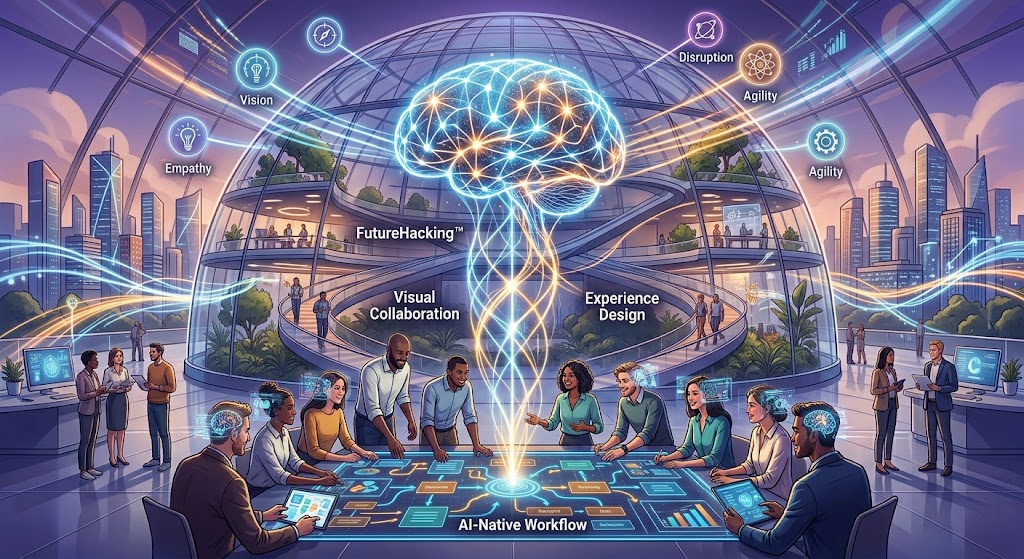
Image credit: Gemini
 Sign up here to get Human-Centered Change & Innovation Weekly delivered to your inbox every week.