The Organizational Shock Absorber
GUEST POST from Art Inteligencia
I. Introduction: The Myth of the “Return to Normal”
For decades, business leaders have treated disruption like a passing storm. The prevailing playbook has been simple: hunker down, weather the gale, minimize the damage, and wait for the skies to clear so the organization can return to its comfortable, steady state. But in an era defined by exponential technological shifts, shifting human expectations, and continuous economic realignment, that “steady state” is a dangerous illusion. There is no normal to return to.
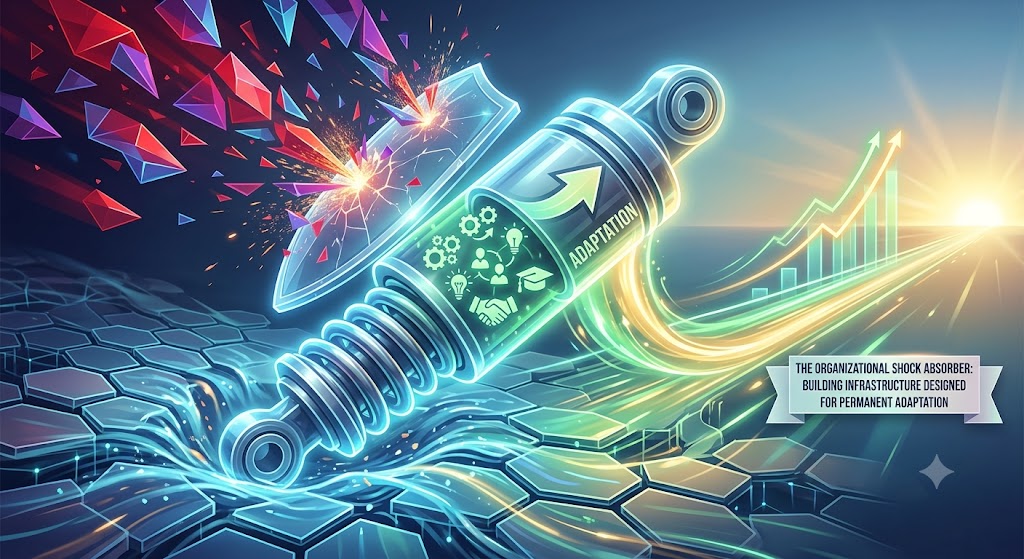
When an organization builds rigid structures designed to withstand impact through sheer strength, it creates a fragile ecosystem. Like a brittle skyscraper in an earthquake, a rigid corporate structure doesn’t adapt to the shaking — it cracks. To survive and thrive in a state of permanent volatility, we must fundamentally reimagine organizational design. We need to move away from static shields and toward a dynamic, human-centered framework: the Organizational Shock Absorber.
An Organizational Shock Absorber isn’t about resisting change; it is about absorbing, dissipating, and redirecting the energy of disruption to propel the company forward. This requires a profound mindset shift. Building for permanence is dead. To build a future-ready enterprise, change capability can no longer be managed as a series of isolated, exhausting projects. It must be woven directly into the foundational infrastructure of the business, engineered for permanent adaptation.
II. The Mechanics of an Organizational Shock Absorber
Building an infrastructure for permanent adaptation requires us to rethink the very anatomy of the enterprise. If the traditional organization is a machine with fixed, rigid gears, the adaptive organization must function like a living organism — highly responsive, interconnected, and structurally fluid. To absorb the impact of constant market shifts, the internal mechanics must be intentionally engineered to flex without breaking.
Fluid Architecture vs. Rigid Silos
Traditional, deeply entrenched functional silos are the enemy of speed and agility. When information and decision-making must travel up and down isolated vertical columns, the organization becomes paralyzed in the face of rapid change. An Organizational Shock Absorber replaces these rigid hierarchies with a fluid, network-based architecture. Cross-functional teams are formed dynamically around specific customer outcomes or innovation challenges, scaling up or pivoting resource allocation rapidly, and dissolving seamlessly once the objective is met.
The Continuous Foresight Engine
An effective shock absorber doesn’t just react to an impact after it happens; it anticipates the terrain ahead. Relying on annual or biannual strategic planning cycles in a hyper-accelerated world is a recipe for irrelevance. Organizations must build a continuous foresight engine — sensory mechanisms embedded throughout the business that actively scan for weak signals, emerging trends, and micro-shifts in customer behavior. By mapping these ripples early, leaders can adjust the tension of the organizational shock absorber before the ripple turns into a catastrophic tidal wave.
The Co-Creation Mandate
The fatal flaw of most organizational transformations is that they are designed in a vacuum by executive leadership and forced top-down onto the rest of the company. This approach inevitably breeds friction, confusion, and active resistance. True adaptive infrastructure must be co-created. By engaging front-line employees — the people who actually interact with customers and operate the systems — in designing the tools and processes of adaptation, you eliminate resistance before it starts. Participatory innovation ensures that the infrastructure is not only robust, but genuinely usable and embraced by the workforce.
III. Human-Centered Change: Protecting the Core Asset
An organizational shock absorber is only as resilient as the people who power it. Too often, leaders treat infrastructure as a purely technical or structural challenge, completely forgetting the human element. If your people are worn down to the point of exhaustion, even the most beautifully designed agile framework will collapse under pressure. To build an infrastructure of permanent adaptation, we must actively protect, sustain, and invest in our human capital.
Combatting Change Fatigue
When change is treated as a continuous barrage of top-down mandates, the predictable result is widespread burnout and change fatigue. People do not naturally resist change; they resist being changed without their input. The shock absorber must be designed to manage the cognitive load of the workforce. This means establishing a sustainable cadence for transformation, eliminating low-value bureaucratic friction, and providing clear visibility into the “why” behind strategic shifts so employees feel like active participants rather than helpless passengers.
Psychological Safety as Infrastructure
Permanent adaptation requires a relentless willingness to experiment, test new ideas, and push boundaries. However, innovation cannot exist without the risk of failure. If an organization’s culture punishes mistakes, employees will naturally default to safe, rigid, and defensive behaviors — effectively locking the shock absorber in place. Psychological safety is not a soft, HR-centric buzzword; it is a critical piece of operational infrastructure. Leaders must deliberately foster an environment where speaking up, challenging assumptions, and failing forward are actively celebrated.
Upskilling for Fluidity
In a rapidly evolving landscape, training employees for static, highly specialized roles is a short-sighted strategy. As automation and artificial intelligence shift the baseline of daily tasks, the core value of human talent lies in learning agility. Organizations must transition their development programs away from rigid technical training and toward fostering transferable, human-centered capabilities. By equipping the workforce with foundational problem-solving frameworks, design thinking mindsets, and collaborative change tools, employees become inherently adaptable — ready to transition seamlessly as business priorities evolve.
IV. Experience Design (EX/CX) for a Moving Target
The true measure of an internal organizational shock absorber is how effectively it preserves the external experience. When an organization’s internal infrastructure is chaotic, brittle, or slow to respond, that friction inevitably spills outward, fracturing the customer experience. To build a system designed for permanent adaptation, leaders must design the employee experience (EX) and the customer experience (CX) as two sides of the exact same coin.
Synchronizing Employee and Customer Experience
You cannot deliver a seamless, delightful experience to your customers if your employees are fighting against broken, rigid internal systems. When disruption hits, the organizations that adapt fastest are those that have tightly aligned their internal capabilities with external customer expectations. By utilizing Experience Level Measures (XLMs) instead of relying solely on traditional operational metrics, leaders can monitor the friction points where internal stress begins to degrade the human experience on either side of the equation.
Adaptive Service Blueprints
Traditional customer journey maps and service blueprints are too often treated as static artifacts — carved in stone and filed away. In an environment of constant market evolution, these blueprints must become living, adaptive documents. By designing service delivery with modular components, organizations can swap out specific touchpoints, automate backend workflows, or integrate new technologies seamlessly without needing to dismantle the entire customer-facing architecture. This modularity ensures the experience remains stable and consistent, even as the landscape shifts beneath it.
V. Case Studies & Signals from the Future
The transition from a rigid organization to an adaptive one is not a theoretical exercise — it is a survival imperative unfolding in real-time across the global market. As we look at the organizations navigating the macroeconomic shifts of our era, the line between those that possess an internal shock absorber and those that do not is becoming starkly apparent.
The Rigid Failure: The Trap of Brute-Force Efficiency
Consider the cautionary tale of a legacy global logistics enterprise that optimized its entire operation for maximum, rigid efficiency. For years, their hyper-specialized silos and tightly locked supply chains produced predictable, incremental returns. However, when a sudden confluence of shifting labor dynamics and rapid automation trends disrupted their core market, their strength became their downfall. Because their infrastructure was engineered for a static environment, it could not flex. They attempted to resist the disruption through top-down mandates and increased operational pressure on their workforce, resulting in unprecedented change fatigue, massive employee turnover, and a fractured customer experience that ultimately eroded their market share.
The Adaptive Triumph: Modular Resilience in Action
Conversely, a mid-sized financial technology firm built its operations around the principles of permanent adaptation. Instead of rigid functional departments, they organized their talent into dynamic, mission-driven networks. When rapid advancements in generative artificial intelligence threatened to disrupt their core service offerings, they didn’t panic or launch a frantic, multi-year restructuring initiative. Their continuous foresight engine had already flagged the ripple. Because they had a culture rooted in psychological safety and a modular infrastructure already in place, front-line teams co-created an entirely new service delivery model within weeks. They effortlessly absorbed the technological impact and redirected that energy to launch an AI-assisted customer experience that set a new industry benchmark.
VI. Conclusion: A Call to Action for Change Leaders
The time for incremental, reactive management is officially over. We can no longer afford to view change as an exceptional event that happens to the business; we must recognize that change is the business. The organizations that continue to rely on rigid structures, top-down mandates, and static strategic plans will inevitably find themselves fractured by the accelerating forces of our modern economy. Survival demands an entirely new blueprint.
The Mindset Shift: Designing for Change
As leaders, our ultimate objective must shift. We must stop trying to manage change and instead start designing organizations that are fundamentally made of change. This requires us to look beyond temporary fixes and commit to building the systemic, human-centered capabilities that define the Organizational Shock Absorber. It means treating psychological safety, continuous foresight, fluid architecture, and co-creation not as optional cultural perks, but as mission-critical infrastructure.
The Final Charge
The next disruption is not waiting for your current transformation project to finish. The ripples are already forming on the horizon. Leaders must stop asking, “How do we survive this disruption?” and start asking, “How do we build the infrastructure that turns permanent disruption into our greatest competitive advantage?” By investing in an infrastructure designed for permanent adaptation, you protect your people, elevate your experiences, and ensure your organization is ready to capture the future — no matter how fast it arrives.
Frequently Asked Questions
What is an Organizational Shock Absorber?
An Organizational Shock Absorber is a human-centered design framework and operational infrastructure built for permanent adaptation. Rather than rigidly resisting market, technological, or economic disruptions, it dynamically absorbs, dissipates, and redirects that energy to drive continuous innovation and change capability.
Why are traditional change management methods failing?
Traditional change management treats disruption as a temporary storm with a fixed beginning and end, aiming for a “return to normal.” In a world of continuous disruption, there is no steady state. Top-down mandates cause severe change fatigue; adaptive organizations require co-creation and fluid structures instead.
How does experience design relate to organizational agility?
Employee experience (EX) and customer experience (CX) are deeply linked. Internal corporate friction caused by rigid, brittle infrastructure inevitably spills outward and fractures the customer experience. Designing modular systems and monitoring Experience Level Measures (XLMs) ensures both sides stay aligned during rapid pivots.
SPECIAL BONUS: Braden Kelley’s Problem Finding Canvas can be a super useful starting point for doing design thinking or human-centered design.
“The Problem Finding Canvas should help you investigate a handful of areas to explore, choose the one most important to you, extract all of the potential challenges and opportunities and choose one to prioritize.”
Image credit: Pexels
 Sign up here to get Human-Centered Change & Innovation Weekly delivered to your inbox every week.