A Leadership Manifesto
GUEST POST from Art Inteligencia
The Shift: From Individual Fatigue to Systemic Failure
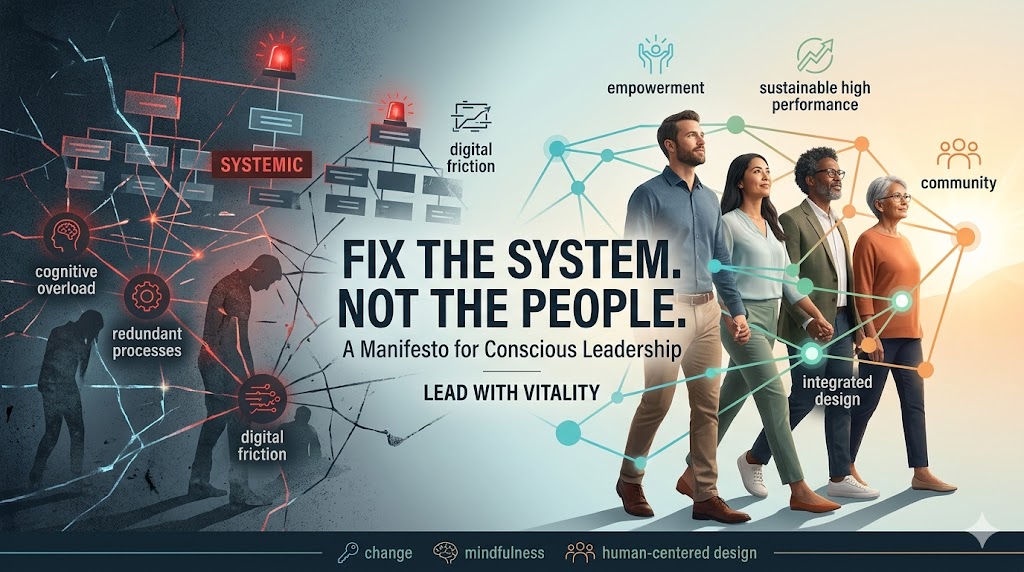
For years, the corporate response to exhaustion has been rooted in the “Leaky Bucket” fallacy — the idea that if we just pour in enough self-care, yoga apps, and “mental health days,” we can offset the holes in our organizational culture. But when burnout becomes systemic, the holes are no longer static; they are widening. Attempting to solve a structural plague with individual resilience is not just ineffective; it is a design failure that places the burden of a broken system onto the shoulders of the people it is breaking.
The Diagnostic Gap: Why Wellness Programs Fail
Traditional “wellness” initiatives treat burnout as a personal deficiency in stress management. However, when an entire department is flagging, the problem isn’t a lack of mindfulness — it’s a misalignment of work design. We must bridge the gap between superficial perks and the deep-seated friction inherent in our daily operations. True leadership in this era requires moving beyond the “band-aid” approach to perform a root-cause analysis of our work ecosystems.
Defining Systemic Burnout
Systemic burnout occurs when exhaustion is no longer an outlier but the baseline. It is characterized by:
- The Culture of Exhaustion: Where “busy-ness” is worn as a badge of honor, yet collective impact is stagnating.
- Institutional Cynicism: A breakdown in trust where employees no longer believe that leadership has the capacity — or the will — to change the pace.
- Erosion of Agency: When the complexity of the system outpaces the individual’s ability to influence their own outcomes.
The Innovation Tax
The most dangerous byproduct of systemic burnout is the invisible “Innovation Tax.” Chronic depletion triggers a survival mindset, forcing the brain to prioritize immediate tasks over long-term strategic thinking. In this state, creativity is viewed as a luxury we can’t afford, and risk-taking is avoided at all costs. To lead for the future, we must recognize that a depleted workforce is an organization that has lost its ability to evolve, adapt, and compete.
The Root Causes: The Design Flaws of Modern Work
Burnout is rarely the result of a single project or a difficult week; it is the cumulative output of a system designed without the human operating system in mind. If we view our organizations through the lens of experience design, we begin to see that systemic exhaustion is often a “feature” of our current work architecture, not a bug. To fix it, we must deconstruct the structural flaws that prioritize digital velocity over human capacity.
The “Always-On” Architecture
Digital transformation was intended to liberate us, yet it has often resulted in a relentless, boundary-less work environment. The “Always-On” architecture treats human cognitive energy as an infinite resource, failing to account for the necessary cycles of recovery and deep thought. When the friction between our digital tools and our biological limits becomes constant, we see a rapid erosion of the human experience. As leaders, we must move from constant connectivity to intentional engagement.
Cognitive Overload and Complexity
Modern organizations have become master architects of complexity. We suffer from an accumulation of redundant processes, excessive meeting cultures, and the “shadow work” required just to navigate internal bureaucracy. This cognitive load acts as a drag on productivity, forcing employees to spend more energy managing the system than performing the work they were hired to do. Identifying and removing these friction points is a primary responsibility of human-centered leadership.
The Reward Paradox
In many corporate cultures, we see a dangerous feedback loop: the Reward Paradox. High-performing individuals who demonstrate agility and efficiency are frequently “rewarded” with more work, higher stakes, and more complexity. Over time, this creates a perverse incentive structure where the most capable people are the first to break. We must redesign our recognition systems to value sustainable impact and strategic contribution rather than simply rewarding the ability to absorb more volume.
Human-Centered Change: Designing the Antidote
Solving systemic burnout requires a pivot from management to design. We cannot command a culture to be energized; we must architect the conditions that allow energy to flourish. By applying human-centered design principles to the very fabric of how we work, we can transition from a system of extraction to a system of empowerment, focusing on the quality of the employee experience as a lead indicator of organizational health.
The Empathy Audit
To fix the system, we must first see it through the eyes of those moving within it. An empathy audit goes beyond engagement surveys to map the actual “day-in-the-life” of our teams. We must identify the “micro-stressors” and friction points — the broken handoffs, the confusing directives, and the tool fatigue — that silently drain organizational bandwidth. Mapping these journeys allows us to treat employee pain points with the same rigor we apply to customer friction.
Strategic Subtraction
Innovation is often associated with “more” — more features, more initiatives, more goals. However, in a state of systemic burnout, the most radical act of leadership is subtraction. We must ruthlessly evaluate our portfolios to identify “zombie projects” and low-value activities that consume time without driving meaningful impact. By creating a “Stop Doing” list, we reclaim the cognitive space necessary for high-value work and creative problem-solving.
Psychological Safety as Infrastructure
Psychological safety is not a “soft” skill; it is the essential infrastructure of a resilient system. In a healthy organization, signaling that capacity has been reached must be seen as an act of professional integrity, not a confession of weakness. We must design rituals and communication channels where truth can be spoken to power regarding workloads. When people feel safe to set boundaries, the system gains the feedback loops it needs to self-correct before it reaches a breaking point.
Leading the Transition: Futurology in Management
The future of work isn’t something that happens to us; it is something we actively construct through our leadership choices today. To move beyond systemic burnout, leaders must adopt the mindset of a futurologist — anticipating shifts in human capacity and organizational needs before they manifest as crises. This requires a fundamental shift in how we perceive the relationship between time, trust, and technology.
Anticipatory Leadership
Most organizations manage resource allocation in the rearview mirror, reacting to burnout only after the data shows a spike in turnover or a dip in engagement. Anticipatory leadership involves using foresight to identify “crunch culture” triggers before they ignite. By analyzing upcoming project pipelines through a lens of human-centered capacity rather than just fiscal forecasting, we can smooth out the peaks and valleys that lead to collective exhaustion.
The Autonomy Pivot
One of the greatest contributors to systemic burnout is a lack of agency. When employees feel like “cogs” in a high-speed machine, their resilience plummets. The transition to a sustainable future requires an autonomy pivot — moving away from surveillance-based management and rigid input tracking toward a culture of outcomes-based trust. Giving people the agency to design *how* and *when* they achieve their objectives is the most effective way to restore the human energy that a rigid system extracts.
Redefining “Productivity”
Our traditional metrics for productivity are relics of the industrial age, focused on volume and activity. In the age of agentic AI and complex problem-solving, these metrics are not only obsolete — they are destructive. We must redefine productivity to measure the *impact* of work and the *sustainability* of the effort required to produce it. A future-ready leader asks: “Are we creating value, or are we just creating noise?” Transitioning our KPIs from activity-based inputs to value-based outputs is the key to decoupling growth from exhaustion.
Building the Resilient System of Tomorrow
The transition from a culture of exhaustion to one of sustainable high performance requires more than a tactical shift; it demands a fundamental re-engineering of our organizational DNA. We must move beyond the crisis management of today and begin building the infrastructure for a future where organizational agility and human well-being are inextricably linked. The goal is to create a system that scales without breaking the people who power it.
Cultural Rewiring
Change starts at the top, but it must be felt at every level. Cultural rewiring happens when leadership moves from talking about balance to modeling “sustainable high performance.” This means the C-suite must be visible in their own boundary-setting — demonstrating that the path to the top is not paved with perpetual martyrdom. When leaders prioritize their own recovery and focus, they grant a silent “permission” to the rest of the organization to do the same, effectively neutralizing the badge-of-honor busy-ness that fuels burnout.
The Role of Community
Systemic burnout thrives in isolation. In a world of distributed and hybrid work, the social capital that once buffered us against stress has often been thinned out. Rebuilding the resilient system of tomorrow requires an intentional focus on community — creating spaces for genuine human connection that aren’t tied to a specific deliverable. By strengthening these horizontal bonds, we create a network of mutual support that can absorb shocks and distribute the weight of organizational challenges more effectively.
Measuring Success: From Velocity to Vitality
If we only measure how fast we are moving (velocity), we will eventually run off a cliff. To build a truly resilient organization, we must introduce new KPIs that track the health of our “human infrastructure.” We should be measuring “Vitality” alongside “Velocity” — tracking metrics such as cognitive bandwidth, internal mobility, and the “Return on Energy” for major initiatives. When organizational health is reported with the same transparency and urgency as financial health, we finally gain the visibility needed to prevent burnout from ever becoming systemic again.
Conclusion: The Legacy of the Conscious Leader
The prevalence of systemic burnout is a signal that our current models of work have reached their logical breaking point. We can no longer afford to treat the human element as a flexible variable that can be infinitely squeezed to meet rigid organizational demands. To lead in this environment is to accept a new mandate: we are not just managers of tasks, but architects of environments where human potential can be sustained over the long term.
The goal isn’t merely to survive the current crisis or to lower turnover rates by a few percentage points. The goal is to design a future where work serves as a source of energy, purpose, and growth rather than a mechanism of depletion. This requires the courage to challenge legacy “hustle” cultures and the vision to implement systems that prioritize human-centered change and experience design.
Ultimately, leading through systemic burnout is the ultimate test of a leader’s commitment to their people. By choosing to fix the system instead of the individual, you aren’t just protecting your workforce — you are future-proofing your organization. The legacy of a conscious leader is found in the vitality of the teams they leave behind and the resilient, human-centered systems they have the bravery to build.
Frequently Asked Questions
How do you know if burnout has become systemic in an organization?
Burnout becomes systemic when exhaustion is the baseline rather than the exception. It is visible when high turnover, institutional cynicism, and a “culture of busyness” persist regardless of individual wellness efforts or time off.
Why do traditional wellness programs fail to solve systemic burnout?
Traditional programs focus on individual resilience (the “Leaky Bucket” approach) rather than fixing the structural flaws — such as cognitive overload, redundant processes, and “always-on” digital cultures — that cause the depletion in the first place.
What is the “Innovation Tax” associated with burnout?
The Innovation Tax is the loss of creative capacity and strategic risk-taking that occurs when a workforce is in survival mode. Chronic depletion forces the brain to prioritize immediate, low-value tasks over the long-term thinking required for organizational evolution.
SPECIAL BONUS: Braden Kelley’s Problem Finding Canvas can be a super useful starting point for doing design thinking or human-centered design.
“The Problem Finding Canvas should help you investigate a handful of areas to explore, choose the one most important to you, extract all of the potential challenges and opportunities and choose one to prioritize.”
Image credit: Gemini
 Sign up here to get Human-Centered Change & Innovation Weekly delivered to your inbox every week.