Private Equity is Ruining Everything from Sandwiches to Pet Ownership
LAST UPDATED: January 20, 2026 at 3:59 PM

GUEST POST from Art Inteligencia
I have always maintained that innovation is a byproduct of human curiosity meeting competitive necessity. It is a biological process of sorts; a marketplace needs diversity, mutation, and the survival of the fittest ideas to stay healthy. However, we are currently witnessing a systemic threat to this ecology: the massive concentration of wealth in the hands of a dwindling few. This financial gravity is creating a “Consolidation Gravity Well” that is sucking the life out of industries, raising prices, and — most crucially — killing the very spirit of innovation, community and entrepreneurship.
When wealth is widely distributed, it acts as seed corn for a thousand different experiments. But when wealth is concentrated, it becomes a weapon of market stabilization. For those at the top, innovation is often viewed as a threat to be managed rather than an opportunity to be seized. The result is a rapid consolidation across industries — from digital platforms to healthcare to agriculture — that leaves consumers with fewer choices and higher bills.
“When wealth concentrates, the marketplace loses its heartbeat. We trade the vibrant pulse of human-centered discovery for the sterile, predictable hum of a monopoly’s balance sheet.” — Braden Kelley
The Erosion of Value for Money
The standard economic argument for consolidation is “efficiency.” Larger firms, we are told, can leverage economies of scale to lower costs. Yet, in practice, we see the opposite. When three or four firms control 80% of a market, they stop competing on value creation and start competing on extraction. Without the threat of a nimble competitor stealing their lunch, these giants engage in “shadow pricing” and “feature stripping.”
The consumer feels this as a decrease in value for money. You pay more for a subscription that offers less; you buy food that is more processed but more expensive; you use software that hasn’t seen a meaningful update in five years because there is nowhere else to go. This is a direct consequence of wealth concentration allowing incumbents to buy their way out of the need to innovate.
How Financial Gravity Sucks Wealth Upwards
Concentrated wealth creates a financial gravity that funnels massive pools of capital — from sovereign wealth funds and ultra-high-net-worth individuals — directly into private equity (PE) vehicles seeking high-return alternatives to public markets. This capital is deployed through aggressive “roll-up” or “buy-and-build” strategies, where a PE firm identifies a stable “platform” company in a fragmented industry — like plumbing, dental services, HVAC, or veterinary care — and systematically gobbles up smaller independent competitors as “bolt-on” acquisitions. By centralizing control, these firms often shift the focus from organic, empathy-driven innovation to “multiple arbitrage” and operational extraction, where value is manufactured by selling the consolidated giant at a higher valuation multiple than the individual pieces were originally purchased for. The ultimate cost is a landscape where consumer prices often spike by 7% to 20%, competition is silenced, and the marketplace loses the healthy diversity required for genuine, breakthrough human-centered innovation.
Case Study 1: The “Kill Zone” in Digital Platforms
In the technology sector, the concentration of wealth has created what venture capitalists call the “Kill Zone.” This is the space around a dominant platform (like Google, Amazon, or Meta) where any startup that shows true innovative potential is either acquired or crushed. Because these giants have nearly infinite cash reserves, they don’t have to wait to see if a startup’s idea is better. They simply buy the team and the patents, often “sunsetting” the product to protect their existing revenue streams. This has led to a stagnation in social media and search innovation, where the goal for founders is no longer to “build a great company,” but to “get bought by the monopoly.” The human-centered focus on solving user problems is replaced by the financial focus of an exit strategy.
The Innovation Debt of Oligopolies
Consolidated industries suffer from what I call Innovation Debt. Because they face no external pressure to reinvent themselves, they continue to polish old, inefficient systems while ignoring the fundamental shifts in human needs. They become brittle. When a shock hits the system—be it a pandemic or a supply chain crisis—these consolidated giants often fail to adapt because they have spent decades optimizing for profit extraction rather than resilient innovation.
Case Study 2: The Consolidation of American Meatpacking
In the mid-20th century, the meatpacking industry was relatively diverse. Today, just four companies control the vast majority of the market. This concentration of wealth and power has allowed these firms to keep prices high for consumers while keeping payments to farmers low. From an innovation standpoint, the industry has stagnated. Instead of investing in more sustainable, humane, or efficient farming practices, the focus has been on process consolidation and political lobbying to prevent regulation. When the supply chain was tested recently, the lack of innovative, decentralized alternatives led to massive price spikes and shortages. The lack of competition meant there was no “Plan B” being developed by a smaller, hungrier innovator.
Case Study 3: Consumer Goods and Shrinkflation Innovation
In consumer packaged goods, consolidation has produced a different form of innovation failure. Fewer parent companies control hundreds of brands. Price increases are disguised through shrinkflation, packaging changes, and marketing narratives.
Instead of innovating on nutrition, sustainability, or affordability, companies innovate on perception management. Value erodes while margins grow.
This is not innovation in service of humans—it is innovation in service of financial engineering.
Case Study 4: How Private Equity is Redefining the Price of Pet Companionship
For decades, the local veterinarian was a staple of the community—an independent practitioner who knew your dog’s name and your family’s budget. Today, that landscape has been fundamentally reshaped. As of early 2026, private equity firms and megacorporations control approximately 50% of all veterinary clinics in the United States, a staggering leap from just 10% a decade ago. This aggressive “roll-up” strategy is not just changing who signs the paychecks; it is systematically altering the economics of pet ownership, pushing life-saving care and insurance out of reach for many families.
The private equity playbook is simple: acquire independent clinics, centralize administrative functions, and implement standardized, profit-maximizing medical protocols. While proponents argue this brings professional management and better technology, the data suggests a different reality for “pet parents.”
“We are witnessing the financialization of empathy. When a clinic’s primary metric shifts from ‘patient outcome’ to ‘EBITDA multiple,’ the price of a pet’s life becomes a line item that many middle-class families simply can no longer afford.”
Case Study 5: The Industrialized Home
In a world of accelerating change, we often focus on digital transformation, but one of the most significant shifts is happening behind the walls of our homes. The plumbing and HVAC sectors, historically dominated by local family businesses, are currently undergoing a massive private equity roll-up. This financialization is fundamentally decoupling the “service” from the “provider,” leading to an environment where the objective is no longer the longevity of the machine, but the maximization of the average service ticket.
“When a technician is carrying a sales quota instead of a toolbox, the pride of an effective and reasonably priced repair dies. We are trading the resilience of our home infrastructure for the sterile efficiency of a private equity exit strategy.”
— Braden Kelley
The “Roll-Up” Reality: Sales over Service
By early 2026, it is estimated that nearly 40% of residential service revenue in major U.S. metropolitan areas is captured by private equity-backed platforms. These firms utilize a “platform and bolt-on” strategy: they buy a large, reputable local company and then acquire smaller competitors to “bolt on” to the operation. While the name on the truck remains the same to preserve generational trust, the internal culture is replaced by high-pressure sales training.
Mini-Case 1: The Wrench Group and the Pricing Surge
The Wrench Group, backed by Leonard Green & Partners, has become a dominant force in the trades. By consolidating major brands like Abacus and Coolray, they have built a multi-billion dollar platform. In many markets where Wrench or similar entities have taken over, homeowners have reported that a standard “capacitor fix” (a $20 part) that used to cost $150 now frequently results in a $15,000 quote for a full system replacement. This shift effectively raises the barrier to home maintenance, making homeownership increasingly unattainable for the middle class as “repairability” is phased out in favor of “replacement cycles.”
Mini-Case 2: TurnPoint Services and the “Membership” Trap
TurnPoint Services, supported by OMERS Private Equity, has rapidly acquired dozens of local plumbing and electrical brands. A core part of their “innovation” is the aggressive push for proprietary membership programs. While marketed as preventative maintenance, these programs are often designed as lead-generation engines. Technicians are trained to find “critical failures” during routine check-ups, using the membership as a hook to keep the homeowner within the corporate ecosystem. This decreases value for money by forcing consumers into a subscription model for services that were historically transactional and transparent.
The Negative Impact on Innovation
This consolidation has a chilling effect on true innovation. Instead of developing more durable HVAC components or more efficient plumbing diagnostics, “innovation” in the sector is now focused on financing algorithms and sales psychology. When the market is controlled by a few giants whose goal is to sell the company in 3 to 5 years, there is no incentive to invest in 20-year solutions. The result is an Innovation Debt that the homeowner pays through premature system failure and inflated insurance premiums driven by the rising cost of emergency repairs.
The Human Cost of Consolidation
From a human-centered perspective, consolidation produces predictable harms:
- Customers pay more for less value
- Workers face fewer employers and weaker bargaining power
- Entrepreneurs encounter higher barriers to entry
- Society loses resilience and adaptability
Innovation ecosystems require tension. Consolidated systems eliminate it.
Rebuilding Conditions for Real Innovation
Restoring innovation is not about punishing success—it is about restoring balance. Healthy systems reward value creation, not value extraction.
That requires:
- Modernized antitrust frameworks
- Capital access beyond elite networks
- Open, interoperable platforms
- Human-centered success metrics
Innovation flourishes when power is distributed, competition is real, and human needs—not financial optimization—define progress.
The Path Forward: Human-Centered Systems
If we want to reignite the engine of innovation, we must address the wealth concentration that enables this consolidation. We need policies that protect the “biodiversity” of our markets. Innovation thrives when the barriers to entry are low and the rewards for genuine value creation are high. An innovation speaker like Braden Kelley might tell a boardroom, “Growth is not a zero-sum game of acquisition; it is a generative process of empathy-driven creation.”
We must shift our focus back to the human. When we design markets that prioritize the few, we lose the genius of the many. It is time to climb out of the consolidation gravity well and build an economy that rewards those who dare to build something new, rather than those who simply have the deepest pockets to buy what already exists.
Frequently Asked Questions
How does wealth concentration lead to industry consolidation?
Why does consolidation decrease innovation?
What is the “Innovation Tax” on consumers?
Postscript
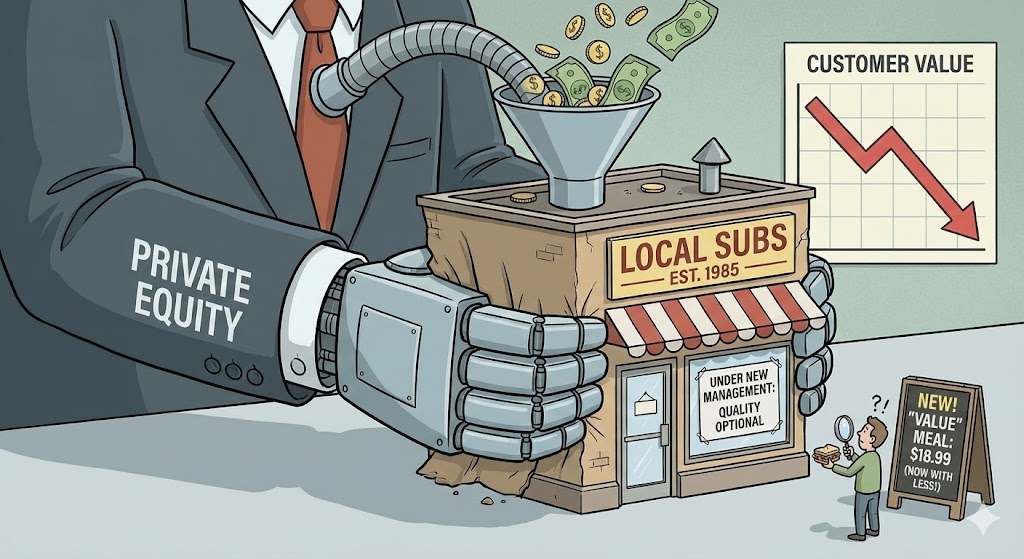
Do yourself a favor and avoid private equity owned sandwich chains like Subway, Jimmy John’s, Arby’s, Panera Bread and Jersey Mike’s Subs that have jacked up prices while simultaneously downsizing portions and replacing ingredients with lower quality alternatives. I now routinely go to grocery stores and get a higher quality sandwich at a lower price.
Disclaimer: This article speculates on the potential future direction of society based on current factors. It is hard to predict whether commercial, political and charitable organizations will respond in ways sufficient to alter the course of history or not.
Image credits: Grok, Gemini
 Sign up here to get Human-Centered Change & Innovation Weekly delivered to your inbox every week.