Tag Archives: FutureHacking Signals Picker

FutureCanvas™: A Better Way to Run Your Next Strategy Offsite

FutureCanvas™: A Better Way to Run Your Next Strategy Offsite

by Braden Kelley and Art Inteligencia

I have a theory about strategy offsites. The best idea of the entire two days is usually spoken during the coffee break, by someone who then doesn’t repeat it in the room, because the room has already moved on to the next slide.

That isn’t a people problem. It’s a structure problem. Most offsites are built like a conference with homework: a sequence of presentations, a breakout or two, a ballroom full of flip charts that get photographed and then never seen again. The output is a pile of opinions with no way to see how they connect, which means the loudest opinion wins by default.

If you’re about to plan one, here’s what I’d change, and the tool I built to help you change it.

What most offsites are missing

Walk into the typical agenda and you’ll find a lot of “what should we do?” and very little “what are we actually looking at?” Teams jump to priorities before they’ve agreed on what’s changing around them. So the debate about priorities is really a hidden debate about the future, and nobody realizes they’re having it.

Two executives can sit side by side, argue for an hour about whether to invest in a new market, and never notice that one of them is picturing a world where a regulation tightens and the other is picturing a world where it disappears. They don’t disagree about the market. They disagree about the future, and nothing on the agenda gives them a place to say so.

An offsite that works needs somewhere for those hidden pictures of the future to come out into the open, be put next to each other, and be compared. That’s the job of a canvas.

Why a canvas, and why visual

There’s a reason I keep reaching for something you can see on a single surface. When people argue in words, they argue past each other, because everyone is holding a slightly different mental map. Put the map on the wall and the argument changes. “I disagree” becomes “I’d move that one over there,” which is a far more useful sentence.

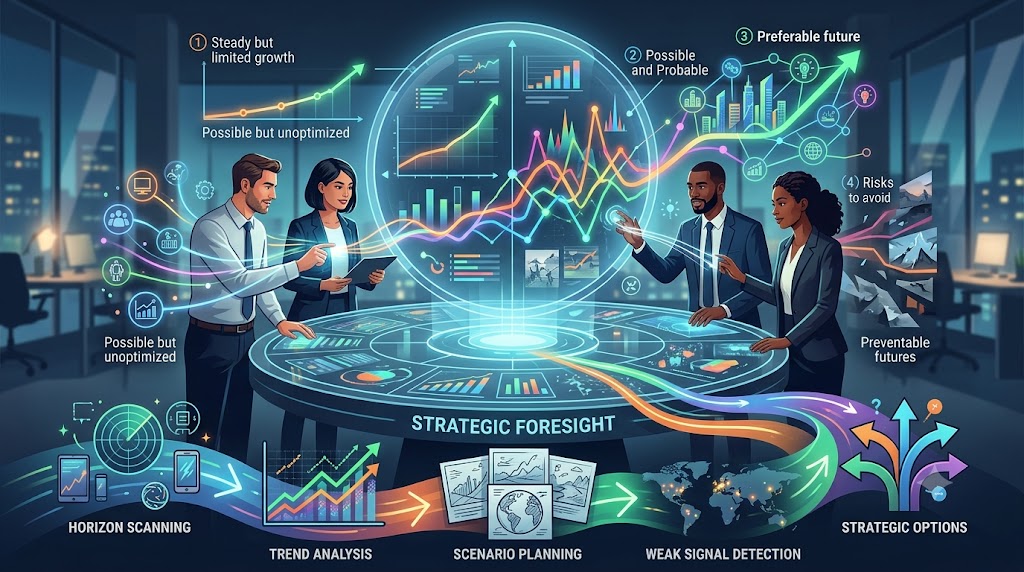
That’s the idea behind FutureCanvas™, one of the tools in the FutureHacking™ toolkit. It gives a leadership team a single, shared, visual place to work through the whole arc of foresight:

  • Signals: the small, specific things people have noticed, laid out where everyone can see them.
  • Trends: the patterns those signals suggest, grouped by the team rather than handed down to it.
  • Possible futures: a set of genuinely different, plausible futures, not one forecast wearing a trench coat.
  • Your most probable future: where the team thinks things are actually heading if nothing changes.
  • Your preferred future, and the path to it: the one you’d like to build, and what it takes to get there.

Notice the order. Priorities come at the end, once the team has agreed on what the world is doing. By then the coffee-break idea has somewhere to live, because there’s a surface for it.

How I’d run the day

If I were building your offsite agenda around it, I’d keep it simple.

Before anyone arrives, collect signals. Ask each attendee, and a few people from outside the leadership team, to bring the three oddest things they’ve noticed this year. The free FutureHacking Signal Picker is a good way to get people thinking in signals instead of opinions, and it means nobody walks in cold.

Morning: put the signals on the canvas and let the group cluster them into trends. Expect disagreement. That’s the point. A trend the whole room sees the same way in five minutes probably wasn’t interesting.

Midday: build the possible futures from those trends. The rule is that every future has to be one somebody in the room could defend with a straight face.

Afternoon: choose the most probable future, then the preferred one, and only then start talking about the path. By this point the priorities almost write themselves, and they’re attached to a picture of the world everyone helped draw.

Leave with something you can actually carry out of the room: a canvas, not a camera roll of flip charts.

Try the next step

I’m putting the finishing touches on the FutureCanvas Picker, a tool that gives planners a real taste of that full arc, from signals to trends to possible futures to a preferred path, in a single sitting. It’s the fastest way I’ve built yet to feel what the canvas does before you commit an offsite to it.

I’m opening early access to a select group first: strategic planners, CSOs and leaders who are designing or running a planning process right now and can tell me honestly what works under a real deadline. If that’s you, reach out and let me know and I’ll follow up personally with the select few who get in first.

One more thing about your agenda

Before you finalize it, find the slot where the team is supposed to agree on what’s changing in your world. If you can’t find one, that’s the slot your offsite is missing.

Put it first. Then keep the coffee break, because I’d still like to hear that idea, only this time somewhere to put it.

Image Credits: Gemini

Content Authenticity Statement: The topic area, key elements to focus on, etc. were decisions made by Braden Kelley, with a little help from Claude to clean up the article.

Subscribe to Human-Centered Change & Innovation WeeklySign up here to get Human-Centered Change & Innovation Weekly delivered to your inbox every week.

FutureSignals™: How to Separate Real Trends From Noise Before Your Next Planning Cycle

FutureSignals™: How to Separate Real Trends From Noise Before Your Next Planning Cycle

by Braden Kelley and Art Inteligencia

Ask any leadership team to name a trend shaping their industry, and you’ll get an answer within seconds. Ask them to explain why they believe it’s real, as opposed to something that just happened to come up in three meetings this month, and the room usually goes quiet. Most organizations aren’t short on trends. They’re short on a way to tell which of the dozens of things competing for the label “trend” actually deserve it.

Why this matters more than people think

Every strategic plan I’ve ever reviewed has been shaped, at least in part, by trends nobody rigorously tested. Not because the people building the plan were careless, but because there’s rarely a formal step in the process for testing a trend before acting on it. Something gets mentioned by a well-regarded analyst, or shows up in three unrelated conversations in the same month, and it quietly graduates from “thing I noticed” to “trend we’re planning around” without ever passing through anything that could reasonably be called scrutiny. Get that step wrong at the start of a planning cycle, and everything built on top of it inherits the mistake.

What actually separates a signal from noise

A genuine signal has a few characteristics that noise almost never does, and it’s worth being explicit about them rather than trusting instinct alone.

  1. It shows up from more than one independent direction. A single source, however credible, is a data point, not a trend. When you start seeing the same underlying shift from unrelated sources — a customer behavior pattern, an unrelated industry’s earnings call, a regulatory conversation, a technology adoption curve — that convergence is a much stronger indicator than any one source repeating itself loudly.
  2. It has a mechanism, not just a correlation. Noise often sounds like a trend because two things happened around the same time. A real signal comes with an explanation for why it’s happening — an incentive that changed, a cost curve that shifted, a constraint that got removed — not just a coincidence in timing that a confident narrator strung together after the fact.
  3. It’s sustained, not spiking. A lot of what gets treated as a trend is really just a spike — a burst of attention that fades within a quarter once the news cycle moves on. Real signals tend to persist and, more tellingly, tend to keep showing up even after the initial attention around them fades.

The traps that let noise through anyway

Even knowing these criteria, a few predictable biases let noise slip past them constantly. Recency bias — whatever you read most recently feels more significant than it actually is, purely because it’s fresh. Authority bias — a signal feels more credible because someone senior or well-known repeated it, regardless of whether they did any more rigorous evaluation than anyone else in the room. And the most dangerous one, confirmation bias — signals that happen to support what leadership already wants to believe about the future get waved through with far less scrutiny than signals that would require uncomfortable change. I’ve watched this last one derail more planning cycles than any of the others combined, because it’s the hardest one for a room to catch in itself.

Building a genuine filter, not just a gut check

The fix isn’t more research, exactly — it’s a consistent set of questions applied to every candidate signal before it earns a place in your planning conversation: Where else is this showing up, independently? What’s the actual mechanism driving it, and does that mechanism hold up under a second look? Has it persisted past its first burst of attention? And, the uncomfortable one worth asking every time — would we be this quick to believe it if it pointed toward a future we didn’t want?

This is exactly what FutureSignals™ is built to do

This filtering discipline is the first formal stage of FutureHacking™, and I built a specific component — FutureSignals™ — around exactly this problem: giving a team a structured, repeatable way to gather candidate signals and stress-test them against real criteria, before any of them get promoted into “trend we’re planning around” status. It’s the foundation the rest of the methodology builds on, because every later stage — the trends you map, the futures you build, the roadmap you eventually commit to — is only as good as the signals it started from.

Where to start

The free FutureHacking Signal Picker puts this exact discipline into practice, at no cost, before your next planning cycle — a genuinely useful way to arrive at your next strategy conversation with signals that have actually been tested, rather than whatever happened to come up most recently.

Something new I’m building

I’m also finishing a second tool — the FutureCanvas Picker — that carries a planning team through the full arc in one sitting: from signals, to the trends they suggest, to a genuine set of possible futures, narrowing to your most probable future, and mapping the path to your preferable one. It’s the closest thing I’ve built yet to running a complete FutureHacking™ session on your own.

I’m opening early access to a select group first — strategic planners, CSOs, and leaders actively running planning processes right now — because I want real feedback from people using it under real deadline pressure before it’s available more broadly. If that’s you, and you’d like to be considered for early access, reach out and let me know — I’ll be following up personally with the first few who get in.

Most planning cycles fail long before the strategy gets built. They fail at the moment someone mistakes a spike for a signal, and nobody in the room had a way to catch it.

Image Credits: Gemini

Content Authenticity Statement: The topic area, key elements to focus on, etc. were decisions made by Braden Kelley, with a little help from Claude to clean up the article.

Subscribe to Human-Centered Change & Innovation WeeklySign up here to get Human-Centered Change & Innovation Weekly delivered to your inbox every week.