The Living Pulse
GUEST POST from Art Inteligencia
Our current systems—whether they are agricultural supply chains, sprawling corporate real estate, or fragile urban grids—are fundamentally “silent” until the moment of failure. We have spent the last few decades obsessed with creating digital overlays to monitor our physical world, yet we remain constrained by a reliance on retrospective data, delayed maintenance cycles, and brittle digital hardware that eventually and inevitably degrades into e-waste.
We are reaching the limit of what silicon-based, disconnected monitoring can achieve in isolation. It is time for a paradigm shift: we must move from “dumb” matter to “living” intelligence.
The Shift to Living Intelligence
The core thesis of this framework is transformative: by engineering synthetic ecology into our environments, we shift the responsibility of “reporting” from the human operator or the IT dashboard to the environment itself. This is the ultimate evolution of experience design.
Imagine a world where the space, the asset, or the ecosystem informs you of its needs, its stress levels, and its structural health before you even think to ask. This isn’t about simply replacing technology; it is about making technology ubiquitous by making it biological. We are designing a future where our environments are not just passive containers for our work and lives, but active, communicative partners in our collective resilience.
At its core, the Synthetic Ecology Framework (SEF) reimagines how human systems interface with the natural world. Rather than layering synthetic digital hardware over natural landscapes or built environments, SEF embeds functional, real-time sensing capabilities directly into the biological code of living organisms. We are shifting from an internet of things to an ecosystem of living indicators.
Biological Signaling as Interface
For decades, human-centered design has treated the screen as the primary locus of information exchange. SEF breaks this paradigm by turning physical, biological organisms into ambient, dynamic dashboards. Through targeted genetic pathway modification, plants, fungi, and cellular colonies become visual signaling mechanisms:
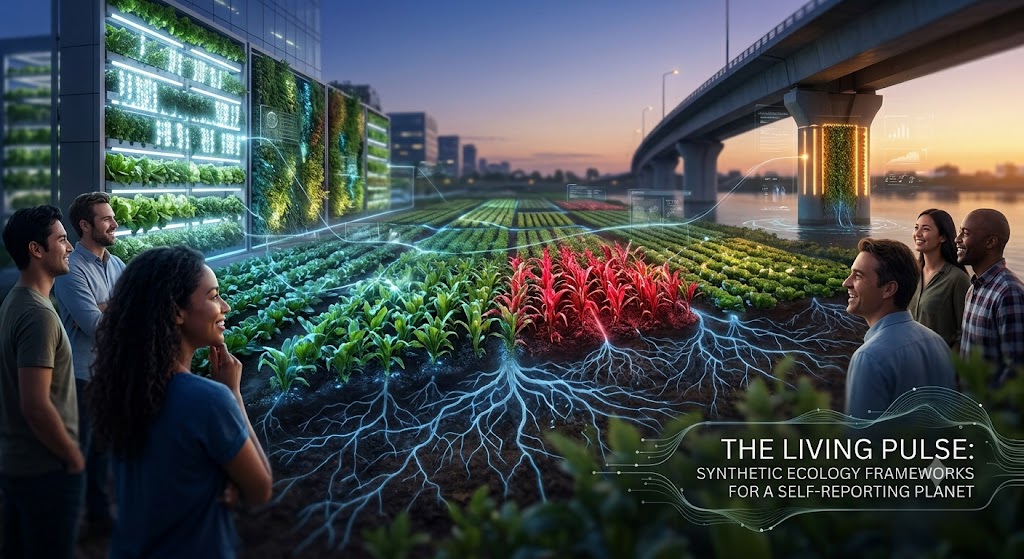
- Color Transitions: Chlorophyll pathways modified to shift pigmentation—changing foliage from green to vivid crimson—when exposed to specific airborne toxins, microplastics, or soil heavy metals.
- Bioluminescence: Cellular organisms engineered to emit localized, low-frequency light in response to structural stress, micro-fractures, or seismic shifts in built environments.
- Altered Growth Patterns: Plants programmed to change directional growth or leaf density when systemic environmental stressors, such as acute nitrogen depletion or hidden water contamination, are detected.
Mechanism vs. Context
The biological mechanism is only half of the equation; the strategic value of SEF lies entirely within its human and organizational context:
- In Corporate Real Estate: Living walls infused with genomic biosensors move from mere aesthetic amenities to functional environmental safety monitors, continuously reporting indoor air quality and chemical exposure without requiring wired infrastructure.
- In Agriculture: Crops designed with dynamic biological signaling allow farmers to read soil health at a glance, replacing high-cost hardware sensors with organic feedback loops across thousands of acres.
The Shift in Human-Centered Design
This is far more than an evolution in biotechnology—it is a fundamental shift in behavioral design. Traditional monitoring relies on active human intervention: checking an application, calibrating a physical sensor, or reading a spreadsheet. Synthetic ecology transforms monitoring into an intuitive, ambient awareness.
When our physical surroundings naturally signal their operational health, our relationship with space changes from reactive oversight to proactive stewardship. We stop managing systems through secondary data and start coexisting with environments that intuitively communicate their needs.
To view synthetic ecology solely as a replacement for hardware is to miss its most profound implication. The true revolution lies in applying systems thinking to bridge the artificial divide between nature, human technology, and organizational infrastructure. We are moving from isolated, point-solution devices toward interconnected, self-sustaining biological feedback loops that operate at a planetary scale.
Moving Beyond the “Device” Paradigm
Modern IoT (Internet of Things) deployments are fundamentally constrained by physics, supply chains, and maintenance lifecycle realities:
- Scalability Limitations: Deploying millions of silicon sensors across vast ecosystems creates massive hardware procurement, battery replacement, and network bandwidth overhead.
- E-Waste and Degradation: Hardware decays under environmental exposure, creating toxic electronic waste and requiring constant human intervention.
- The Biological Advantage: Biological systems are self-replicating, self-repairing, and powered by ambient solar or chemical energy. An engineered seed line propagates its own sensing network naturally, transforming maintenance burdens into regenerative cycles.
The Living Supply Chain
In global supply chains, visibility often breaks down at the agricultural or biological baseline. Synthetic ecology creates a dynamic, self-reporting origin layer:
- Macro-Environmental Feedback: Entire crop fields function as expansive diagnostic arrays. When soil pH shifts, nitrogen levels drop, or pathogens arrive, regional color variations become readable via standard satellite imagery or drone flyovers.
- Predictive Supply Interventions: Instead of discovering crop failure weeks after harvest, supply chain leaders receive visual, pre-emptive signals in real time—allowing for agile sourcing re-allocations long before market shortages occur.
Corporate Real Estate as an Organism
When applied to urban architecture and commercial property, SEF redefines the concept of “smart buildings”:
- Structural Stress Sensing: Bio-engineered bio-films or mosses applied to load-bearing concrete elements emit low-level fluorescence when structural micro-fractures generate stress chemicals, revealing hidden fatigue long before visible cracking occurs.
- Ambient Air & Toxicity Guards: Interior botanical installations serve as non-invasive, live air filters and warning systems, signaling volatile organic compounds (VOCs) or mold spores directly to facilities teams and occupants without relying on digital sensors.
Market Frontiers: Pioneering Companies & Living Indicator Ventures
Synthetic ecology is moving rapidly from academic proof-of-concept into commercial deployments. A growing ecosystem of synthetic biology foundries, agtech startups, and material science innovators is building the foundational tools that allow living organisms to function as real-time biological sensors.
1. Plant-Based Diagnostic Networks
Leading agricultural biotech ventures are re-coding crop genetics to turn fields into optical feedback systems:
- InnerPlant: A pioneer in crop biosensors, InnerPlant modifies plant DNA so that crops express optical fluorescent signals when under attack by pathogens, fungal infections, or water stress. These signals are invisible to the naked eye but easily picked up by satellites, tractor cameras, or drones—allowing farmers to treat individual stressed plants days before symptoms manifest physically.
- Oak Ridge National Laboratory (ORNL – SEED Program): Developing split-protein intein biosensors in plants that emit localized fluorescence the moment plant cell receptors detect microbial signaling or fungal cell wall components.
2. Organism Foundries & Custom Cellular Sensing
Behind commercial plant and microbial biosensors are high-throughput platform foundries that automate cellular design:
- Ginkgo Bioworks: Functioning as the “foundry for biology,” Ginkgo custom-designs microbes and cellular pathways across agriculture, defense, and industrial supply chains. Their platform enables custom metabolic programming for environmental detection and living biosensors.
- Light Bio: Leveraging synthetic genomics to commercialize bioluminescent flora, demonstrating how living ambient light signaling can be integrated directly into indoor architecture and human environments.
3. Microbial & Material Environmental Monitors
In industrial, urban, and environmental applications, bio-materials and engineered micro-organisms are being deployed to monitor environmental health:
- Ecovative & Mycelium Platforms: Utilizing mycelium-based structures infused with biological indicators to create self-reporting structural insulation and packaging materials.
- Soil & Water Biosensor Startups: Early-stage ventures leveraging engineered soil microbes that produce measurable electrical or optical signals when heavy metals, synthetic fertilizers, or microplastics leach into local water tables.
At its core, experience design is about shaping how humans perceive, interpret, and interact with the world around them. Transforming our environments into self-reporting biological networks changes the fundamental nature of that interaction. We transition from a model of mechanical monitoring—pulling data from dashboards and screen notifications—to one of organic communication, where information is felt, seen, and experienced naturally within a space.
Radical Transparency and Ambient Awareness
Traditional monitoring forces a friction-heavy cognitive loop: data is collected by hardware, sent to a database, processed into a chart, and pushed to a screen for a human to interpret. Synthetic ecology eliminates this friction through ambient visibility:
- Direct Perception: When a building wall shifts color or a crop field glows under stress, the environment communicates its state directly to human senses without requiring an intermediary device, app, or login.
- Psychological Impact: Moving data out of hidden databases and into plain sight creates a culture of radical transparency. Occupants, workers, and leaders share a real-time, undeniable awareness of environmental health and safety.
The Ethics of Biological Agency and Truth
Designing biological systems to act as communication channels introduces profound ethical considerations that change the risk profile for organizational leaders:
- Integrity of the Signal: If a living organism is engineered to signal environmental contamination or structural degradation, how do we guarantee signal fidelity? Biological mutations, invasive species interference, or natural plant diseases could produce false positives or, worse, dangerous false negatives.
- System Security & Biological Tampering: Just as digital networks can be hacked, biological networks could theoretically be disrupted or manipulated. Designing robust “fail-forward” mechanisms and redundant validation paths is essential to maintain trust in biological indicators.
Human-Environment Symbiosis
Ultimately, the Synthetic Ecology Framework alters the human relationship with infrastructure and physical assets. We move away from viewing real estate, land, and supply chains as passive, disposable assets to be managed through spreadsheets.
By learning to “read” living signals as part of daily operational routines, leaders and employees cultivate an intuitive, empathetic connection with their environments. Stewardship replaces mere maintenance, creating resilient spaces where humans and living systems actively support one another’s well-being.
As we look toward the next horizon of experience design and organizational foresight, synthetic ecology moves from speculative concept to tangible infrastructure. However, crossing the chasm from controlled lab environments to global deployment requires navigating critical biological, regulatory, and societal tipping points.
The 5–10 Year Horizon: From Testbeds to Living Zones
The roadmap toward widespread integration will unfold across three distinct phases of adoption:
- Phase 1: Closed-Loop Testbeds (Years 1–3): Initial commercial applications will focus on highly contained indoor environments—such as corporate lobbies, hydroponic vertical farms, and cleanrooms—where custom genomic biosensors can be calibrated safely without environmental exposure risk.
- Phase 2: Pilot Living Zones (Years 4–7): Expansion into controlled outdoor zones, including corporate campuses, municipal parks, and agricultural research plots. Here, biological indicators will work in tandem with existing digital IoT networks to benchmark diagnostic accuracy.
- Phase 3: Autonomous Biological Infrastructures (Years 8–10): Full-scale deployment across global supply chains and civic infrastructure, where living indicator networks self-propagate and replace legacy hardware installations.
Regulatory, Safety, and Containment Hurdles
Designing with living code introduces unique responsibilities that do not exist in traditional hardware or software engineering. Releasing modified organisms into broader ecosystems requires strict safety protocols:
- Synthetic Kill Switches: Organisms must be engineered with metabolic dependencies—requiring synthetic nutrients not found in wild nature—ensuring they cannot survive or reproduce beyond designated operational boundaries.
- Genetic Containment: Implementing multi-layered genomic locks to prevent horizontal gene transfer between engineered biosensors and wild flora or fauna.
- Regulatory Frameworks: Proactively shaping standards with civic and environmental authorities to establish clear protocols for biological data verification and public safety transparency.
The “Post-Digital” Frontier
We are standing at the threshold of a post-digital epoch. For the past half-century, innovation has been defined by adding more silicon, more screens, and more bandwidth to every problem. Synthetic ecology offers a counter-path: one where technology becomes subtle, organic, and truly integrated into the living fabric of our planet.
When our buildings, roads, and farmlands actively participate in their own stewardship, the distinction between “built” and “natural” environments disappears. Innovation will no longer be measured by the density of our microchips, but by the harmony of our ecosystems.
Innovation has reached a defining inflection point. For decades, our answer to operational complexity has been to stack more silicon, more wiring, and more fragile hardware onto problems that demand long-term, organic resilience. Synthetic ecology frameworks challenge this status quo, offering a bold path forward where living organisms become the interface, the diagnostic engine, and the foundation of our built world.
The Call to Action for Innovators
As leaders, experience designers, and change agents, our mandate is clear: we must stop designing for static control and start designing for dynamic coexistence. Aligning our technological strategies with the inherent wisdom, self-repair capabilities, and signaling pathways of biological systems is not merely a futuristic ideal—it is a competitive necessity for building resilient organizations.
By transforming silent assets into dynamic, self-reporting networks, we can eliminate critical operational blind spots, reduce environmental waste, and create safer, more responsive environments for the people who inhabit them.
The Final Horizon
We are transitioning into an era where our environments are no longer passive backdrops to human activity, but active, communicative partners in our collective survival. The technology to turn the physical world into a living, responsive dashboard is already emerging.
The ultimate question for modern leadership is no longer whether this technology is possible, but rather: Are we ready to start listening when our world finally begins to speak back?
Translating synthetic ecology from a visionary framework into an actionable innovation strategy requires leaders to challenge long-held assumptions about technology, infrastructure, and risk. Use these diagnostic questions to guide your leadership team as you evaluate where living indicators can transform your operational landscape:
- Identifying Operational Silence:
Where in your current supply chain, physical assets, or facilities does “silence” cost you the most in terms of capital, delayed risk detection, or operational downtime? - Accelerating Response Cycles:
How would having a living, self-reporting environmental indicator change your organization’s response time, decision-making agility, and mitigation costs during a critical system failure or crisis? - Bridging the Cultural Trust Gap:
What mindset and cultural shifts must occur within your engineering, operations, and leadership teams to trust biological, ambient signals as much as—or more than—traditional digital data dashboards? - Refining the Human Experience:
How can your organization leverage ambient, direct-perception environmental signaling to reduce cognitive load and friction for your employees, customers, and surrounding communities?
Frequently Asked Questions
What is Synthetic Ecology and how do genomic biosensors work?
Synthetic Ecology involves engineering living cellular organisms, plants, or fungi to function as real-time, biological indicators within an ecosystem. By modifying their genetic pathways, these organisms are designed to change color, bioluminescence, or alter their growth patterns when they detect structural anomalies, airborne toxins, soil nutrient imbalances, or systemic environmental stressors.
How do living biological indicators replace traditional digital hardware sensors?
Unlike silicon-based IoT hardware, which requires physical wiring, battery maintenance, network bandwidth, and eventually becomes toxic e-waste, biological indicators are self-replicating, self-repairing, and powered by ambient energy. They allow physical spaces, agricultural fields, and buildings to communicate their health directly to humans through direct visual perception rather than complex digital dashboards.
What prevents genetically modified biosensors from spreading uncontrolled into wild ecosystems?
Synthetic ecology frameworks incorporate synthetic bio-containment features such as “metabolic kill switches” and genetic locking. Organisms are engineered with dependencies on specific synthetic nutrients not found in nature, ensuring they cannot reproduce or survive outside their intended operational environments or designated testbed boundaries.
Disclaimer: This article speculates on the potential future applications of cutting-edge scientific research. While based on current scientific understanding, the practical realization of these concepts may vary in timeline and feasibility and are subject to ongoing research and development.
Image credits: Gemini
 Sign up here to get Human-Centered Change & Innovation Weekly delivered to your inbox every week.