Sifting the Signals
GUEST POST from Art Inteligencia
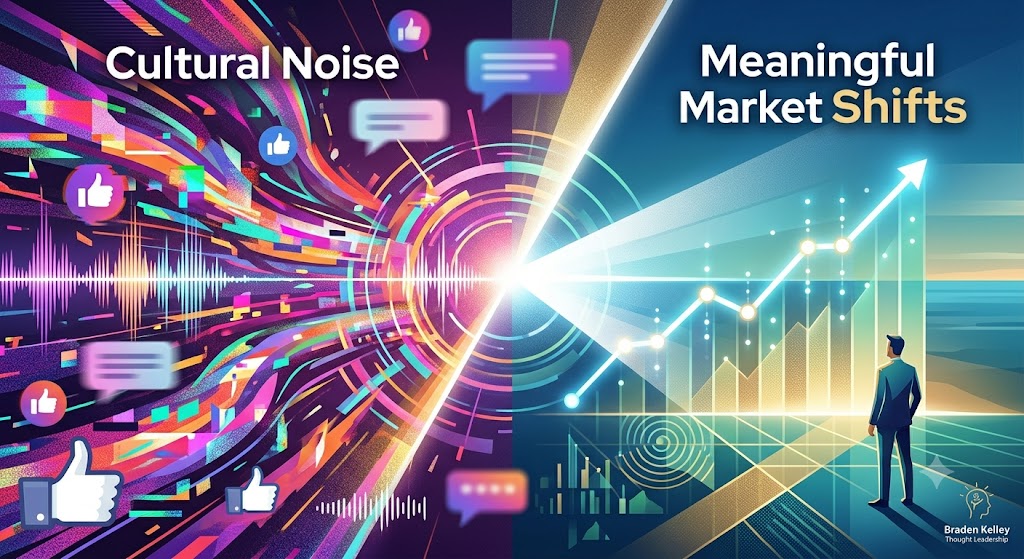
I. Introduction: The Noise Economy
The Modern Paradox: We are drowning in data but starving for clarity. The speed of social media, viral trends, and flash-in-the-pan tech creates an illusion of constant disruption.
The Cost of Misjudgment:
- Chasing the Noise: Wasted capital, organizational fatigue, and strategic whiplash (e.g., pivoting the entire brand for a two-week internet trend).
- Missing the Signal: Obsolescence, losing market relevance, and being disrupted by slow-moving but unstoppable shifts.
The Thesis: True innovation and sustainable growth require leaders to develop an organizational filter — a methodology to distinguish short-term cultural noise from deep, meaningful market shifts.
II. Defining the Spectrum: Noise vs. Signals
To navigate the modern business landscape, leaders must first establish a shared vocabulary. The distinction between a temporary market distraction and a foundational shift comes down to structural permanence and human behavior.
What is Cultural Noise?
Cultural noise consists of high-velocity, high-visibility phenomena that capture public attention rapidly but lack long-term structural viability. They are often driven by emotional contagion, novelty, or algorithmic amplification.
- Characteristics: Short lifecycle, superficial impact, rapid decline, and low barrier to exit.
- Example: Viral social media challenges, short-lived meme stocks, or sudden, panic-driven consumer spikes that normalize as soon as the immediate context shifts.
What is a Meaningful Market Shift (Signal)?
A meaningful market shift, or a true signal, is an underlying transformation grounded in evolving human behaviors, foundational technological adoption, or structural economic realities.
- Characteristics: Gradual acceleration, deep systemic roots, cross-industry impact, and a permanent alteration of user expectations.
- Example: The steady, irreversible rise of asynchronous remote work infrastructure, or the macroeconomic pivot toward circular economic models and sustainable resource loops.
The Overlap and the Masquerade
The core challenge for innovators is that noise rarely announces itself as a distraction. It frequently masquerades as a revolutionary signal, amplified by tech evangelists and media hype cycles. Conversely, weak signals — the quiet, early indicators of profound change — are easily drowned out by the volume of the prevailing cultural noise. Success requires a look past the volume to evaluate the structural physics of the trend.
III. The Human-Centered Filter: Rooting Analysis in Human Needs
Data-driven forecasting frequently fails because it tracks the artifacts of change rather than the drivers of change. To effectively separate signal from noise, innovators must deploy a human-centered filter: understanding that technology changes rapidly, but fundamental human nature evolves slowly.
The “Why” Behind the What
Trends do not reshape markets on their own; people do when they adopt them to fulfill a specific purpose. When evaluating any market movement, leaders must look past the flashy technology, the new product interface, or the soaring metric, and ask the foundational question: What human behavior or friction is actually driving this? If a trend cannot be mapped back to a genuine human motivation, it is highly likely to be a transient cultural fad.
Core vs. Surface Needs
Developing an accurate filtering mechanism requires distinguishing between temporary manifestations and enduring human requirements:
- Surface Needs (Noise): The fleeting desire for a specific digital aesthetic, a niche app interface, or participation in a temporary collective moment. These change with fashion and social pressure.
- Core Needs (Signal): The fundamental, unchanging human drivers — such as the desire for autonomy, psychological safety, social belonging, economic security, or the reduction of cognitive friction.
The Experience Design Lens
From an experience design perspective, the ultimate litmus test for a true signal is value creation at the human level. If an emerging market trend does not fundamentally improve, streamline, or enrich the human experience, its adoption will stall once the novelty wears off. Meaningful innovation occurs when a technological breakthrough aligns perfectly with an latent core need, permanently elevating customer and employee expectations from that moment forward.
IV. The Strategic Framework: The Sifting Process
Organizations cannot rely on gut instinct alone to navigate the noise economy. To build a repeatable capability for strategic foresight, leadership teams must implement a structured, objective evaluation process to stress-test emerging market signals.
Step 1: Velocity and Friction Testing
The first filter examines the relationship between adoption speed and human friction. True signals typically remove systemic, cognitive, or physical friction from people’s lives. When evaluating an emerging trend, ask:
- Does this shift make a necessary human experience significantly simpler, or does it introduce artificial complexity for the sake of novelty?
- Is the adoption velocity driven by genuine utility, or is it artificially sustained by marketing spend and media hype?
The Rule: Friction-reducers tend to stick and mature into permanent signals. High-complexity, high-friction trends usually collapse into noise once the initial novelty fades.
Step 2: Cross-Industry Convergence
Isolated anomalies are rarely indicators of a macroeconomic shift. True signals leave footprints across multiple, seemingly unrelated sectors simultaneously. Innovators must look for patterns of convergence:
- Is this behavior or technology contained within a single niche (e.g., just gaming, or just finance)?
- Or is the underlying concept appearing concurrently across healthcare, retail, enterprise software, and education?
The Rule: When an underlying human expectation — such as the demand for real-time transparency or hyper-personalization — crosses industry boundaries, it indicates a structural shift in consumer psychology.
Step 3: The Infrastructure Check
A signal cannot mature into a permanent market reality without an underlying ecosystem to sustain it. The final step requires a sober analysis of the foundational infrastructure:
- Are there robust developer ecosystems, regulatory frameworks, hardware capabilities, and sustainable business models being built to support this shift?
- Or is the trend floating on pure speculation, venture capital subsidization, and isolated pilot programs?
The Rule: Innovation requires a scaffold. Without the quiet, unsexy development of foundational infrastructure, even the most promising trend will remain cultural noise.
V. Overcoming Organizational FOMO (Fear Of Missing Out)
Even with a robust analytical framework, the greatest barrier to effective signal sifting is often psychological. The fear of missing a market window can paralyze or derail an executive team, leading to reactive decision-making driven by external hype rather than internal strategy.
The Psychology of the Hype Cycle
When a new technology or cultural phenomenon dominates headlines, an organizational panic often sets in. Leadership teams frequently mistake the volume of discussion for the velocity of adoption. Driven by the fear of appearing left behind to board members, investors, or competitors, companies rush to buy into trends prematurely. This panic-buying behavior results in fractured focus, wasted R&D budgets, and severe organizational fatigue as teams are forced to pivot toward half-baked initiatives that eventually fizzle out.
Building a Culture of “Patient Urgency”
To survive the noise economy, organizations must cultivate a mindset of patient urgency. This approach balances rapid exploration with disciplined, deliberate execution:
- Active Monitoring: Establish an continuous, low-cost sensing mechanism to track emerging trends, ensuring the organization is always aware and never caught off guard.
- Disciplined Commitment: Maintain a high bar for deploying capital and human resources. Watch, experiment, and learn rapidly in small sandboxes, but do not scale the initiative until a trend clears the strategic human-centered filters.
The Role of Change Management
Sifting the signals is fundamentally a change management capability. If an organization exhausts its workforce by chasing every loud, transient cultural fad, employees will develop change fatigue and cynicism. When a genuine, structural signal finally arrives, the workforce will lack the energy and trust required to pivot effectively. Leadership’s primary responsibility is to serve as an organizational shock absorber — filtering out the external noise so the team can focus on executing meaningful, human-centered transformation with clarity and conviction.
VI. Conclusion: Designing the Future, Not Just Predicting It
Sifting the signals from the cultural noise is not an exercise in abstract crystal-ball gazing; it is a core competency for modern innovation and sustainable organizational change. True futurism does not look to predict exactly what will happen tomorrow; instead, it seeks to understand human needs deeply enough to design an intentional, resilient path forward.
The Ultimate Goal: A Sharper Filter
By shifting from a state of constant reaction to a practice of human-centered foresight, leadership teams can permanently tune out the surface-level distractions that derail strategy. The goal is to build an organizational filter that allows you to see past the immediate hype cycle, keeping your capital, energy, and talent focused strictly on solving real-world friction and driving long-term value creation.
A Call to Action for Innovators
To put this into immediate practice, take a sober look at your current portfolio of innovation initiatives and ask yourself:
- What is the loudest, most talked-about trend your organization is currently chasing?
- Does it genuinely remove friction from a core human experience, or are you pursuing it out of strategic FOMO?
It is time to turn down the volume on the transient cultural noise, look beneath the surface, and focus your resources on the quiet, structural shifts that will genuinely define the future of your industry.
Frequently Asked Questions
How do you tell the difference between a short-term trend and a long-term signal?
The distinction lies in human friction and structural support. Short-term trends (noise) introduce superficial novelty or complexity and rely on hype. Long-term signals remove real friction from a core human experience and are backed by emerging infrastructure, cross-industry adoption, and shifting regulatory or economic frameworks.
Why is a human-centered approach critical for strategic foresight?
Technology and cultural fads change at a rapid, volatile pace, but fundamental human needs — like the desire for autonomy, security, connection, and simplicity — evolve very slowly. By filtering market changes through a human-centered lens, you look past what the technology is and focus on how it alters human behavior and expectations.
How can leadership teams overcome organizational FOMO during a major technology hype cycle?
Leaders can combat strategic panic by shifting to a mindset of “patient urgency.” This involves setting up low-cost, continuous monitoring systems to study emerging trends in safe sandboxes, while maintaining a strict, objective threshold of human value and structural viability before scaling any major resource investments.
FutureHacking™ Is Coming
FutureHacking™ is Braden Kelley’s strategic foresight methodology — and a paid download and training program is launching soon. Register your interest now to be the first to know when it’s available, and get early access pricing.
Image credit: Gemini
 Sign up here to get Human-Centered Change & Innovation Weekly delivered to your inbox every week.