The Cognitive Divide
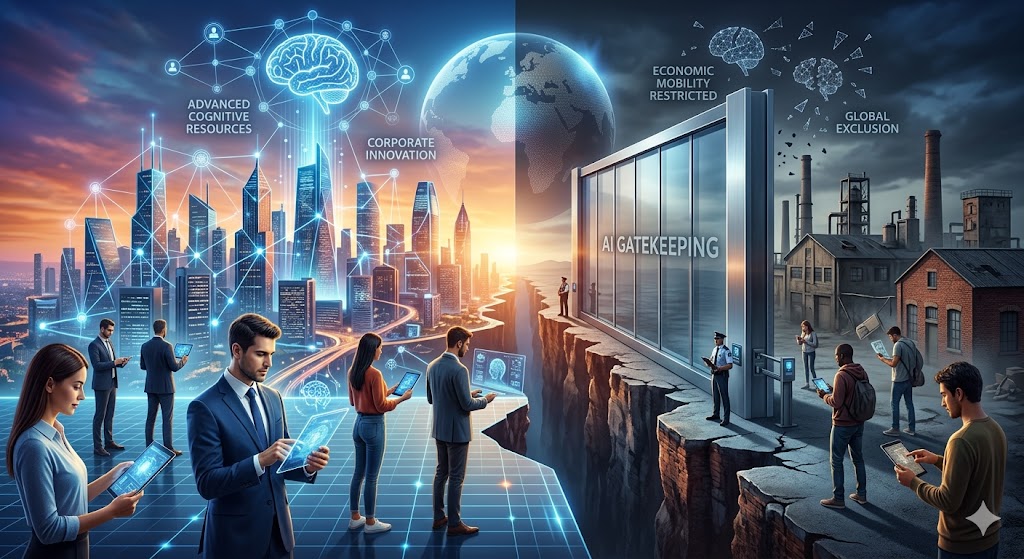
GUEST POST from Art Inteligencia
The New Architecture of Exclusion
The traditional digital divide was a crisis of infrastructure — a tangible gap between those with fiber-optic cables and those left in the dark. Today, that divide has evolved into something far more insidious: a cognitive barrier. We are witnessing the birth of an architecture of exclusion, where the raw material being rationed is no longer just bandwidth, but intelligence amplification itself.
From Digital Divide to Cognitive Divide
For decades, human-centered change looked at connecting the world. Now that a baseline of connectivity exists, the goalposts have been moved. The new paradigm splits the global workforce not by whether they can access information, but by how effectively they can synthesize it. When advanced frontier AI models are sequestered behind premium tiers and corporate firewalls, we create a multi-class system of thought. Those with the tools can automate complexity and scale their impact exponentially; those without are left to compete using manual cognitive labor, cementing a permanent structural disadvantage.
The Mechanics of Corporate Gatekeeping
This exclusion isn’t accidental; it is a deliberate moat-building strategy executed through several key levers:
- Tiered Access Models: Relegating the public and developing nations to heavily rate-limited or outdated legacy models, while reserving the true frontier capabilities — the models capable of complex reasoning and novel synthesis — for high-paying enterprise clients.
- Geofencing and Regional Licensing: Restricting access based on geography, often under the guise of compliance, which effectively cuts off emerging markets from the modern engines of economic growth.
- Aggressive IP and Compute Moats: Using capital intensity and proprietary data hoarding to ensure that no grassroots competitor can match the scaling capabilities of centralized tech giants.
The Erosion of the Digital Commons
True innovation requires an open sandbox. Historically, the internet thrived because its foundational layers were open. Today, we see a systematic squeezing of the open-source AI ecosystem. Under the banner of safety and risk mitigation, aggressive lobbying is driving regulatory capture. By setting compliance costs impossibly high, institutional gatekeepers are attempting to outlaw independent development. This doesn’t make technology safer; it simply ensures that the future of human thought is managed by a small circle of corporate compliance officers, choking out the diverse, decentralized ideas that drive genuine global mobility.
Stifling the Global Engine of Innovation
Innovation is not a top-down corporate mandate; it is a collaborative, emergent phenomenon that thrives on diversity, serendipity, and human-centered problem-solving. When we allow corporate gatekeepers to control the access points to advanced intelligence, we effectively starve the grassroots engine that drives global progress. By optimizing AI solely for enterprise efficiency, the broader spectrum of human ingenuity is left out of the equation.
The Small Business and Solopreneur Disadvantage
The lifeblood of economic mobility has always been the agile disruptor — the small business or solopreneur who spots a local inefficiency and fixes it. However, as the global economy increasingly relies on an “intelligence layer” to manage everything from supply chain logistics to predictive market analysis, the cost of entry is skyrocketing. Hyper-local innovators in developing or underserved economies are being priced out of the very tools required to compete on a global stage, creating a severe structural asymmetry that favors established monopolies over entrepreneurial grit.
The Death of Serendipity
When technology is locked behind corporate walls, its development roadmap is guided strictly by shareholder returns and immediate commercial applications. This transaction-focused approach leads to the death of serendipity. Real breakthrough innovation relies on unexpected use cases — what happens when an tool built for one purpose is adapted by someone with an entirely different worldview to solve a unique local challenge? Gatekeeping ensures that AI remains hyper-optimized for Western corporate needs, like advertising click-through optimization, while starving the creative exploration needed to tackle systemic global crises in decentralized education, agriculture, and public health.
The Experience Design Failure
From an experience design perspective, current corporate AI ecosystems are fundamentally flawed because they treat people as mere users to be monetized rather than active participants to be empowered. True human-centered design requires that technology respects and integrates with diverse cultural, linguistic, and behavioral realities. By building rigid, one-size-fits-all platforms optimized for centralized corporate structures, gatekeepers ignore the cultural nuances and local realities of global communities. This lack of inclusive design converts a tool that should elevate human capability into a digital monoculture that forces everyone to adapt to the machine, rather than the machine adapting to humanity.
The Threat to Economic Mobility
The promise of the digital age was a flattening of the global playing field. For a moment, a talented creator with a laptop and an internet connection could compete from anywhere. But as advanced AI transforms from a luxury into the baseline operating system of business, corporate gatekeeping threatens to permanently distort the socioeconomic landscape. By controlling the access points to high-tier cognitive tools, we are actively dismantling the ladders of upward mobility.
Upward Mobility in the Automation Age
As routine tasks are increasingly automated, the premium value in the workforce shifts entirely to orchestration — the ability to direct, prompt, and synthesize outputs from sophisticated AI systems. In this environment, career velocity and earning potential are directly tied to the caliber of the model you collaborate with. Restricting access to legacy or throttled versions for the public creates a glass ceiling for the next generation of knowledge workers. It ensures that those born outside privileged corporate or geographic circles are trained for a world that no longer exists, locked out of high-value orchestrator roles.
The Cognitive Drain
Human-centered innovation relies on retaining brilliant minds within local ecosystems to solve local problems. However, corporate gatekeeping forces a devastating talent migration. When the frontier tools required to conduct cutting-edge research, design breakthrough experiences, or build scalable applications are held exclusively within mega-corporations or specific geographic tech hubs, the world’s best talent must migrate to where the compute lives. This creates a severe cognitive drain, stripping underserved regions of their brightest minds and leaving local economies structurally dependent on foreign intellectual property.
Widening the Global GDP Gap
We are facing the real danger of a permanent economic stratification between the Global North and Global South. Nations and organizations that can afford massive enterprise licensing agreements and proprietary infrastructure are experiencing an exponential compounding of productivity and wealth creation. Meanwhile, regions restricted by high subscription costs, regional licensing blocks, or geofencing are trapped in a linear growth model. This imbalance does not just widen the existing global GDP gap; it cements it, establishing a systemic economic hierarchy driven entirely by who controls the keys to synthetic intelligence.
A Human-Centered Blueprint for Cognitive Equity
To avoid a future of permanent economic and intellectual stratification, we cannot rely on the benevolent tech monopolies to self-correct. We need a fundamental paradigm shift that repositions advanced intelligence as a foundational human right. Designing a path forward requires a deliberate blend of strategic foresight, open architecture, and a relentless commitment to human-centered experience design that empowers the individual over the institution.
Redefining AI as a Global Public Utility
We must begin by fundamentally changing how we view advanced cognitive compute. Just as electricity, clean water, and cellular networks became recognized as essential infrastructure for societal participation, frontier AI capabilities must be treated as a global public utility. This requires building international, collaborative frameworks and public-private consortiums dedicated to providing open, subsidized, or free access to baseline advanced models. When the foundational layer of intelligence is universally accessible, the competitive landscape shifts back to where it belongs: on human creativity, execution, and local problem-solving.
Fostering Decentralized, Open-Source Innovation
True resilience is built on diversity, not centralized monocultures. To break the corporate stranglehold, we must actively invest in and protect the open-source ecosystem from regulatory capture. This means supporting sovereign AI initiatives where local communities, universities, and regional governments build, fine-tune, and retain ownership of models tailored to their unique linguistic, cultural, and economic needs. By decentralizing the data, training, and deployment of these tools, we ensure that the intellectual capital remains within local economies to fuel grassroots, self-sustaining growth.
Democratic Experience Design
Universal access to code and compute is meaningless if the interface remains a barrier. The future of equity relies on democratic experience design (XD)—shifting the tech industry’s focus from maximizing corporate user acquisition to maximizing human community empowerment. Designers must intentionally craft intuitive, hyper-accessible interfaces that function flawlessly across low-bandwidth environments, older hardware, and varied literacy levels. By designing tools that meet humans exactly where they are — respecting their diverse cognitive patterns and cultural contexts — we turn AI from a complex corporate gate into an open, inclusive doorway to global mobility.
Conclusion
The trajectory of artificial intelligence is not a predetermined law of physics; it is a series of deliberate design choices. If we continue down the current path of unchecked corporate gatekeeping, we will successfully build an incredibly sophisticated machine that serves an vanishingly small percentage of the global population. This isn’t just an ethical failure; it is a massive strategic misstep that chokes out the collective intelligence required to navigate an increasingly complex world.
The Call to Action for Future Leaders
The challenge ahead calls for a new breed of futurists, corporate leaders, and policymakers who can see past next quarter’s shareholder report. True leaders must aggressively push back against monopolistic moats and short-sighted regulatory capture masquerading as safety. We must intentionally design policies, platforms, and business models that actively share cognitive power rather than hoarding it. The premium for future leadership should be measured not by how much intelligence a company can sequester, but by how much human potential it can unlock globally.
The Human-Centered Imperative
At its core, innovation has never been about the tools themselves; it has always been about what humans can achieve when those tools elevate their natural capabilities. If we are to achieve true global economic mobility, cognitive equity must become our baseline requirement, not an afterthought. We must bridge the cognitive divide before its architecture hardens into a permanent barrier. True progress occurs when we stop designing smarter machines for a select few, and start using technology to make the entirety of humanity smarter together.
Frequently Asked Questions
What exactly is the “Cognitive Divide”?
The Cognitive Divide is the widening economic, social, and intellectual gap between individuals or organizations with unrestricted access to advanced, frontier AI reasoning models and those who are restricted to outdated, throttled, or heavily paywalled legacy systems.
How does corporate gatekeeping affect global innovation?
When corporations restrict advanced AI capabilities to high-paying enterprise clients, they stifle grassroots innovation. Small businesses, solopreneurs, and creators in developing regions are priced out of the “intelligence layer” needed to compete, shifting AI’s focus to corporate efficiency rather than solving broad human challenges.
What is a human-centered solution to this divide?
A human-centered approach involves treating baseline advanced compute as a global public utility, actively funding and protecting decentralized open-source AI ecosystems, and utilizing democratic experience design (XD) to create intuitive, accessible interfaces that work across diverse cultural and technical environments.
Image credit: Gemini
 Sign up here to get Human-Centered Change & Innovation Weekly delivered to your inbox every week.